

Singapore, Australia expand essential supplies pact, sign landmark carbon storage agreement
PM Wong says these are practical arrangements that will make a real difference when the next disruption comes
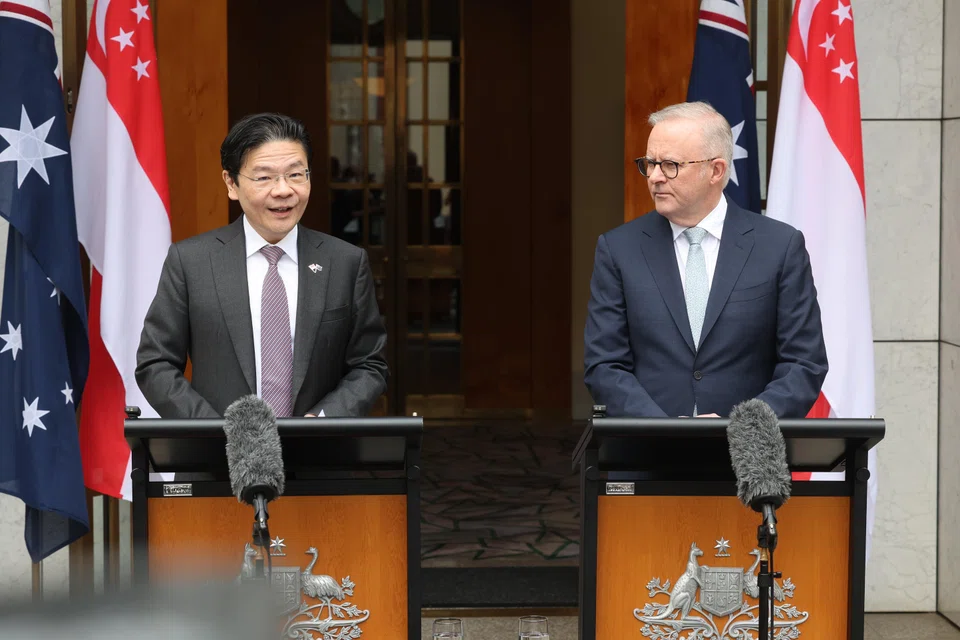
[CANBERRA] Singapore and Australia signed two agreements on Nov 24 to strengthen cooperation on essential supplies and pave the way for cross-border carbon capture and storage, bolstering economic resilience amid growing global uncertainty.
The first agreement expands existing supply chain arrangements beyond petroleum oils and liquefied natural gas (LNG) to cover food, semiconductors, water treatment chemicals, pharmaceuticals and medical products, telecommunications equipment and other critical goods.
The second establishes a framework for transporting captured carbon dioxide from Singapore to Australia for offshore geological storage, potentially opening up a new avenue for Singapore to address industrial emissions that are difficult to eliminate.
Both agreements were exchanged at a ceremony witnessed by Prime Minister Lawrence Wong and his Australian counterpart Anthony Albanese in Canberra, following a one-on-one meeting between the leaders and the 11th Singapore-Australia Annual Leaders’ Meeting.
Speaking at a joint press conference, PM Wong said following the Middle East crisis, he and his counterpart agreed in April that the two countries will support one another in keeping essential supplies flowing.
They then agreed to do so for trade in petroleum oil, including diesel and LNG. “Today we are taking this cooperation further,” he said.

Against this backdrop, PM Wong said he had a wide-ranging and substantive discussion with Albanese in the morning.
“Our bilateral ties are in excellent shape,” he added.
Both countries were already making progress in translating their enhanced Comprehensive Strategic Partnership (CSP 2.0), launched in October 2025, into concrete results, he added.

“I’m glad we are already making good progress and translating our plans into concrete results,” he said.
Keeping essential supplies flowing
The new memorandum of understanding (MOU) on essential supplies supplements a legally binding Protocol on Economic Resilience and Essential Supplies signed in July under the Singapore-Australia Free Trade Agreement.
The July protocol covers petroleum oils and LNG, with both countries committing to endeavour not to impose export restrictions on agreed essential supplies. It also provides for advance notification and consultation, but has yet to enter into force as both sides complete their domestic procedures.
The new MOU extends their commitments to support trade flows to a broader range of essential goods.
In a factsheet released on Nov 24, Singapore’s Ministry of Energy, Trade and Industry listed 10 categories of goods included under the MOU.
Beyond food, semiconductors and medical products, these include agricultural chemicals and inputs such as crop protection products and fertilisers, construction materials, fuel and fuel additives, renewable energy technologies and traffic signalling equipment.
On the expanded cooperation, PM Wong said: “These are practical arrangements that will make a real difference when the next disruption comes.
“They reflect the trust we have built, and our shared commitment to keeping trade open and supply chains resilient, even in difficult times.”
Australia is an important source of Singapore’s food and energy imports, while the Republic is a major supplier of refined petroleum products to Australia.
Based on figures cited by the Australian government in July, Singapore supplied 55 per cent of Australia’s petrol, 15 per cent of its diesel and 23 per cent of its aviation fuel.
The new MOU was signed by Singapore’s Minister for Sustainability and the Environment and Minister-in-charge of Trade Relations Grace Fu and Australian Foreign Minister Penny Wong.
More avenues for emission cuts
The agreement on cross-border carbon capture and storage (CCS) formalises the transfer of responsibility for accounting for carbon dioxide transported from Singapore to Australia.
It also lays the groundwork for measuring, reporting and accounting for the emissions, in line with the Paris Agreement and the United Nations Framework Convention on Climate Change reporting guidelines.
CCS involves capturing carbon dioxide emissions and storing them in geological formations to prevent their release into the atmosphere. It is considered a potential means of reducing emissions from hard-to-abate industries, where existing technologies may not be sufficient.
PM Wong described the agreement as a landmark development that would open up new possibilities for industries to reduce emissions while supporting the longer-term energy transition.
The CCS agreement was signed by Fu and Australian Minister for Trade and Tourism Don Farrell.
Tapping digital and green growth
Beyond economic resilience, PM Wong said the two leaders discussed new opportunities for cooperation in artificial intelligence.
Noting that AI will be a major driver of economic transformation, he said: “We both have capabilities, and we can focus on where we can build complementary strengths to develop and deploy AI in ways that benefit both businesses and workers.
“We both also have an interest in AI that’s safe, reliable and widely accessible.”
In July, the two countries held their first Cyber and Digital Senior Officials Dialogue, where they agreed to explore opportunities in AI adoption, digital infrastructure and investment, as well as collaborate on AI safety and governance.
Singapore and Australia were also among 10 countries that signed a US-led declaration on Nov 15 to strengthen the security of sensitive technologies and critical infrastructure underpinning AI supply chains.
On green economy cooperation, PM Wong said both countries would launch the Getting to Zero Co-Innovation Programme to support enterprises in developing and commercialising low-emission products and services.
The programme is part of efforts to put the Singapore-Australia Green Economy Agreement, signed in 2022, into action.
Deepening bilateral and regional ties
PM Wong pointed to his frequent exchanges with his Australian counterpart as a reflection of their close friendship and trust, noting that this was his second visit to Australia in two years, while Albanese had also visited Singapore twice over the same period.
Defence and security ties were especially strong, he said, noting that the two countries had conducted the biennial Exercise Trident in Queensland just the previous week.
He also thanked the Australian government for its continued support for Singapore Armed Forces training in Australia.
The enhanced CSP 2.0 sets out 80 initiatives across five areas of cooperation over the coming decade, including defence and security, economic connectivity and the transition to net zero.
Turning to regional cooperation, PM Wong said Singapore and Australia shared a strong interest in a peaceful, stable and prosperous region, noting that Australia was Asean’s oldest dialogue partner.
He thanked Albanese for supporting Singapore’s upcoming Asean chairmanship in 2027 and welcomed Australia’s commitment to deepening its engagement with South-east Asia.
Singapore hoped more Australian companies would use the Republic as a launchpad to invest in the region, he added. Both countries would also continue supporting regional development through their joint Third Country Training Programme.
His remarks come just over two weeks after Senior Minister Lee Hsien Loong urged Australia to deepen its ties with South-east Asia, saying that closer regional relationships would give it greater room to pursue its interests amid US-China rivalry.
In his Nov 8 Boyer Lecture, Lee also highlighted Australia’s relatively modest investment footprint in South-east Asia, noting that it invested no more in Asean countries collectively than it did in New Zealand.
PM Wong, for his part, emphasised the trust underpinning Singapore’s relationship with Australia.
“In a world of growing uncertainty, trusted partnerships matter more than ever,” he said.
“Singapore and Australia have built such a partnership. We have shown that we can count on one another in good times and bad.”
On Nov 24, the second day of his official visit, PM Wong will meet Australian opposition leader Angus Taylor and New South Wales Premier Chris Minns, before attending a reception with overseas Singaporeans in Sydney.
His final scheduled official engagement is a call on Australian Governor-General Sam Mostyn on Nov 25, before departing for Singapore later that day. THE STRAITS TIMES
Decoding Asia newsletter: your guide to navigating Asia in a new global order. Sign up here to get Decoding Asia newsletter. Delivered to your inbox. Free.
Share with us your feedback on BT's products and services






