

Singapore, China reach 29 deals at top bilateral forum
These cover the areas of trade and finance, science and technology, and public health
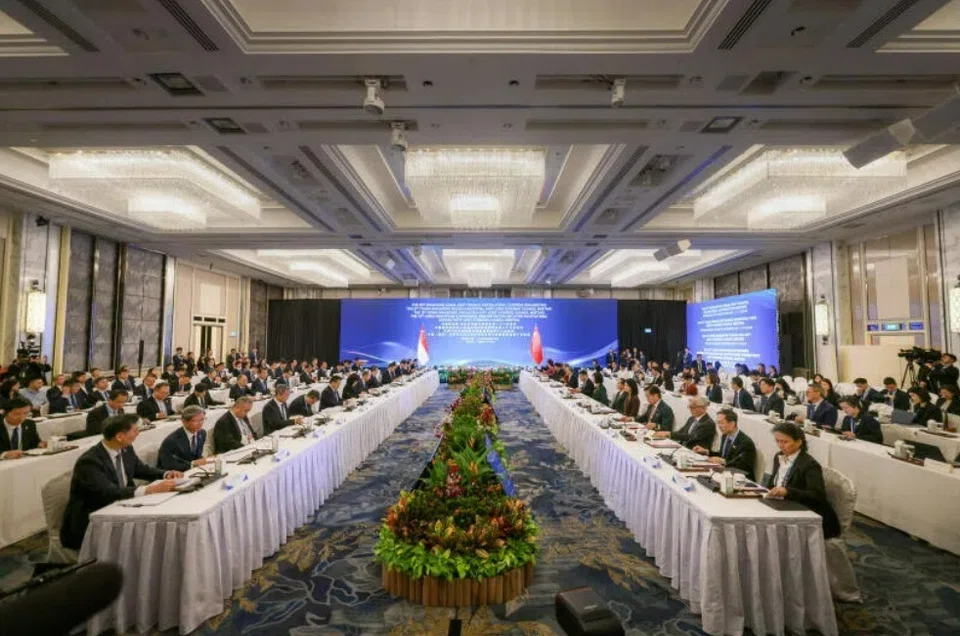
[SINGAPORE] Singapore and China have concluded 29 deals in the areas of trade and finance, science and technology, and public health at the end of their top bilateral forum on Monday (Nov 23).
Deputy Prime Minister Gan Kim Yong, who co-chairs the forum with Chinese Vice-Premier Ding Xuexiang, witnessed the announcement of these bilateral agreements in a ceremony after the Joint Council for Bilateral Cooperation (JCBC) meetings.
Gan said the breadth of the discussions reflects how the two countries’ partnerships have continued to evolve.
A key distinguishing trait of the Singapore-China relationship has always been the ability to stay relevant and forward-looking through different phases of the countries’ development, he said in his closing remarks.
“Even as circumstances change, both sides have continued to adapt, build on our complementary strengths and find new areas of practical cooperation,” said Gan.
Singapore and China take turns hosting the JCBC, which is in its 22nd edition. This year’s talks lasted more than two hours at the Shangri-La Singapore hotel.

The 29 deliverables announced are the highest in recent years. In 2025, the JCBC held in the south-western Chinese city of Chongqing resulted in 27 deals. In 2024, 25 agreements were reached in Singapore.
Elaborating on this year’s agreements, Gan said both sides renewed a memorandum of understanding on trade in services which will bring opportunities for companies to work with one another, and for consumers to tap healthcare, eldercare, professional, legal and other services.
In finance, he said a fast payment systems linkage for small-value payment transfers – which could boost commerce and tourism numbers – is under discussion.
“This will complement the growing range of renminbi payment channels between our countries, and make it easier for our people and businesses in Singapore to access the Chinese market.”
In public health, agencies from both countries signed a new agreement that will facilitate mutual exchanges and learning, he added.
In his closing remarks, Ding said the meeting was productive, with both sides reaching a consensus on numerous issues.
He said the two countries should continue to deepen and expand practical cooperation across all sectors, including in emerging fields such as science and technology innovation, the digital economy, artificial intelligence and green industries.
Both sides should also continue to leverage existing inter-governmental projects as catalysts, as well as continue expanding people-to-people exchanges, he added.
“I hope that our respective departments will work closely together to effectively implement the consensus reached today, further advancing China-Singapore cooperation and achieving even greater results,” Ding said.
“I look forward to welcoming our Singapore colleagues in China next year.”
Singapore officials who attended the JCBC included Minister for Education Desmond Lee, Minister for Digital Development and Information Josephine Teo and Minister for National Development Chee Hong Tat.
Ding was flanked by top Chinese officials such as Deputy Secretary General of the State Council Wang Yang, Vice-Minister of Foreign Affairs Hua Chunying, and China’s Ambassador to Singapore Cao Zhongming. THE STRAITS TIMES
Decoding Asia newsletter: your guide to navigating Asia in a new global order. Sign up here to get Decoding Asia newsletter. Delivered to your inbox. Free.
Share with us your feedback on BT's products and services






