

Singapore key exports jump by higher-than-expected 68.4% in September, led by non-electronics
Electronics exports continue to surge on AI-related demand, but economists warn that this will soften in 2027

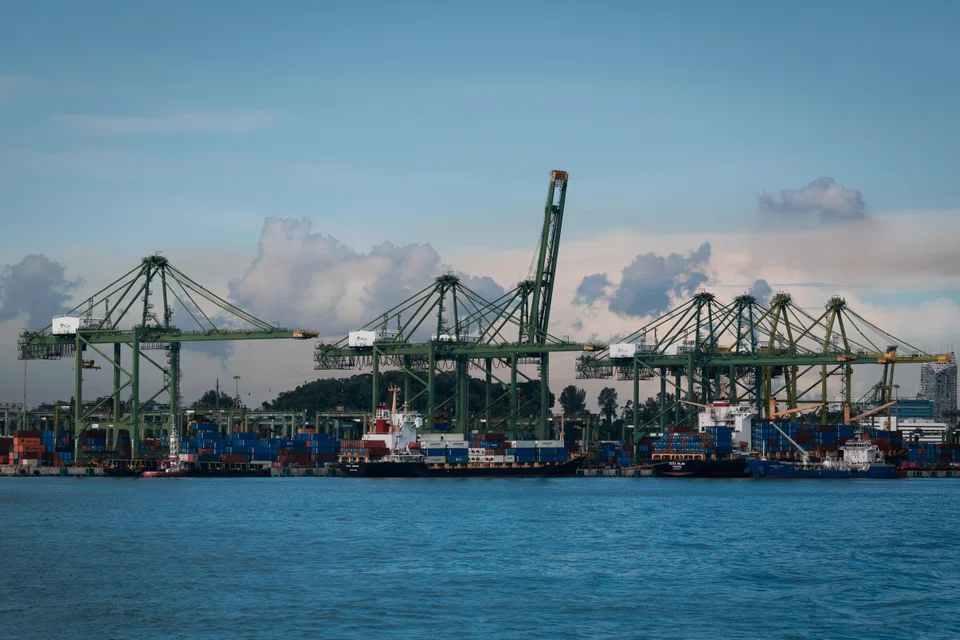
[SINGAPORE] The Republic’s non-oil domestic exports (NODX) surged 68.4 per cent year on year in September, more than double the 32.2 per cent consensus forecast of private-sector economists in a Bloomberg poll.
Driven by non-electronics NODX, the latest showing also extended August’s revised 46.1 per cent expansion, Enterprise Singapore (EnterpriseSG) data showed on Friday (Oct 16).
This was the strongest print since February 1980, said OCBC chief economist Selena Ling.
Electronics exports growth remained robust, and watchers agreed that the trend should hold in the near term. But they noted that artificial intelligence-related tailwinds will begin to soften in 2027.
In the first nine months of 2026, NODX grew 27.6 per cent year on year.
Underpinned by this robust year-to-date growth, RHB upgraded its full-year NODX to 25 per cent, from 15.5 per cent.
Ling also observed upside risk to OCBC’s full-year forecast of 20 per cent, even if growth in the final quarter moderates to 11.5 per cent on year, considering base effects.
Non-electronics shipments expanded 54.2 per cent on the year in September, significantly higher than August’s 11.9 per cent, which EnterpriseSG primarily attributed to “the lumpy exports of structures of ships and boats”.
But it did not cite the year-on-year growth rate, “as the exceptionally high percentage growth reflects a low base effect in the same period last year”.

Other key drivers of the non-electronics NODX increase were non-monetary gold (124.3 per cent) and specialised machinery (50.4 per cent).
Meanwhile, electronics exports soared 107.6 per cent on a yearly basis in September, supported by robust AI-related demand. This was down from 131.6 per cent in the preceding month.
The growth was mainly led by disk media products (312.4 per cent), integrated circuits (74.7 per cent) and PCs (149.5 per cent).
Still growing
Electronics NODX grew 89.5 per cent year on year so far in 2026; and non-electronics, 8.2 per cent, Ling noted.
She said: “Despite recent equity market volatility in AI-related names, fundamentals such as earnings growth and order books, as well as domestic leading indicators such as the manufacturing and electronics Purchasing Managers’ Indexes, remain healthy.”
She thus believes that near-term export momentum should hold up, even as headline NODX growth moderates on higher base effects.
Said DBS senior economist Chua Han Teng: “Notably, electronics PMI sub-indices such as new export orders, and order backlogs have remained on an uptrend, while inventories are drawn down.”
RHB group chief economist Barnabas Gan and associate research analyst Laalitha Raveenthar expect that resilient AI demand and the ongoing tech upcycle should underpin export momentum through year-end.
While the three-month moving average growth of several key electronics products moderated in September, electronics exports remained robust, suggesting that underlying technology demand remains firm despite some moderation in product-level growth momentum, they said.
Global semiconductor sales, which reportedly reached a record US$159.7 billion in August 2026, also point to the broader semiconductor cycle remaining supportive, the pair added. “The global AI investment cycle is expected to remain a key growth support, even as AI-driven growth moderates from its exceptional pace.”
Eventual slowdown
Still, RHB’s duo flagged a quarter-on-quarter manufacturing output contraction in the third quarter, reversing from the second quarter’s expansion. While this does not necessarily signal a turning point, they said that the pullback warrants caution over the durability of growth in the coming quarters.
Economists cautioned that AI-led demand looks set to moderate in the longer term.
Ling pointed out: “The risk is that the current investment cycle begins to mature into 2027.”
Private-sector economists believe that AI-related spending will ease from the high levels in 2026, especially in the second half of next year, weakening demand for Singapore’s exports.
RHB said that MAS highlighted the possibility of an “AI infrastructure credit shock”, where weaker-than-expected AI monetisation could prompt hyperscalers to pare back capital expenditure, triggering a repricing of debt-financed AI investments.
“This could tighten financial conditions, delay projects along the AI supply chain and create a self-reinforcing downturn in investment and global growth,” the RHB duo added.
Standard Chartered’s chief economist Edward Lee and senior economist Jonathan Koh explained: “A sharper or more sustained correction in AI-related assets could pose an additional downside risk if tighter financing conditions cause technology firms to reassess AI capex.”
UOB associate economist Jester Koh added that higher global interest rates that could instill a degree of caution among firms about undertaking new investments.
Beyond technology-related risks, economists also named geopolitical tensions, crude oil price volatility, trade restrictions and a weaker US economy as key headwinds.
Breakdown by market
In September, key exports to Singapore’s top 10 markets – except India – rose. NODX to India fell 5.6 per cent, in a turnaround from the 23.6 per cent growth recorded in August.
UOB’s Koh said: “By destination, electronics NODX to markets deeply embedded in the semiconductor value chain remained robust.”
Key exports to the US rose 73.2 per cent year on year; the rise for Taiwan was 96.9 per cent, and for South Korea, 96 per cent.
Key exports to the EU grew 11.3 per cent in September, reversing from the 1.7 per cent fall in the previous month. In September, the EU was the only market out of Singapore’s top 10 to record a decline in NODX.
Decoding Asia newsletter: your guide to navigating Asia in a new global order. Sign up here to get Decoding Asia newsletter. Delivered to your inbox. Free.
Copyright SPH Media. All rights reserved.
TRENDING NOW
Singapore identifies 7 firms responsible for haze fires, notices issued urging action: Grace Fu

DBS remains analysts’ pick ahead of Q3 earnings after Singapore banks’ share slump

High Court rules against Julius Baer’s Singapore trust arm in US$50 million family trust dispute

Could stablecoins be the future of money?

