

Economists upgrade GDP estimates after Singapore’s manufacturing output surprises with 16.1% surge in September
Electronics and biomedical manufacturing drive growth

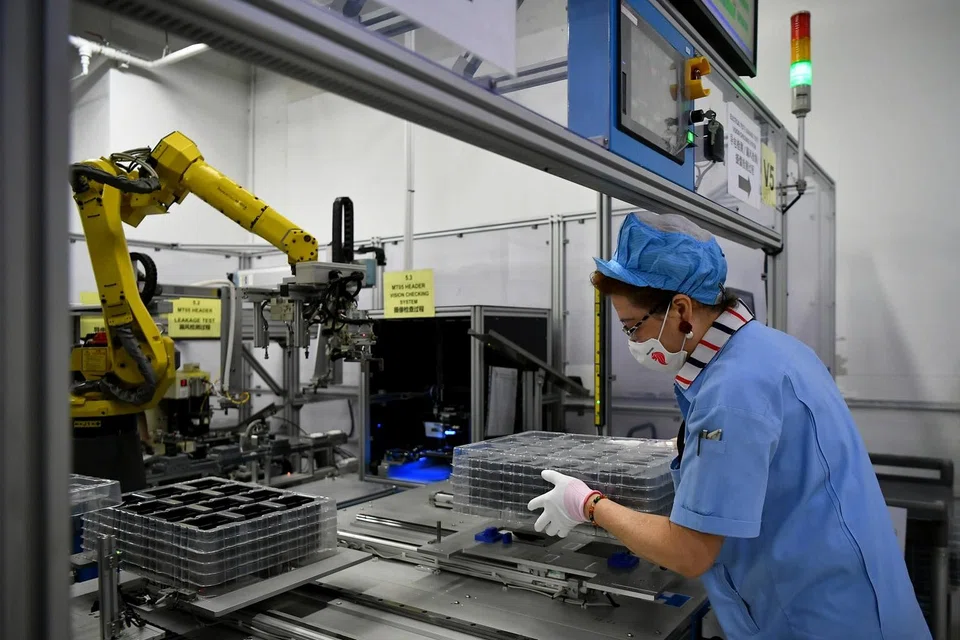
[SINGAPORE] Several private-sector economists have raised their full-year gross domestic product growth forecasts for 2025, after the latest industrial production (IP) print was much better than anticipated.
Factory output returned to expansion territory with a 16.1 per cent year-on-year surge in September, a reversal from August’s revised 9 per cent drop, data from the Economic Development Board showed on Friday (Oct 24). In August, the IP print ended a 13-month expansion streak.
The latest print exceeded economists’ expectations. In a Bloomberg poll, private-sector economists’ median estimate had been a mere 0.5 per cent rise.
Excluding the volatile biomedical manufacturing cluster, output grew 5.4 per cent year on year in September, reversing August’s 4.4 per cent contraction.
Manufacturing has remained resilient despite US tariffs, economists noted.
“The strong upturn comes on the back of a similar resurgence in September’s non-oil domestic exports (NODX), reinforcing our view that the impact from higher US tariffs would be short-lived and muted,” Maybank analysts Chua Hak Bin and Brian Lee said.
Of the six manufacturing clusters, four expanded in September.
“The blockbuster IP performance was driven by two factors,” said UOB associate economist Jester Koh. He highlighted that pharmaceuticals output “skyrocketed”, while electronics IP staged a “meaningful” rebound on a monthly basis.
Optimism on outperformance
The September figure brings third-quarter manufacturing growth to 5 per cent, outstripping the government’s advance estimate of zero per cent year on year, economists noted.
This is also stable compared with Q2’s 5.1 per cent expansion on-year, DBS senior economist Chua Han Teng pointed out.
Several economists flagged that Q3 GDP could be revised up to 4 per cent, from 2.9 per cent in the flash estimate, given the higher-than-expected Q3 IP figure.
OCBC chief economist Selena Ling said that if this upgrade materialises, GDP growth for the first three quarters of the year would rise from 3.9 per cent to 4.2 per cent on a yearly basis.
“Even assuming that Q4 2025 growth momentum tapers as US reciprocal tariffs start to weigh, full-year GDP growth may overshoot the 3 per cent year-on-year handle to come in around 3.3 per cent year on year,” she added.
Following Friday’s IP print, Maybank upgraded its full-year GDP forecast to 4 per cent from 3.5 per cent previously. UOB raised its forecast to 3.5 per cent, from 3.2 per cent before.
Chua and Lee from Maybank expect several factors to support manufacturing demand: the ongoing artificial intelligence (AI) capex boom; Singapore’s low 10 per cent baseline reciprocal tariff; significant tariff exemptions for most major semiconductor and pharmaceutical multinational corporations; and a limited build-up of front-loaded inventories by US companies since Q2.
“Q4 growth is likely to remain robust, as trade remains resilient while other drivers remain intact, including a construction boom, falling interest rates and generous fiscal support,” they said.
Ling said that, ironically, Singapore’s manufacturing sector this year may outperform its 2024 showing despite the US tariffs.
While “payback” may materialise in the coming months, affected firms worldwide are increasingly recalibrating their supply chains – and could leverage Singapore’s lower tariff rate, she noted. This is amid negotiations with the US for lower duties in exchange for onshoring some production and investments to America, she added.
DBS’ Chua believes that the electronics cluster could keep benefiting from “relentless AI-related demand” for some time, until threatened US tariffs on semiconductors are announced and implemented.
But he also warned that while the manufacturing sector as a whole performed “better than feared” in Q3, “high volatility is likely to persist, with downside risks amid evolving US tariff developments”.
He also noted that all eyes are on US-China trade talks, with a meeting between the countries’ leaders slated for Oct 30.
“Should heightened US-China tariff tensions persist, this would negatively impact Singapore’s export-oriented manufacturing sector, given its trade linkages to China’s supply chains,” he said.
On a seasonally adjusted monthly basis, factory output jumped 26.3 per cent in September, a turnaround from August’s 11 per cent fall. Excluding biomedical manufacturing, output edged up 0.8 per cent, reversing from the 5.1 per cent decline in the previous month.
Performance by cluster
The majority of the clusters marked year-on-year rises in production, with output for precision engineering and general manufacturing posting falls.
Production in the linchpin electronics cluster expanded 13.2 per cent year on year, reversing from August’s 8.5 per cent fall. Within the cluster, the infocomms and consumer electronics segment led growth with an 80.6 per cent expansion, which economists attributed to buoyant global, AI-driven investment demand.
Volatile biomedical manufacturing output was up 45.9 per cent year on year in September (compared with -37.4 per cent in August), as the pharmaceuticals and medical technology segments both expanded, by 55.3 per cent and 4.8 per cent, respectively.
The level of output surged to a record high, Maybank’s Chua and Lee pointed out, even as they noted that pharmaceutical NODX fell 8.7 per cent on-year in the same month.
“New production facilities could have come onstream in September,” they noted.
The duo and UOB’s Koh also said that manufacturers could be front-loading production after Trump announced impending 100 per cent tariffs on branded pharmaceutical products.
“If so, there will likely be a jump in October exports,” said the Maybank economists. “Most pharmaceutical firms should be exempt from tariffs given their expansion plans in the US, but are awaiting confirmation from the US that they qualify for the exemptions.”
Koh, noting that the tariffs – originally set to take effect from Oct 1 – have been delayed, believes that pharmaceutical production could remain resilient in October. This is because the tariff announcements were made only in late September.
“With implementation delayed, production is probably still running at an accelerated pace to fulfil front-loaded orders from the US,” he said.
Transport engineering output posted double-digit growth at 13.8 per cent, while chemicals production rose by a muted 1.2 per cent.
In contrast, precision engineering marked a second straight month of year-on-year contractions, with production shrinking 5.9 per cent. General manufacturing output fell for the ninth consecutive month, down 4.7 per cent in September.
TRENDING NOW

ComfortDelGro appoints two new independent directors

Once staunchly pro-China, Malaysian Chinese businesses are now distancing themselves from Beijing

NoonTalk needs continued financial support from CEO Dasmond Koh, auditors warn

DP Architects sets the benchmark for sustainability disclosure and design

