

Singapore to negotiate FTA with regional bloc of 8 East African countries
President Tharman’s state visit is the first such visit by a Singapore president to Tanzania
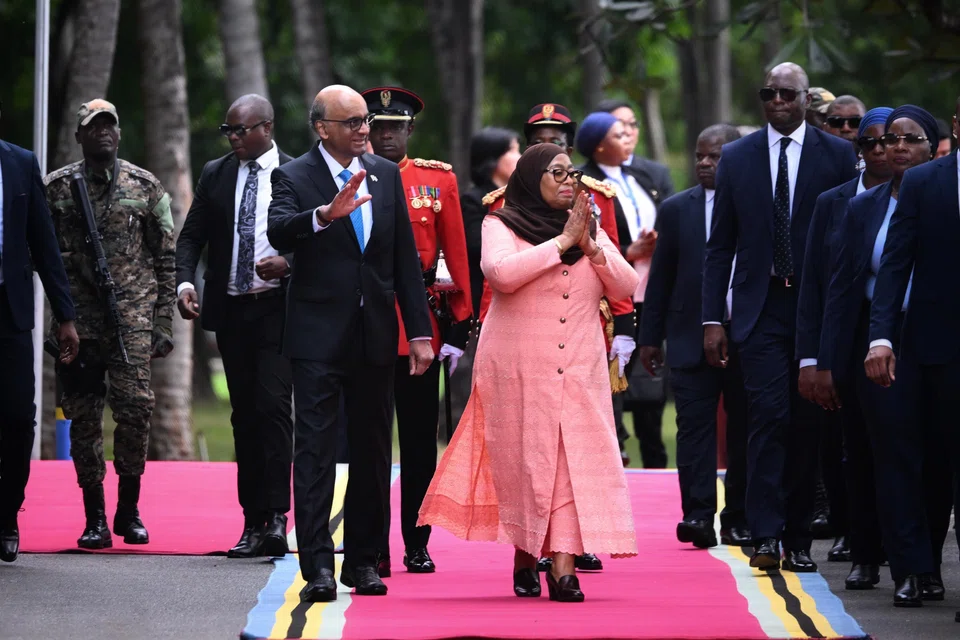
[DAR ES SALAAM] Singapore will negotiate a free trade agreement (FTA) with a bloc of eight East African countries, its first with an African partner.
President Tharman Shanmugaratnam said on Tuesday (Jun 9) that the Republic welcomed the East African Community’s (EAC) intention to pursue such a pact, which would improve trade flows between the economies and open up new areas of growth.
This would also be the regional bloc’s first FTA negotiation with a partner outside Africa.
Tharman was speaking to the media alongside Tanzanian President Samia Suluhu Hassan as part of his state visit to the country from Jun 8 to 10.
The FTA would be a significant step, as it would connect Singapore not only with Tanzania, but also with the other seven partner states in the bloc, said Tharman.
These are Burundi, the Democratic Republic of the Congo, Kenya, Rwanda, Somalia, South Sudan and Uganda.
“The EAC-Singapore FTA would be a timely move to diversify our trade networks amid current geopolitical tensions,” Tharman said.
An FTA would improve market access and the flow of goods and services between the EAC and Singapore, he added.
“Singapore could provide East African exporters with a gateway to the larger Asean market,” he said. “It will also open up newer areas of growth, such as in the digital economy.”

Hassan, speaking in Swahili, said she welcomed Singapore to enhance cooperation with the East African region with an FTA.
She added that while trade between the two countries has grown, “it has not yet reached the level we believe it can achieve”.
Hassan also invited Singapore to set up an embassy in Tanzania.
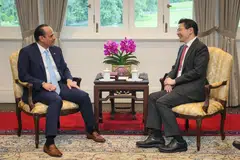
The two leaders were speaking to the media after they and their delegations met earlier on Tuesday at the Dar es Salaam State House, also known as the Ikulu, the official residence of the Tanzanian president.
Tharman’s state visit, at the invitation of Hassan, is the first such visit by a Singapore president to the East African country, and coincides with the 45th anniversary of diplomatic relations between the two countries.
In line with this milestone, it is timely for the two countries to inject fresh momentum into the relationship, and to explore new areas for practical cooperation, said Tharman.
With the current global situation where international rules, institutions and habits of cooperation are under strain, countries must address problems with resolve and not diffidence, he added.
“Our response must be to build bridges – including between Asia and Africa, and among countries that believe that openness and partnership still offer the best path forward.”
The two leaders also witnessed the exchange of a number of agreements between the two countries that would deepen cooperation in areas including trade flow, carbon credits and skills development.
Among the agreements exchanged was one to avoid double taxation for cross-border business activities. This will lower barriers to investment and trade and economic flows between the two states. It will enter into force after ratification by both countries.
The agreement will give businesses greater certainty and make it easier for them to invest in the long term, said Tharman.
Another agreement was for both sides to collaborate more on carbon markets. This includes exchanging information, knowledge and best practices on carbon market frameworks and mitigation projects.
Singapore’s Foreign Ministry also inked an agreement with its Tanzanian counterpart to evaluate all aspects of bilateral relations between both countries, and exchange views on regional and international issues of mutual interest.
Tharman noted that Singapore and Tanzania are working together to enhance bilateral cooperation, including on the economic front, in climate and resilience, and between the peoples and institutions.
He cited the example of Singapore’s Duke-NUS Graduate Medical School, which is drawing on its strengths in translational research, gene therapy and global health innovation to collaborate with Tanzania’s Muhimbili University of Health and Allied Sciences, to strengthen Tanzania’s national sickle cell disease programme.
This is a chronic illness affecting 11,000 newborns in Tanzania each year, and accounts for about 6.4 per cent of under-five mortality in Africa.
The collaboration could improve public health outcomes in Tanzania, generate spillover benefits across Africa, and contribute to global health innovation, Tharman said.
Upon arrival at the Ikulu, Tharman was met with an official welcome ceremony that included a 21-gun salute.
The visit is part of Singapore’s efforts to grow ties with Africa as the country strengthens and expands its global network of partnerships.
In November 2025, Prime Minister Lawrence Wong visited Ethiopia, where he announced that Singapore would open an embassy in the capital, Addis Ababa.
Africa is the second-fastest-growing region in the world, and is expected to be the fastest-growing region by 2029.
At a state banquet later on Tuesday, Tharman said the multiple agreements signed reflect the breadth of what Singapore and Tanzania can do together. They also show that both countries, though different in scale and circumstance, can be useful partners to each other as they navigate a more uncertain global environment.
“It is that spirit of partnership that I carry with me on this state visit, and that is reflected in the constructive engagements of Singapore companies which have been active in Tanzania, several of which are represented in the business delegation that accompanied me here,” he said.
In her toast speech delivered in English, Hassan said Tanzania has “a lot to learn” from Singapore’s accomplishments, and it looks forward to cooperate in new frontiers and expand opportunities for trade and investment.
Tharman said the people of both nations are also connected through everyday life, work and culture.
The Makundi family is an example of Tanzanians with roots in Singapore. Its patriarch Walter Makundi worked on the structural design of some of Singapore’s MRT stations.
The Makundis have also observed that the two countries’ cuisines speak a familiar language, noted Tharman.
Coastal Swahili dishes in Tanzania, much like Singapore’s Malay, Indian and Peranakan cuisines, draw richness from coconut milk and warmth from spices such as cloves, cinnamon and cardamom. These similarities reflect old spice routes and the long movement of people, goods, and cultures across the Indian Ocean.
“And I am sure you will agree that once two peoples discover they both take their coconut milk and spices seriously, it is no longer just culinary affinity; it is strategic alignment!” Tharman quipped. THE STRAITS TIMES
Decoding Asia newsletter: your guide to navigating Asia in a new global order. Sign up here to get Decoding Asia newsletter. Delivered to your inbox. Free.
Share with us your feedback on BT's products and services
TRENDING NOW

Singapore identifies 7 firms responsible for haze fires, notices issued urging action: Grace Fu

‘How many will survive?’: Bubble fears arise as China’s humanoid robotics face reality check
GIC-backed Bank Jago sees wealth management as next growth engine as Indonesian investor base grows
Ageing in Asia: Huge potential for the consumer economy

