

Singapore raises 2026 growth forecast to ‘around 6%’; Q3 GDP revised up at 6.1%
AI-driven demand lifts full-year outlook from previous forecast of 4.5-5.5%

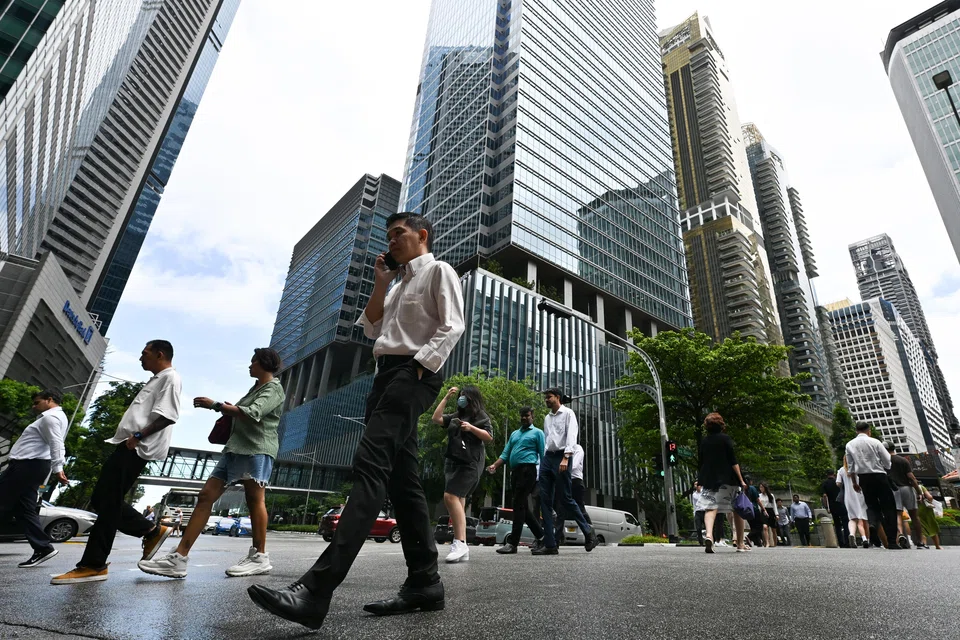
[SINGAPORE] The Republic has upgraded its full-year growth forecast for 2026 to “around 6 per cent”, from the 4.5 to 5.5 per cent range set in August, as strong global artificial intelligence-related demand continues to drive its trade-reliant economy.
This was as third-quarter gross domestic product grew 6.1 per cent year on year, easing from the 6.4 per cent growth recorded in the second quarter, according to data from the Ministry of Energy, Trade and Industry (METI) on Tuesday (Nov 24).
The Q3 figure was revised up from the advance estimate of 5.4 per cent, which was largely based on data for July and August. For the first three quarters of 2026, the economy grew 6.2 per cent.
On a seasonally adjusted quarter-on-quarter basis, GDP expanded 1.5 per cent, moderating from the 1.8 per cent growth in Q2.
The wholesale trade, manufacturing, and finance and insurance sectors drove Q3 growth, METI said.
Growth in the machinery, equipment and supplies segment of wholesale trade, as well as the electronics and precision engineering clusters of manufacturing, was boosted by strong AI-related demand.

Meanwhile, the expansion in the finance and insurance sector was underpinned by credit growth and fee-generating activities, said the ministry.
In contrast, the retail trade and F&B services sectors contracted, partly due to a sustained shift in local spending abroad as outbound travel increased, it added.
Growth to ease in 2027
METI said AI-related production and exports, driven by a stronger-than-expected build-out of data centres, have continued to accelerate since August, and that momentum is expected to last through the rest of the year.

While elevated energy prices have fuelled global inflationary pressures and tighter monetary policy in several economies, the ministry assessed that, on balance, Singapore’s external demand outlook has improved compared with August.
Strong AI-related demand will continue to drive the manufacturing and wholesale trade sectors, while outward-oriented services such as finance and insurance, and information and communications should remain resilient.
The accommodation sector will be supported by strong hotel bookings amid a robust line-up of events. The outlook for retail trade and F&B, however, remains subdued.
For 2027, METI projected full-year growth of 2.5 to 4.5 per cent, as the pace of new AI investments is expected to ease from its high level this year.
Growth in most of Singapore’s key trading partners is also projected to soften, it added.
The ministry expects oil supply from the Middle East to recover gradually, which should ease global energy prices and inflationary pressures over the course of the year.
The US economy is expected to slow as restrictive monetary policy and weaker real wage growth weigh on investment and consumption. China is also set to slow as export growth softens and consumption stays sluggish.
The eurozone, by contrast, is forecast to pick up, helped by firmer household spending and defence-related manufacturing, said METI.
Growth in key South-east Asian economies is projected to ease as AI investments and AI-related exports moderate.
Domestically, the electronics and precision engineering clusters and the machinery, equipment and supplies segment of wholesale trade will continue to be supported by AI demand, although at a slower pace.
Transport engineering should benefit from multi-year capacity expansions in the aerospace segment and strong aircraft maintenance, repair and overhaul orders, while the information and communications sector will get a lift from demand for digital transformation and AI-related services.
Consumer-facing sectors such as retail trade and F&B services may continue to be weighed down by the shift in local spending abroad.
Sector growth
Three downside risks remain, said METI. Concerns over the sustainability of the global AI cycle could trigger sharper corrections in financial markets, with potential spillovers to the broader economy.
Further escalation of the Middle East conflict could cause fresh spikes in energy and other input prices, stoking inflation and tightening global financial conditions. Economic and political uncertainties in external economies could also weigh on investment and consumption.
The ministry said it will monitor developments closely and adjust the forecast over the course of 2026 if necessary.
The goods-producing industries expanded 8.3 per cent year on year in Q3, slowing from 11.2 per cent in the previous quarter.
Manufacturing output grew 8.5 per cent on the year, moderating from the 13.2 per cent growth in the previous quarter. Output expansions in the electronics, precision engineering, transport engineering and general manufacturing clusters outweighed declines in the chemicals and biomedical manufacturing clusters.
Sequentially, however, the sector contracted 0.2 per cent, a reversal from the 6.5 per cent expansion in Q2.
The construction sector grew 9.5 per cent year on year, faster than the 6.5 per cent growth in the previous quarter, supported by both public and private-sector works.
Quarter on quarter, construction output grew 3.6 per cent, a turnaround from the 2.4 per cent contraction in Q2.
The services-producing industries, meanwhile, grew at a quicker pace of 6.1 per cent year on year, up from 5.4 per cent in Q2. On a quarterly basis, they expanded 1.9 per cent, compared with 1.1 per cent previously.
Wholesale trade expanded 14.5 per cent year on year, accelerating from 9.8 per cent in Q2.
Wholesale volumes of telecommunications and computers, and electronic components rose on strong global demand for AI-related electronics, while volumes in the fuels and chemicals segment fell, affected by oil supply disruptions from the Middle East conflict.
Sequentially, the sector grew 6.5 per cent, versus 0.5 per cent in Q2.
The information and communications sector grew 6.2 per cent year on year, picking up from 4.7 per cent in Q2, driven by data centre operations and Internet search engine activities.
Finance and insurance expanded 3.8 per cent year on year, slowing from 6.2 per cent in the previous quarter. Banks, fund managers and securities dealers saw a more modest increase in fee and commission incomes amid more selective risk-taking by investors, although credit intermediation remained strong.
Quarter on quarter, the sector contracted 3 per cent, a reversal from the 0.9 per cent growth in Q2.
The real estate sector grew 4.7 per cent year on year, compared with 5 per cent in Q2, while administrative and support services expanded 3.6 per cent, faster than the 2.7 per cent growth previously.
Growth in the accommodation sector slowed to 0.9 per cent year on year from 1.9 per cent, and transportation and storage grew 2.2 per cent, easing from 3.6 per cent.
Retail trade shrank 2.7 per cent on the year, reversing a 0.8 per cent expansion in Q2, with both motor vehicular and non-motor vehicular sales volumes falling.
F&B services contracted 2.1 per cent, worsening from a 1.3 per cent decline the year before.
Decoding Asia newsletter: your guide to navigating Asia in a new global order. Sign up here to get Decoding Asia newsletter. Delivered to your inbox. Free.
Copyright SPH Media. All rights reserved.
TRENDING NOW

Indonesia’s coal tycoon Low Tuck Kwong replaced as Bayan Resources president-director

Nvidia reinstates Jensen Huang as CEO; Trump says move poses no national security risk

Six workers file employment claims against Crystal Jade Food Manufacturing

AI agents and stablecoins a ‘perfect match’ for payments, says MetaComp’s Tin Pei Ling

