

Singapore to review COE categories for cars: Jeffrey Siow
This will include proposals to apply discounts or surcharges based on a car’s open market value

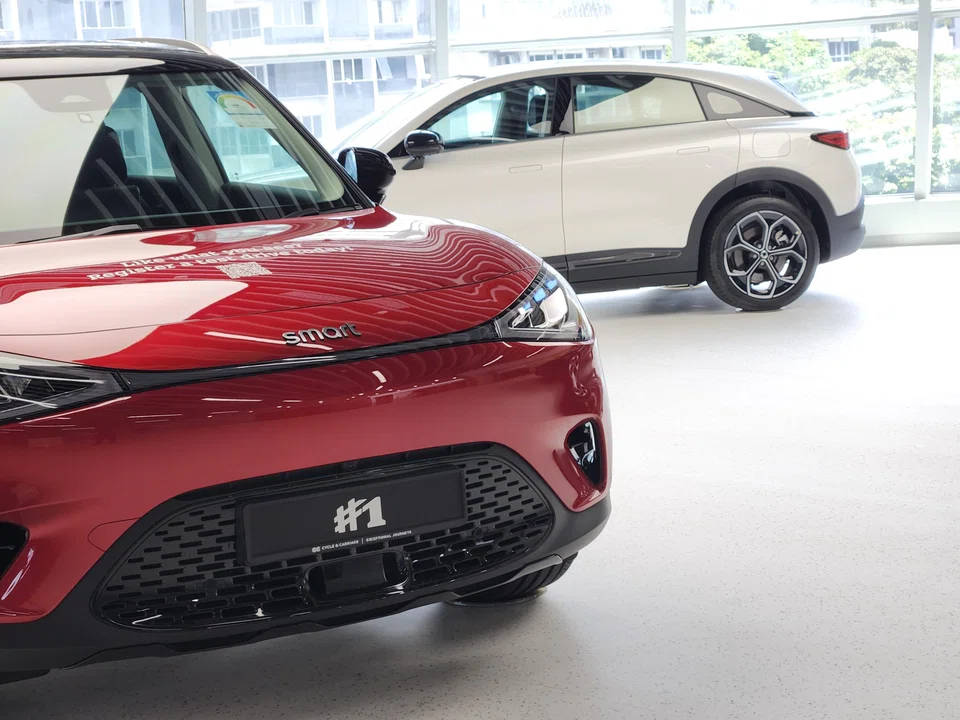
[SINGAPORE] The government will review the Certificate of Entitlement (COE) categorisation for cars, said Acting Minister for Transport Jeffrey Siow at his ministry’s Committee of Supply debate on Wednesday (Mar 4).
The review will not just look at a system based on car price, but also examine merging the two car categories, A and B, into a single bidding category.
Siow noted that the price difference between Category A, for mainstream cars, and Category B, for larger or more powerful cars, has been converging in recent times as car manufacturers have been adjusting specifications of cars to fit within Category A.
“I have therefore asked (the Land Transport Authority) to review this issue. We will gather views from the public and from the industry on how to improve the COE categorisation for cars, including Mr Chia’s specific proposal to apply discounts or surcharges based on open market value,” he said.
He was referring to Member of Parliament Edward Chia’s suggestion that a car’s open market value – or OMV – represents a stronger basis for differentiation between categories, rather than technical specifications. OMV is the cost of a car when it lands in Singapore before major taxes are applied and without a COE. The stakeholders who will be consulted for the review include car buyers, manufacturers, dealers and academics.
On the time frame, Siow said: “We intend to start this immediately and to take the rest of the year to do the consultation as part of the Land Transport Master Plan process, and hopefully by the end of the year we will... have some form of conclusion.”
Blurred lines
In the past, Category A cars were defined solely by engine capacity. In 2014, a power cap was introduced to help differentiate Category A and B cars, and this was later updated to cover electric vehicles (EVs).
Currently, the Category A COE applies to mainstream cars that have engines of up to 1,600 cubic centimetres (cc) in capacity or with up to 97 kilowatts (kW) of power, or for electric vehicles (EVs) with up to 110 kW of power. Category B cars have more than 1,600 cc capacity or 97 kW, while Category B EVs have more than 110 kW of power.
Because it is easier for EVs to be tuned for less power by tuning electric motors, in contrast to internal combustion engines, Category A has seen numerous EV models introduced over the past few years.
SEE ALSO




“(The 2014) change worked for some time, but... in recent years, manufacturers have been adjusting specifications of cars to fit within Category A, and this has once again caused Category A and B prices to converge,” noted Siow.
He also said that Category A’s quota supply peaked last year, while the Category B quota supply will continue to increase this year and it is likely that the premiums of the two will continue to converge for some time.
Answering subsequent queries from MPs, Siow added that further investigation would be needed. “I think we have to look at how to do this, because there’s probably still some merit to having some distinction between a mass-market car category and a higher-end car category.”
Decoding Asia newsletter: your guide to navigating Asia in a new global order. Sign up here to get Decoding Asia newsletter. Delivered to your inbox. Free.
Copyright SPH Media. All rights reserved.






