

Singapore River precinct revitalisation measures to continue after year-long pilot
Between August 2025 and June 2026, 37 applications for new nightlife uses in the area have been approved

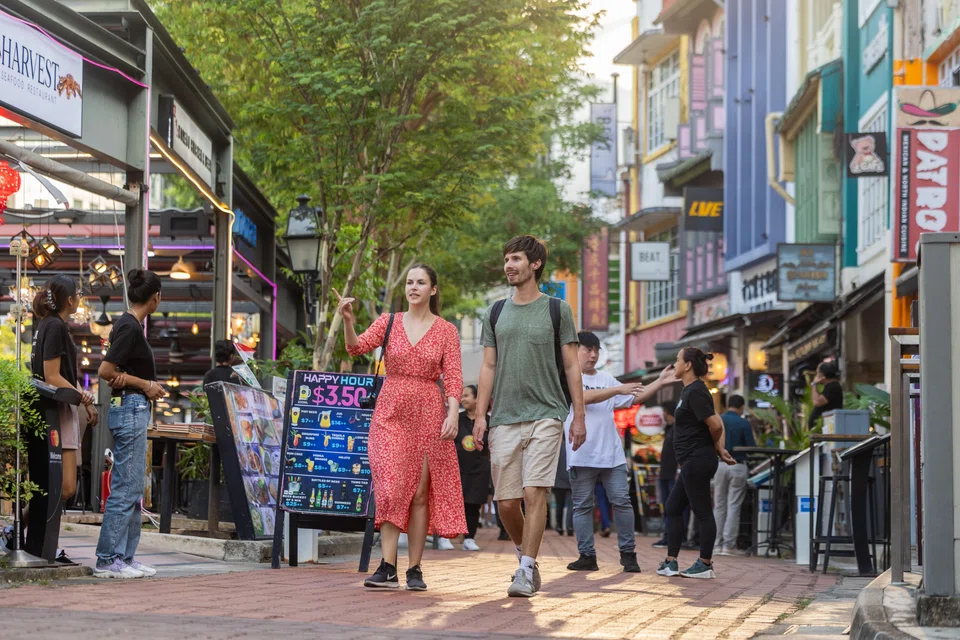
[SINGAPORE] Revitalisation measures for the Singapore River precinct – which comprise allowances for new nightlife businesses, extended liquor trading hours and road closures – will continue to run after Aug 18.
The government will formalise these measures after the “encouraging results” of the year-long pilot programme that began on Aug 18, 2025, Minister of State for National Development and Foreign Affairs Alvin Tan told the media on Monday (Aug 17).
These efforts at the “key heritage, lifestyle and entertainment precinct” will help the city-state’s tourism and nightlife offerings become more attractive, he said, adding: “It will support business vibrancy and also create good jobs in this sector.”
Michelle Koh, executive director of Singapore River One (SRO), which manages the precinct, said footfall for Circular Road and the Boat Quay waterfront has increased by about 10 per cent since the start of the trial.
In a joint statement, the Ministry of Trade and Industry (MTI), Ministry of National Development (MND) and Ministry of Home Affairs (MHA) said the pilot brought in “strong interest” from businesses.
Under the programme, businesses can submit applications for new bars, pubs and nightclubs along the Boat Quay waterfront, Circular Road, Lorong Telok and Canton Street, which make up the Boat Quay Historic District. Approved proposals will be granted permission for three years.
Between August 2025 and June 2026, the Urban Redevelopment Authority approved 37 applications for new nightlife uses in the area, the ministries said.
Restaurants, pubs, bars and nightclubs will also continue to be able to apply for liquor trading hours to be extended to 4 am of the following day, for Thursday and Friday nights, compared with 3 am previously.
This applies to businesses in the Boat Quay Historic District, Clarke Quay Conservation Area and Upper Circular Road area.
MTI, MND and MHA said the Singapore Police Force approved 92 applications for the August 2025 to June 2026 period.
Road closures at Circular Road for events and pedestrian-friendly activities – which were announced under the trial, but have yet to commence – begin in October, with the first being Halloween themed.
SRO needed to discuss the road closures with the affected operators and work with agencies, said Koh, explaining the implementation lag.
She estimated that it has received buy-in from close to 90 or 100 per cent of the area’s businesses, calling the move “something very sought after”.
Looser rules, fresher ideas
Koh said the formalisation of the relaxed rules give operators and landlords more certainty to act on the “wiggle room to check out new concepts”.
President of the Singapore Nightlife Business Association (SNBA) Danny Loong said it hopes to work with SRO to support events in the area, whether these are music festivals or coffee parties. “We don’t really mind as long as we have Singaporeans come out, enjoy the precinct, and also the businesses get to enjoy the footfall,” he said.
Stakeholders are also committed to ensuring the safety and security of the area amid the moves to boost nightlife vibrancy.
In 2018, the government introduced a trial allowing alcohol sales until 4 am on Saturdays in Clarke Quay, but ended it after four months following an increase in certain public order crimes.
For the latest pilot, Koh noted that SRO spent S$20,000 each month on five additional manpower officers, working from 7 pm to 3 am.
The ministries said on Monday: “With support from local stakeholders in stepping up security patrols, the law-and-order situation in the precinct has remained stable throughout the pilot.”
Loong said the nightlife measures at the Singapore River feeds into SNBA’s wider plan to “redefine the night”, which will target night-time activities at various precincts. He named an end-August activation at Holland Village as an upcoming example.
The association is working with agencies to address challenges such as limited or costly late-night transport options, he added.
It is also engaging with young people to keep abreast of changing mindsets and trends.
Decoding Asia newsletter: your guide to navigating Asia in a new global order. Sign up here to get Decoding Asia newsletter. Delivered to your inbox. Free.
Copyright SPH Media. All rights reserved.






