
From Singapore Slings to Vegas pours: ecoSpirits tackles spirits’ packaging waste, now eyes other sectors

Invented in the Republic, the startup’s reusable bottle system is used by big names such as Bacardi, Diageo and Absolut Vodka

Summarise
Tessa Oh
Published Wed, Oct 1, 2025 · 09:30 AM
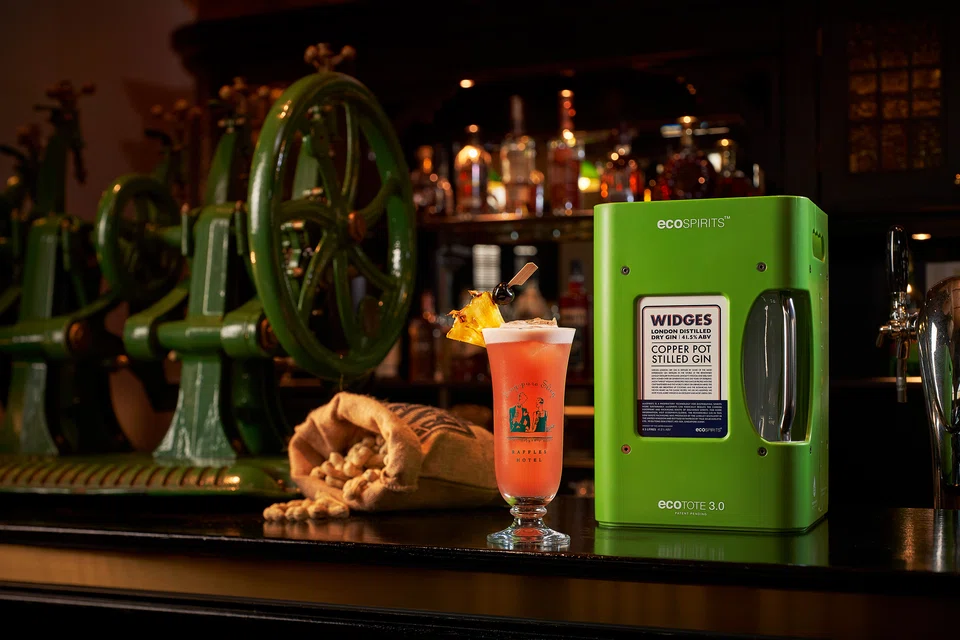
    • EcoSpirits replaces the traditional “make-use-dispose” model with a closed-loop system that includes the ecoTote – a 4.5-litre reusable container.
    • EcoSpirits replaces the traditional “make-use-dispose” model with a closed-loop system that includes the ecoTote – a 4.5-litre reusable container. PHOTO: RAFFLES SINGAPORE

    [SINGAPORE] Walk into Raffles Hotel and order a Singapore Sling. The cocktail’s gin, cherry and orange liqueurs all come from ecoSpirits’ reusable containers – a system that replaces six single-use bottles with one large refillable container.

    Paul Gabie came up with the idea for the green packaging startup in late 2017, when he questioned why spirits could not come in reusable containers. It began operating the following year.

    Gabie arrived in Singapore 16 years ago from New York to work in finance. He opened 28 HongKong Street in 2011, a Chinatown bar that still operates today, before moving into spirits distribution. He spent nearly a decade building Proof & Company, a spirits distributor which closed in July this year.


    After nearly a decade in the local spirits industry, he witnessed the supply chain’s wastefulness first-hand. Almost all the spirits served in bars, hotels and restaurants are shipped from distilleries in London, Kentucky and Mexico in glass bottles that get tossed within 20 minutes to an hour in busy venues.

    “It’s not just packaging waste – it’s glass, which is carbon-intensive and heavy,” he said. “If you look at a bottle of spirit, half of the weight is in the glass bottle itself.”

    Initially, he tried to source ready-made solutions, but realised none existed – so he decided to create one. “Singapore is a good place for innovation. Let’s hire an engineer or two and start working on something.”

    The result was the startup’s ecoTote technology – a large, durable glass container that holds the equivalent of six standard bottles, and which can be refilled hundreds of times.

    Paul Gabie came up with the idea for ecoSpirits in 2017, after witnessing the spirits industry's wastefulness first-hand. PHOTO: ECOSPIRITS

    Raffles Hotel became the company’s first partner, agreeing to trial the technology in its Long Bar in 2018 as part of the group’s own sustainability push. The gamble paid off. To this day, the hotel’s iconic Singapore Slings are served using the ecoSpirits system.

    What began as a “little idea born in Singapore” has since expanded to 35 countries, with global partners including major alcohol brands such as Diageo, Bacardi and Absolut Vodka, as well as hospitality giants like Carnival Cruise Line.

    Closing the loop

    EcoSpirits replaces the traditional “make-use-dispose” model with a closed-loop system. Instead of shipping spirits in small glass bottles, distilleries send 1,000-litre containers to Singapore, where a local bottling facility fills the ecoTote – a 4.5-litre reusable container.

    The process is simple: ecoTotes are delivered to venues such as Raffles Hotel and LeVeL33, then collected when empty and returned to the bottling facility – called the ecoPlant – for cleaning, sanitising and refilling.

    According to Gabie, each ecoTote lasts up to 200 cycles, or about 15 years. Combined with the startup’s SmartPour system, establishments can dispense precise volumes – from 25 ml to 50 ml for a double shot, depending on the cocktail recipe.

    The company has expanded beyond its original hardware focus. In addition to manufacturing ecoTotes and providing bottling services, ecoSpirits has developed software that manages the system’s operations.

    The software tracks container locations, records dispensing volumes, and can recall specific batches when issues occur. It also authenticates products to prevent counterfeiting in the supply chain.

    The gin, cherry and orange liqueurs in Raffles Hotel’s Singapore Sling all come from ecoTotes, ecoSpirits’ reusable containers. PHOTO: RAFFLES SINGAPORE

    The company’s revenue reflects this approach: About 70 per cent comes from hardware sales, including those of ecoPlants and ecoTotes, while 30 per cent is generated from software licensing and support fees for what it calls the CircularOne system.

    Customers typically purchase the complete package, which includes hardware, software access and engineering support, rather than individual components.

    Gabie emphasised that all the technology is developed locally. “These are the technologies we developed, all developed here in Singapore with our own engineers and research and development.”

    Reaping the benefits

    Businesses are adopting the technology for tangible benefits. According to Gabie, Raffles Hotel has eliminated 95 per cent of its glass packaging waste, and reduced the carbon footprint of Singapore Sling ingredients by 60 to 90 per cent through ecoSpirits’ system.

    The advantages extend beyond environmental impact to cost savings. Gabie explained that bulk shipping reduces transportation costs and eliminates the expense of manufacturing individual bottles, often resulting in lower prices for venues.

    The company expects to turn profitable this financial year. Although he declined to disclose exact figures, the founder said that ecoSpirits has achieved 30 to 40 per cent year-on-year revenue growth over the past three years.

    The startup has grown to 25 employees, and secured partnerships with major spirits companies such as Diageo, Bacardi, Remy Cointreau and Pernod Ricard, the owner of Absolut Vodka.

    “With that customer base now, we’re reaching profitability on a global level, including our R&D and ability to invest in R&D,” Gabie noted.

    EcoSpirits’ long-term vision is to become the default packaging standard for the spirits and wine industry – much like kegs are for beer, he added.

    “We have a ways to go, but at the moment, we’re the only technology of its type out there, and that gives us a chance, hopefully, to become the industry’s preferred choice in the next three years.”

    The startup is targeting three main growth areas: cruise lines, integrated casinos and “high-volume” hospitality groups such as the UK’s Stonegate, which operates 4,800 pubs.

    Almost all the spirits served in bars, hotels and restaurants are shipped from distilleries in glass bottles that get tossed within 20 minutes to an hour in busy venues. PHOTO: BLOOMBERG

    “The cruise line industry is a really attractive place for use of our technology,” said Gabie. “For cruise ships, weight and space (are) really important for sustainability. Finding ways to reduce the amount of packaging waste that the cruise ships generate is very important to them.”

    For now, the company is no longer focusing on specific geographical markets. India, for instance, was a target for years, but ecoSpirits realised regulatory limitations made expansion difficult.

    Beyond spirits

    While spirits remain ecoSpirits’ immediate focus, it is evaluating applications to other industries.

    Over the past couple of years, it has been approached by non-spirits brands and global companies “looking to introduce a circular packaging system into their supply chains”, noted Gabie.

    This puts the startup at a crossroads: Should it remain a spirits company or become a broader sustainable packaging company? This question also comes amid changing drinking patterns in the spirits and wine industries, with younger generations consuming less alcohol.

    Companies in personal care and cosmetics are among those which have expressed interest, as they face similar single-use packaging issues and seek circular alternatives.

    Companies in industries such as cosmetics also face single-use packaging challenges and seek circular alternatives. PHOTO: REUTERS

    “We don’t know the answer to that yet, but there’s been quite a bit of interest from companies that have the same challenge,” Gabie said.

    Though no direct competitors have emerged, he remains vigilant as demand for circular solutions grows. To meet increasing demand, the company continues to innovate by developing a fourth-generation ecoTote and working to fully automate ecoPlants.

    “Hopefully, by the time a competitor launches, we’re on to the fourth generation of our technology, which is even more effective.”


