

Singapore tells US it has no forced labour in supply chains, pushes back on overcapacity claims
Any trade surplus the city-state runs with other nations is a ‘market-driven’ outcome, says MTI

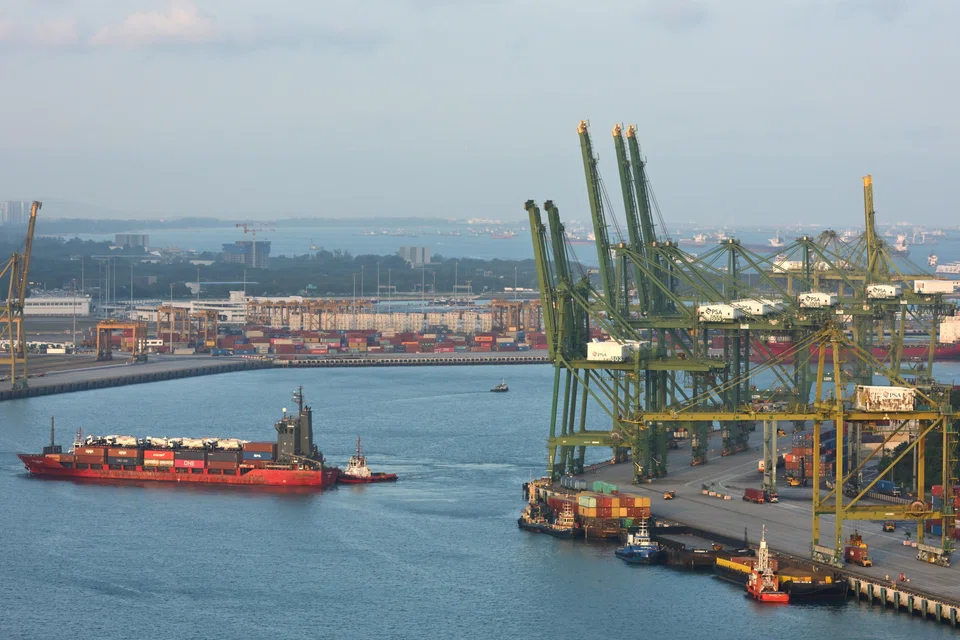
[SINGAPORE] The Ministry of Trade and Industry (MTI) filed two written submissions to the Office of the United States Trade Representative (USTR) on Wednesday (Apr 15), rejecting accusations that it tolerates forced labour in its supply chains and maintains excess industrial capacity in violation of fair trade norms.
The submissions – now publicly available on the USTR docket – address two probes launched by the trade agency in March: one into structural excess capacity and production in manufacturing sectors, covering 16 economies including Singapore; and a second into alleged failures by 60 economies to prohibit imports of goods made with forced labour.
In its submission on the overcapacity probe, MTI said the bilateral trade relationship between the two countries already favours the US.
The ministry cited Bureau of Economic Analysis data showing that Washington ran a goods surplus of US$1.9 billion and a services surplus of US$25.1 billion with Singapore in 2024.
Both of the surpluses grew further to US$3.6 billion and US$29.6 billion, respectively, in 2025.
MTI also pointed out that in two of the three specific sectors flagged in the USTR’s initiation notice – semiconductors and electrical equipment, and petrochemicals – the US ran trade surpluses with Singapore in 2024 of US$1.8 billion and US$463 million, respectively. Both of these figures increased in 2025.
The only sector where the US ran a deficit with Singapore was pharmaceuticals, where the gap narrowed from US$17.7 billion in 2024 to US$12.9 billion in 2025.
MTI added that Singapore has faced just one anti-dumping investigation from the US throughout the history of their trading relationship – for acetone in 2019 – as evidence that its industrial production is broadly aligned with market demand.
More broadly, the ministry argued that any trade surplus Singapore runs with other nations reflects “the market-driven outcomes of Singapore’s geography and open economy, rather than non-market-oriented government interventions”.
On industrial occupancy rates, the USTR alleged that Singapore’s state-owned industrial landlord was expanding capacity despite a recent drop in occupancy.
MTI said that manufacturing-specific occupancy has held at around 90 per cent over the past five years. It noted that this was in line with advanced economies, including the US, the United Kingdom, Sweden and Hong Kong.
Industrial property prices and rentals grew at compound annual rates of roughly 5 per cent over the same period, MTI said. These trends are not consistent with the presence of excess capacity in Singapore’s industrial property sector,” the ministry added.
MTI also drew direct comparisons between Singapore’s economic metrics and those of the US.
For instance, Singapore has a manufacturing capacity utilisation rate of 74.6 per cent, compared with the US’ 74.4 per cent; annual productivity growth of 2.7 per cent against the US’ 1.9 per cent in non-farm businesses; and similar rates of firm entry and exit.
“Not aware” of forced labour
In its submission on the forced-labour probe, MTI said that Singapore was “not aware of any goods produced with forced labour that have been exported to the US from Singapore”.
It cited two pieces of US government data to support this.
First, Singapore has not appeared on the US Department of Labor’s list of goods produced by child or forced labour in any edition since the report’s inception in 2009.
Second, there are no records of any Withhold Release Orders issued by US Customs and Border Protection (CPB) against Singapore shipments in the CBP’s database going back to 1958.
Furthermore, Singapore has cooperated with the US when there have been “specific and credible allegations related to forced labour in supply chains that potentially violate US laws”, said MTI.
For instance, in 2024, CPB cooperated with Singapore Customs under the US-Singapore Customs Mutual Assistance Agreement over a palm oil shipment that was allegedly linked to forced labour.
Singapore Customs investigated and confirmed that no such shipment had originated from Singapore.
“International cooperation is required to effectively mitigate this transnational issue,” said MTI, adding that import bans by individual countries alone will not stop goods from being produced by forced labour.
Instead, it may result in such goods being rerouted to other markets or ports, it noted.
The ministry said that there are, therefore, limitations as to how much Singapore can enforce against forced labour within its borders and with its own domestic regulation.
Effective enforcement, it pointed out, requires specific intelligence, third-party evidence and cooperation from the countries of origin, none of which Singapore can compel on its own.
In a separate submission on the forced-labour probe, the Singapore National Employers’ Federation (SNEF) said employers in the Republic are committed to ethical business practices and responsible employment practices.
Employers in Singapore comply with local labour legislation protecting workers, and also follow tripartite guidelines on responsible employment practices.
“Many Singapore employers with international operations have suppliers’ codes of conduct which specifically seek to eliminate forced labour,” SNEF added. “They will take appropriate actions should their suppliers fall short of (expectations).”
Yet, the association cautioned that forced labour in supply chains remains a complex issue, and that without harmonised universal standards, compliance with forced-labour import bans presents fundamental practical challenges for employers.
The USTR will hold public hearings on the overcapacity investigation starting May 5, with the forced-labour hearing scheduled for Apr 28.
Any tariffs imposed as a result of the Section 301 investigations are expected to be finalised before July 24, when the existing Section 122 surcharge expires.
Deputy Prime Minister and Minister for Trade and Industry Gan Kim Yong told Parliament earlier this month that Singapore would continue to engage the US constructively and would not speculate on the outcome of the investigations.
Decoding Asia newsletter: your guide to navigating Asia in a new global order. Sign up here to get Decoding Asia newsletter. Delivered to your inbox. Free.
Copyright SPH Media. All rights reserved.
TRENDING NOW

LTA proposes combining car COE categories, adding rebate-surcharge system
StarHub to acquire MyRepublic’s mobile business amid ongoing telco consolidation

DBS, OCBC, UOB rout lops billions off STI as inflation, rate concerns spook investors

Grab CEO’s wife Chloe Tong on life with Anthony Tan and finding her purpose

