Singapore to update restructuring and insolvency framework to better serve economy, businesses
Law minister Edwin Tong says judicial management has become a precursor to liquidation, adding time and costs

[SINGAPORE] Forty years after judicial management was introduced in Singapore, the process has not always fulfilled its purpose of rescuing beleaguered but viable businesses and preserving their value.
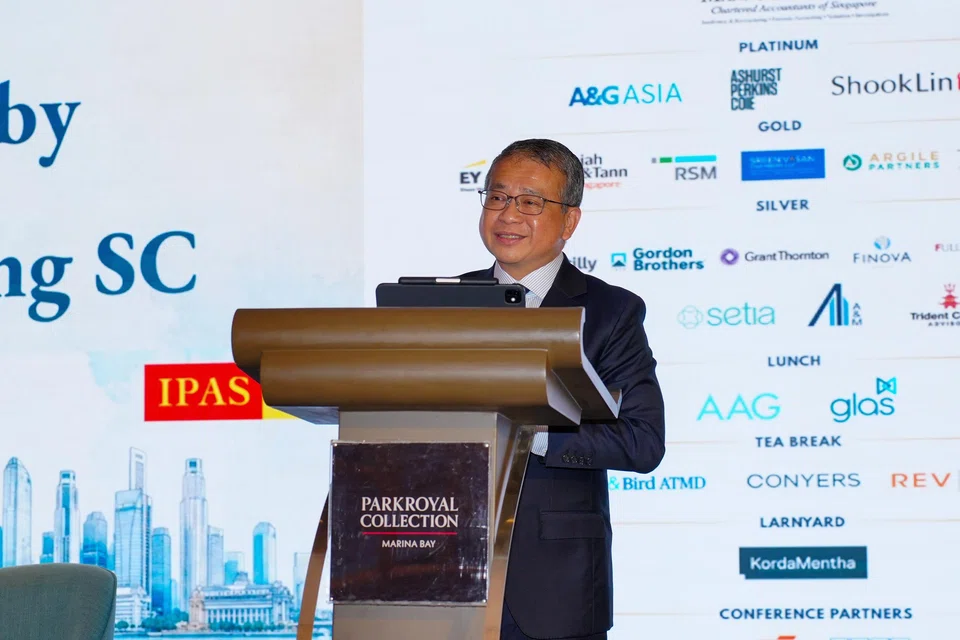
“Too often, it has become a precursor to liquidation, adding time and costs without necessarily achieving meaningful rehabilitation,” said Minister for Law Edwin Tong on Oct 21. “This is unacceptable,” he added, giving the keynote address at the Singapore Insolvency Conference organised by the Insolvency Practitioners Association of Singapore.
His ministry will amend the Insolvency, Restructuring and Dissolution Act 2018 (IRDA) to make it clear that judicial management is a rehabilitative process, with the first reading of the Bill in Parliament slated for later in 2026 or early 2027.
In May, the Ministry of Law broadly accepted reform recommendations made in 2025 by the Committee to Enhance Singapore’s Corporate Restructuring and Insolvency Regime, after a public consultation.
Tong stressed that premature liquidation can destroy value and that financial distress does not necessarily mean a business is no longer viable.
“The company may well have a very sound underlying business and good assets, but an unsustainable debt burden or temporary liquidity difficulties. And in such a situation, premature liquidation or prolonged administration can destroy them,” said Tong, who is also the second minister for home affairs.
“In a mature economy like Singapore’s, business cycles, ups and downs will be inevitable. They will be recurring, and industries will go through periods of growth and decline. We need a stronger restructuring framework to allow businesses to recover and to absorb the shocks of that ebb and flow.”
Under judicial management, control of a financially distressed company is temporarily placed under an independent, court-appointed judicial manager with the aim of keeping the company afloat, or to work out a debt restructuring plan. The company is protected against lawsuits by creditors during this period.
The business typically shifts to liquidation and winding up if the creditors reject the proposed rescue plan by the judicial manager.
SEE ALSO



As part of the amendments to the IRDA, applicants for judicial management must be able to explain how the process is expected to rehabilitate the company or its business, and the tangible benefits compared to winding up the company.
A company, its directors or a creditor can apply to the court for a judicial management order. Should judicial management fail to rehabilitate the company, and it proceeds to liquidation, the circumstances leading to this must be explained. The judicial manager will also typically not be allowed to transition into the company’s liquidator role.
“Not every rescue will succeed, even when there were good prospects at the outset for a successful restructuring,” Tong said. “But it is really about making sure that the judicial management is pursued for the right reasons, with clear objectives and, importantly, in this case, accountability for the outcomes that are sought.”
The second recommendation is to make cross-class cramdown to be more accessible and user-friendly. Cross-class cramdown allows the court to approve a restructuring or bankruptcy plan even if it is not accepted by the majority of the voting creditors or shareholders. Such plans are typically structured to ensure a better overall outcome for stakeholders compared to other alternatives.
In Singapore, a restructuring plan must be approved by at least one group of creditors who would be worse off or whose rights would be affected by the plan and who would receive some payment if the company were wound up. At least 75 per cent of the creditors in this group must vote to support the plan.
The plan must also be approved by a majority in terms of the number of creditors voting on the plan, and those voting in favour must hold at least 75 per cent of the total value of claims held by all creditors covered by the plan.
At the conference, Tong noted that the cross-class cramdown mechanism has seen limited use since its introduction in 2017.
In its report, the committee noted that the “overall numerosity and value cramdown conditions jointly constitute a high threshold, which deters the putting together of a plan that involves a cross-class cramdown”.
Tong said that voting thresholds will be refined under the reform, and cross-class cramdowns will be extended to shareholders in appropriate circumstances. This change is to reflect the economic reality that, where a company is insolvent, shareholders may no longer have any residual economic interest in the business, but may still be able to obstruct a viable restructuring.
He added that appropriate safeguards will remain important to ensure that affected stakeholders are treated fairly.
The third reform Tong mentioned was the adoption of two United Nations Commission on International Trade Law (UNCITRAL) model laws. A model law is a sort of blueprint law drafted by an international panel of experts that various countries can adapt and modify to suit their own legal systems.
The first is the model law on Enterprise Group Insolvency, which will facilitate coordination across insolvency proceedings involving different companies within the same group. The second model law on the Recognition and Enforcement of Insolvency-Related Judgments will facilitate recognition and enforcement of relevant judgments across borders, improving legal certainty and predictability.
These two additions will complement the existing adoption of the model law on cross-border insolvency in 2017. Once implemented, Singapore will be among the first jurisdictions in the world to adopt all three UNCITRAL Model Laws relating to insolvency.
Adopting these model laws will strengthen cross-border cooperation, as Singapore aims to be an international restructuring hub, added Tong.
There were over 90,000 foreign enterprises operating in Singapore in 2025, compared with 50,000 in 2015. The country’s asset management industry reached S$6.7 trillion in assets under management in 2025, with more than three-quarters of these assets from overseas.
Modern businesses increasingly operate as integrated international groups, but insolvency proceedings remain governed by national legal systems. This creates challenges for coordinating restructurings and preserving value across borders, noted Tong. THE STRAITS TIMES
Decoding Asia newsletter: your guide to navigating Asia in a new global order. Sign up here to get Decoding Asia newsletter. Delivered to your inbox. Free.
Copyright SPH Media. All rights reserved.