

Singapore welcomes competition for AI leadership; not a zero-sum game: Gan Kim Yong
Competition will further capability, create opportunities for cross-border partnerships

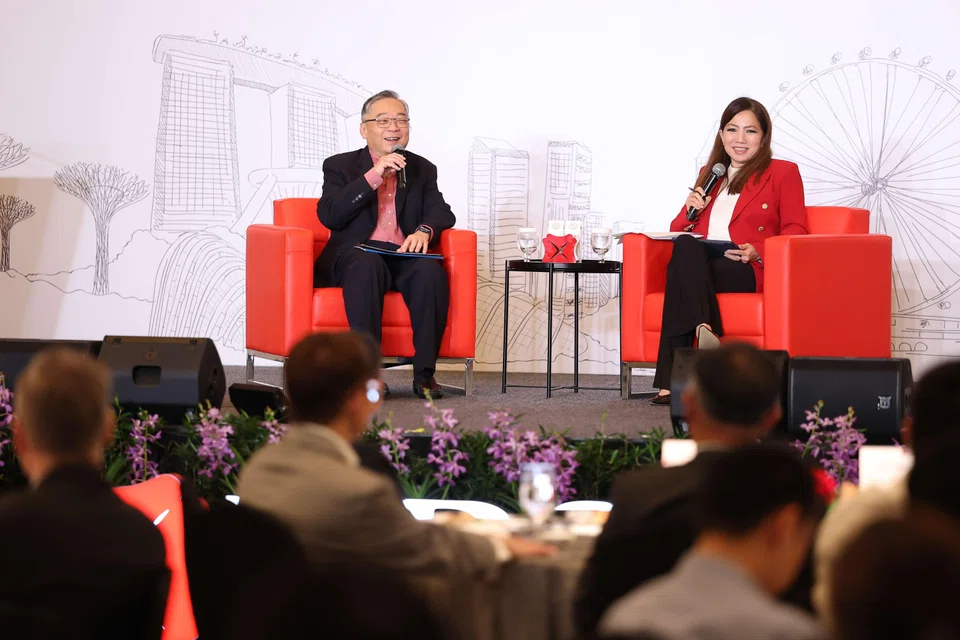
[SINGAPORE] The city-state is happy to work with any other country which wants to compete for artificial intelligence leadership “to make progress together”, Minister for Trade and Industry Gan Kim Yong said on Wednesday (May 20).
AI leadership is not a zero-sum game, and healthy competition can make both the country and its competitors better, he said during a dialogue session with DBS CEO Tan Su Shan.
Singapore will also need to be able to access global AI talent from other countries, added Gan, who is also deputy prime minister. In addition to having a small population, the city-state’s small size means that it would not be able to house the global talent it taps.
AI and technology allow opportunities for cross-border collaborations, he said.
Noting that Asean is already negotiating the Digital Economy Framework Agreement, he said: “The next step is to think about how (we can) cooperate among Asean members to develop AI systems jointly, to help each other, to leverage each other’s strength, to level up AI capability within Asean.”
Highlighting the government’s promotion of AI adoption nationally and the potential disruption to employment as AI agents replace people, Tan asked about the back-up plan for manual processing in the event of a system failure.
DPM Gan said that this is a question that has been asked about electricity and data disruptions before, or during the pandemic, and is not unique to AI.
Every institution, company or enterprise with critical systems must think about continuity and have a back-up plan, whether that is “going back to paper” or a back-up system that “kicks in instantaneously”, he said.
Tan also noted that DBS has “alternative pathways” for crucial customer journeys, such as payments, in case one fails.
SEE ALSO




But DPM Gan acknowledged that a balance must be struck for “sufficient resilience” that allows continued operations while being cost-efficient.
Tan and DPM Gan also spoke about workers in an age of AI. DPM Gan acknowledged a sense of anxiety within the workforce, which he said is “not unhealthy”, as it means that employees are aware of the shifting market.
They will need to change how they search for jobs, he said, adding that the government is working with institutes of higher learning and employers to introduce more robust internship and traineeship opportunities.
Other topics addressed during the dialogue include the urgency of AI adoption and Singapore’s appeal as an AI leader, due to its investment in the workforce, flexibility and trust premium built over decades.
Next steps
In her opening address, Tan noted Singapore’s role as a trusted hub for capital, and recognised its potential, with AI, to be a trusted hub for ideas, R&D, tech and talent.
“But this requires a paradigm shift,” she said. “Singapore’s traditional value proposition has been ‘we are trusted because we don’t make mistakes’.”
Operating amid accelerating change requires a shift to being trusted as the safest place to make mistakes, she noted – such as in test-bedding new products and helping companies expand into markets and move up the value and supply chain.
Earlier on Wednesday, DBS Group Research unveiled the Global AI Financial Hub Index, which benchmarks financial centres based on five pillars: integration; trust and governance infrastructure; digital financial infrastructure; talent and innovation; and AI-driven market outcomes.
This was part of a report which noted that financial hubs that can combine AI adoption with trusted governance, digital infrastructure and institutional credibility will have the advantage in the age of AI.
The inaugural index examined 15 major financial hubs globally, and identified New York, San Francisco and Singapore as the top three leaders overall.
It said regulatory coherence, digital identity infrastructure, institutional AI adoption, and international trust were Singapore’s strengths, adding that the findings support the Economic Strategy Review’s AI strategy.
In his keynote address, DPM Gan said Singapore’s ranking is a strong vote of confidence, but also a call to action.
He said that while deep markets, strong institutions and good infrastructure remain essential, financial centres will increasingly also be judged by whether they can harness AI responsibly, deploy it at scale, preserve trust, ensure security and nurture people skilled with technology.
Singapore’s next steps are to translate AI from experimentation into enterprise-wide adoption; ensure that AI creates good jobs and opportunities; and build trust, safety and security into the way AI is developed and used, Gan said.
Decoding Asia newsletter: your guide to navigating Asia in a new global order. Sign up here to get Decoding Asia newsletter. Delivered to your inbox. Free.
Copyright SPH Media. All rights reserved.
TRENDING NOW

Once staunchly pro-China, Malaysian Chinese businesses are now distancing themselves from Beijing

Looking beyond looming CEO succession, should UOB potentially pursue a transformative merger?

Could stablecoins be the future of money?

Grab CEO’s wife Chloe Tong on life with Anthony Tan and finding her purpose

