

Singapore’s AI transition need not pit workers against businesses, says Tan See Leng
MPs call for AI adoption to be linked to job redesign and worker outcomes; government vows no worker will be left behind

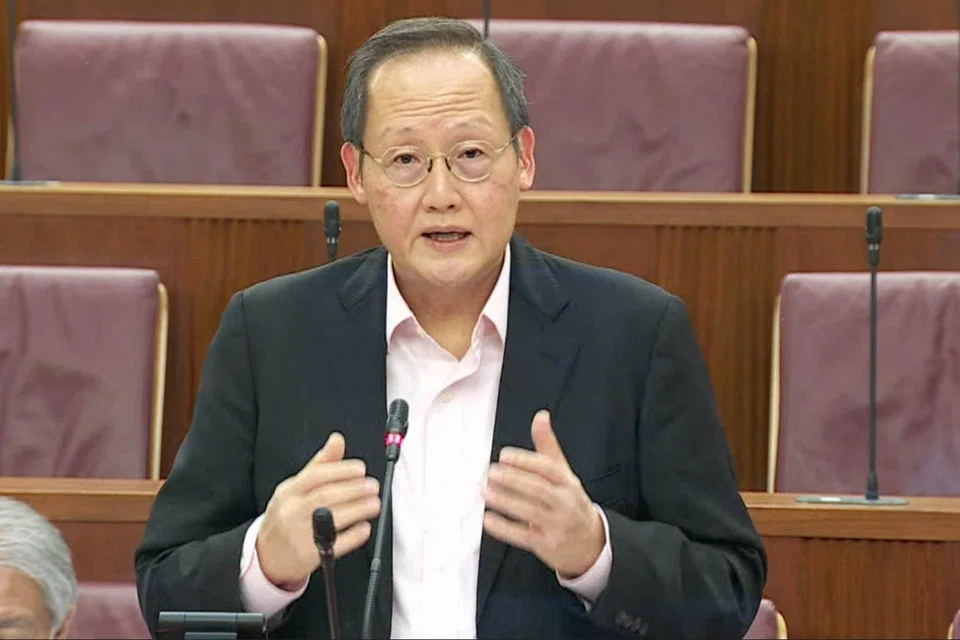
[SINGAPORE] Unlike in many other countries where artificial intelligence has become a source of conflict between workers and employers, Singapore can chart a different course, Manpower Minister Tan See Leng said in Parliament on Wednesday (May 6).
“In many countries, AI becomes a tug of war – workers on one end, businesses on the other. Progress contested, trust strained,” he said, wrapping up a debate on a motion by labour chief Ng Chee Meng, which called for an AI transition without “jobless growth” – in which an economy expands, but job creation lags.
“Singapore does not have to go down that road,” Tan added.
The motion calls on Parliament to recognise AI’s transformative potential while ensuring the transition is anchored in fairness, resilience and opportunity.
It passed on Wednesday evening after a nearly seven-and-a-half hour debate in which 24 MPs spoke.
Wrapping up the debate, Ng said: “I am therefore glad that through this motion, the government has affirmed that it will not leave outcomes to chance, but will shape the direction of AI growth deliberately.”
Unsettling changes
Dr Tan’s remarks came as MPs from both sides of the aisle called for an AI transition that brings workers along, and offered a range of suggestions on how the government and businesses could better facilitate this.
One recurring theme in the debate was the need to ensure that AI adoption by businesses translates into better jobs, rather than fewer of them.
Dr Tan said this concern was one the government took seriously.
SEE ALSO



“Change of this scale is genuinely unsettling,” he said. “AI will create opportunities that we cannot yet fully imagine. But it will also bring about disruptions that we cannot fully foresee.”
Even so, he pointed to early signs, both globally and at home, that offer reason for optimism.
Recent global surveys showed that two in three companies that made AI-driven cuts were already rehiring, having found that while AI could handle the predictable and the routine, customers still wanted human judgment, empathy and genuine connection, which the technology cannot provide.
Closer to home, a newly released Ministry of Manpower study found that only about 6 per cent of firms in Singapore that had adopted AI had reduced headcount as a result.
Several MPs nonetheless raised concerns that the benefits of AI were not being distributed equally.
People’s Action Party (PAP) MP Saktiandi Supaat warned that AI adoption was progressing at varying speeds across sectors, worker segments and businesses of different sizes.
Dr Tan shared the concern, warning that without deliberate effort, “the gains from AI could flow to some while others are left behind”.
But the government will not leave this to chance, he said, pointing to the newly formed Tripartite Jobs Council as a key mechanism to ensure AI adoption across the economy is fair and broadly shared.
AI adoption with job redesign
Several MPs called for AI adoption funding to be explicitly tied to job redesign, rather than allowing productivity gains to simply manifest as a shrinking headcount.
Labour MP Yeo Wan Ling proposed that AI grants be made conditional on mandatory job redesign requirements, with productivity gains linked to measurable worker outcomes.
She also called on the government to fund a systematic study and mapping of actual job roles and workflows, so that redesign efforts are built on “ground truth” rather than job descriptions on paper.
Workers’ Party Non-Constituency MP Andre Low proposed a retraining tax credit that would be available only to firms that can show that they have kept an existing worker in an AI-augmented role, rather than retrenching them.
Without such a conditional incentive, he argued, the tax code remains “silent at the fork”, and an unaided market would default towards retrenchment over retention.
Responding to Yeo, Minister of State for Digital Development and Information and Education Jasmin Lau – who also spoke during the debate – said the government is considering tying grants to job redesign and worker outcomes, but will discuss the specifics with tripartite partners.
Separately, PAP MP Vikram Nair raised a concern about the use of AI in employment decisions, warning that without proper safeguards, workers could find themselves assessed or even let go based on automated processes that are neither transparent nor accountable.
He asked whether Singapore should set clearer expectations around human oversight in AI-driven employment decisions, and whether workers should have the right to know when such systems are being used to assess them.
Formalising such principles, he said, could help to maintain trust between employers and workers as AI adoption accelerates.
Supporting businesses, too
On the enterprise side, Nominated MP Mark Lee put forward several proposals aimed at making the AI transition more accessible for businesses.
He called for more upfront support for larger or more complex AI projects, noting that firms should not be constrained by cash flow when making longer-term investments.
Lee, who is also vice-chairman of the Singapore Business Federation, proposed targeted flexibility for small and medium-sized enterprises to bring in specialised foreign AI expertise on a time-limited, application basis, with checks to prevent abuse.
The government can also fund the trade associations and chambers to act as coordinating platforms for sector-wide AI adoption, he said, and help reduce the duplication of effort that now happens when firms attempt to solve similar AI problems in isolation.
Decoding Asia newsletter: your guide to navigating Asia in a new global order. Sign up here to get Decoding Asia newsletter. Delivered to your inbox. Free.
Copyright SPH Media. All rights reserved.
TRENDING NOW

LTA proposes combining car COE categories, adding rebate-surcharge system

StarHub to acquire MyRepublic’s mobile business amid ongoing telco consolidation

DBS, OCBC, UOB rout lops billions off STI as inflation, rate concerns spook investors

Grab CEO’s wife Chloe Tong on life with Anthony Tan and finding her purpose

