Singapore’s 2025 investment pledges rise 5.3% to S$14.2 billion; related job creation dips 16%
Over a third of fixed asset investment is in electronics; total 2025 commitments expected to create 15,700 jobs over 5 years

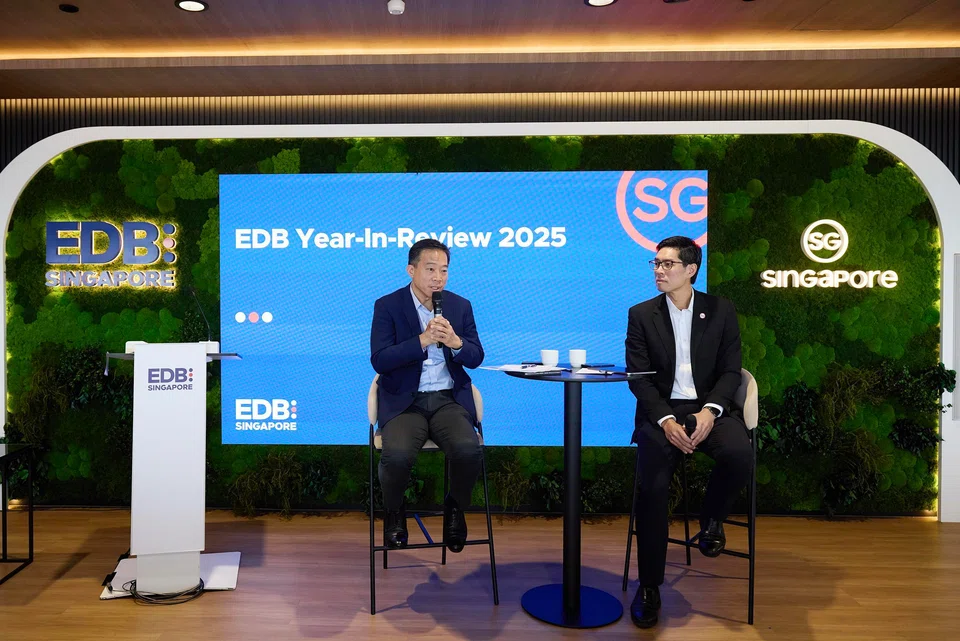
[SINGAPORE] The Republic anchored some S$14.2 billion in fixed asset investment (FAI) commitments in 2025, more than a third of which were in electronics, the Economic Development Board (EDB) said in its annual year-in-review.
This was 5.3 per cent higher than the S$13.5 billion secured in 2024. FAI refers to a company’s incremental capital investment in facilities, equipment and machinery.
Total business expenditure commitments rose 6 per cent to S$8.9 billion, from S$8.4 billion in 2024, with the majority coming from investments in headquarters, professional services, and research and development (R&D).
Yet the investment commitments are expected to contribute just S$18 billion in value-added per annum, down 23 per cent from S$23.5 billion in 2024.
Job creation is also expected to fall. EDB said the commitments are expected to create 15,700 jobs when realised over the next five years, down 16 per cent from 18,700 in 2024.
The jobs are expected to come from services (40 per cent), manufacturing (37 per cent), and R&D and innovation (23 per cent).
The majority of these will be jobs for professionals, managers, executives and technicians, said EDB managing director Jermaine Loy at a media briefing last week ahead of the release of the data on Monday (Feb 9).
Over two-thirds of the jobs created from the investments secured are expected to fetch a gross monthly salary of above S$5,000, said the statutory board’s chairman Png Cheong Boon.
“Given the uncertain environment, companies were naturally more conservative in their projections,” said Loy, explaining the dip in jobs created.

There are also structural shifts at play, he added, given higher automation and digitalisation across industries.
“But the jobs expected to be created are good, high-value jobs that will offer meaningful career pathways for Singaporeans,” he said.
Looking ahead, EDB said it expects continued intense global competition for investments, with climate risks and technological advancements further disrupting industries. These structural shifts mean that job creation will become more challenging.
EDB said it will focus on several areas – strengthening Singapore’s leadership in growth sectors; pursuing emerging opportunities to create new growth engines; anchoring and growing a new generation of leading enterprises with a global footprint; and developing Singaporeans to capture opportunities in the evolving economy.
AI-fuelled demand
Electronics accounted for 33 per cent of FAI commitments, followed by biomedical manufacturing at 30.8 per cent and chemicals at 9.1 per cent.
This is the second consecutive year in which the electronics sector contributed the greatest share of FAI. In 2024, investments from the electronics sector accounted for 57 per cent of FAI.
A significant part of the electronics FAI over the past two years has been driven by continued investments in semiconductors, supported by strong demand from artificial intelligence (AI) and digitalisation, said Loy. This demand flows across the value chain – from chip manufacturing to equipment and supporting activities.
Asked if this trend is expected to continue, Loy pointed out that Singapore is “well poised” to ride the growth in semiconductors, which is being bolstered by demand from these areas.
He noted that the global semiconductor market is widely expected to reach US$1 trillion by 2030 on the back of rapid advancements in these two areas.
“EDB will support our companies and Singaporeans to tap these opportunities,” he said.
Chinese investments
Investments from China increased sharply in 2025, and last year marked the first time that FAI from China exceeded that of the United States.
China accounted for 20.6 per cent of FAI commitments in 2025, up from just 2.5 per cent in 2024. In contrast, the US accounted for 17.3 per cent of FAI commitments, from 55.5 per cent in the previous year.
The increase was even more pronounced for total business expenditure, where China’s share jumped to 50.7 per cent in 2025 from 15 per cent the previous year.
China is also expected to contribute 57.1 per cent of the value-added generated from 2025’s investment commitments, up significantly from 12.6 per cent in 2024.
Asked about the greater interest from Chinese companies in Singapore, Png said many Chinese companies are seeking to expand internationally in response to slower growth domestically.
He noted that, over the last few years, China-headquartered companies from a range of sectors have expanded their footprint here.
These include consumer brands such as Haid Group and Kuka Home; e-commerce and games firms such as Bytedance and Mihoyo; clean energy company Envision Energy; pharmaceutical firm Wuxi; and robotics player Hai Robotics.
“We are glad that companies all over the world have found Singapore a suitable launchpad from which to seek new growth markets, and to bring their technologies and solutions to the global stage,” said Png.
“This is testament to Singapore’s strengths as a global business hub,” he said, adding that Singapore has a “good track record” of hosting multinationals from other major economies such as the US, Europe, Japan, India and countries in South-east Asia.
“We continue to look towards the US and Europe to be key sources of investment commitments in terms of stock and flow,” said Png.
Decoding Asia newsletter: your guide to navigating Asia in a new global order. Sign up here to get Decoding Asia newsletter. Delivered to your inbox. Free.
Copyright SPH Media. All rights reserved.