

Singapore’s manufacturing output beats forecasts in March, but chemicals decline signals emerging Iran war risk
Strong factory growth points to an upward revision of Q1 GDP growth to around 5.2%, economists say

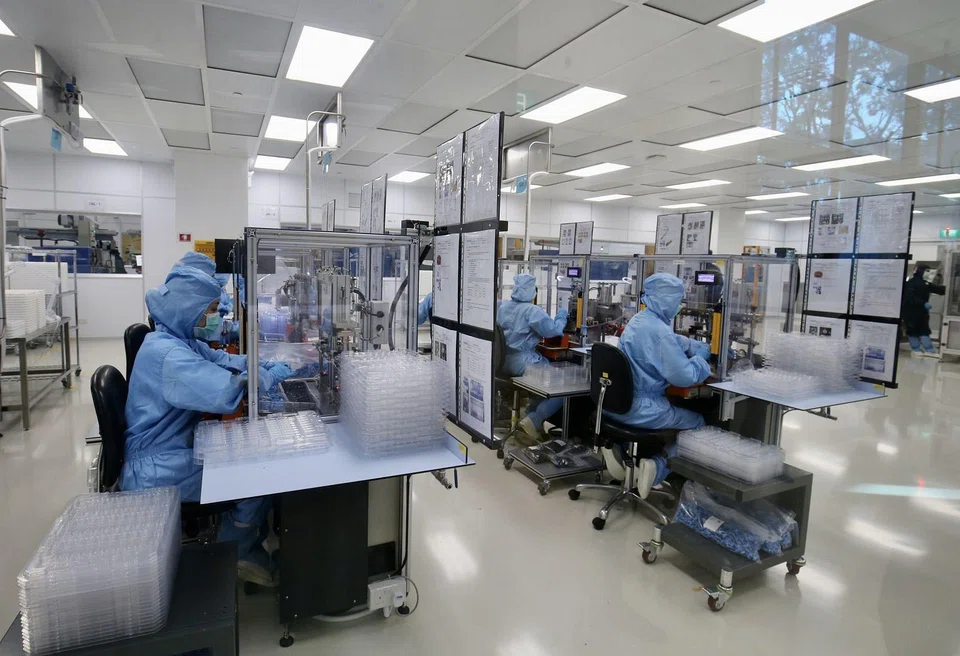
[SINGAPORE] Singapore’s manufacturing output surged 10.1 per cent year on year in March 2026, beating forecasts and accelerating from 3.3 per cent growth the month prior, data from the Singapore Economic Development Board (EDB) showed on Monday (Apr 27).
Private-sector economists polled by Bloomberg had forecast growth of 6 per cent.
On a seasonally adjusted month-on-month basis, factory output climbed 4.7 per cent, also exceeding the consensus forecast of 2.7 per cent and reversing from the 1.2 per cent decline in February.
Excluding biomedical manufacturing, output rose 13.5 per cent year on year and 3.5 per cent month on month.
The strong March print lifted first-quarter 2026 manufacturing growth to 7.9 per cent year on year, well above the Ministry of Trade and Industry’s (MTI) advance estimate of 5 per cent.
Economists said that this would likely prompt an upward revision to Q1 gross domestic product growth from the advance estimate of 4.6 per cent.
UOB associate economist Jester Koh said that, assuming construction and services activity remained unchanged from the advance estimate, the revision would bring Q1 GDP growth to around 5.2 per cent year on year.
OCBC chief economist Selena Ling noted that while Q1 manufacturing growth of 7.9 per cent remained robust, it was still a moderation from the 11.4 per cent seen in Q4 2025.
She maintained a full-year manufacturing growth forecast of around 3 per cent, or possibly higher depending on the sustainability of the artificial intelligence boom.
SEE ALSO



War risks to chemicals
Not all sectors fared well, however. The chemicals cluster contracted sharply amid feedstock supply disruptions linked to the Middle East conflict and shipping constraints in the Strait of Hormuz.
DBS economist Chua Han Teng noted that the cluster’s 16 per cent year-on-year contraction in March was its steepest decline since the 2008 global financial crisis.
Within the cluster, petroleum output fell 20.2 per cent year on year and petrochemicals declined 35.2 per cent.
Standard Chartered chief economist for Asean and South Asia Edward Lee said that on a month-on-month seasonally adjusted basis, petroleum dropped 13.4 per cent and petrochemicals plunged 23.9 per cent. He noted that these were among the steepest monthly falls since 2000, particularly for petrochemicals.
EDB cited disruptions in feedstock supply as the primary cause for the declines.
UOB’s Koh pointed to the sustained blockage of cargo ship passage through the Strait of Hormuz and damaged infrastructure weighing on supply. He noted that Asian refineries and petrochemical firms have been cutting production runs, with some declaring force majeure.
OCBC’s Ling added that Singapore’s petrochemical sector was facing significant disruption following a wave of force majeure declarations, citing Petrochemical Corporation of Singapore, Aster Chemicals and Energy, The Polyolefin Company and Sumitomo Chemical Asia among those affected.
Even refiners switching to alternative barrels may not be running optimally, she noted.
Standard Chartered’s Lee said the cluster would continue to face pressure with the Strait of Hormuz effectively closed, and flagged the broader risk that the supply disruption could eventually spread to other parts of the manufacturing sector.
He added that petrochemical production would remain curtailed by continued shortages of naphtha input, with significant uncertainty surrounding both the resolution of the Middle East conflict and the recovery of critical energy shipments through the strait.
Electronics surge
On the other hand, the electronics cluster was a standout performer, surging 30 per cent year on year in March – its fastest expansion since late 2024.
The cluster’s performance was driven by the infocomms and consumer electronics segment, which jumped 72.1 per cent, and semiconductors, which rose 30.6 per cent.
On a month-on-month basis, electronics output climbed 5.7 per cent.
EDB attributed the gains to robust AI-related demand, a theme that has underpinned Singapore’s manufacturing outperformance in recent quarters.
DBS’ Chua said that electronics growth in March was supported by external demand for Singapore’s memory chips and server products.
He added that electronics manufacturing momentum would likely remain resilient in the near term. Still, he cautioned that the global AI and electronics cycle was not fully insulated from Middle East-related disruptions, given its reliance on helium – of which Qatar is a major global supplier.
Maybank economists Chua Hak Bin and Brian Lee said that electronics demand would continue to outperform.
They added that this would help to offset the war’s drag on the chemicals segment, as demand for semiconductors and other electronic components accelerated amid the rising prevalence of autonomous AI agents fuelling appetite for computing capacity.
Cluster performance
Standard Chartered’s Lee noted that precision engineering was also benefiting as a derivative of electronics demand.
Precision engineering’s 14 per cent year-on-year growth was supported by the higher output of optical instruments and metal precision components, as well as stronger production of semiconductor equipment in the machinery and systems segment.
General manufacturing expanded 7.6 per cent year on year, led by structural metal products, ready-mix concrete, beverage concentrates and animal feeds.
Transport engineering grew 2 per cent year on year. The aerospace segment expanded 8.8 per cent, buoyed by aircraft parts production and sustained maintenance, repair and overhaul activity from commercial airlines.
On the other hand, the marine and offshore engineering segment contracted 13.4 per cent year on year, on the back of lower production of oil-field and gas-field equipment.
Biomedical manufacturing declined 14.3 per cent year on year. Weakness in both pharmaceuticals, down 17.9 per cent, and medical technology, down 12.9 per cent, reflected softer demand and a different production mix of active pharmaceutical ingredients.
Decoding Asia newsletter: your guide to navigating Asia in a new global order. Sign up here to get Decoding Asia newsletter. Delivered to your inbox. Free.
Copyright SPH Media. All rights reserved.
TRENDING NOW

DBS, OCBC, UOB rout lops billions off STI as inflation, rate concerns spook investors

Grab CEO’s wife Chloe Tong on life with Anthony Tan and finding her purpose

OCBC sheds S$8 billion in value as shares close nearly 6% down; analysts cautious on banks

Deal between tycoon friends sparks scrutiny of Philippine power sector

