Singapore’s public-private partnership model must evolve as other countries ‘roll out red carpet’ for investments: panellists
This playbook may no longer be sufficient, especially in strategically critical areas such as semiconductors

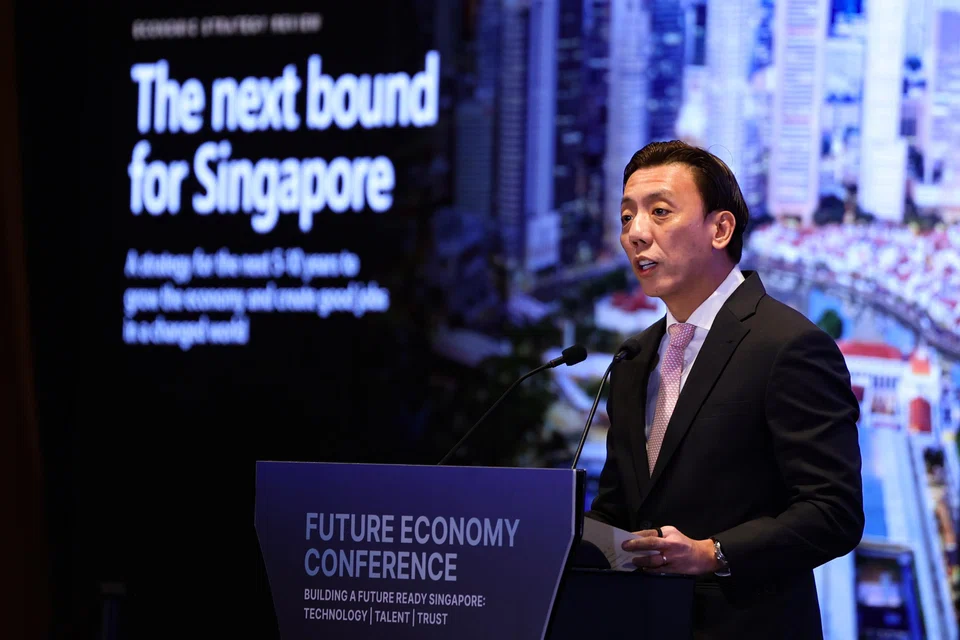
[SINGAPORE] The Republic’s tried-and-tested model of public-private partnerships needs to be rethought and elevated, as governments around the world compete aggressively to attract investments, business leaders said at a dialogue on Wednesday (May 13).
While Singapore’s model of joint risk-taking and shared rewards between government and corporates has worked well historically, this playbook may no longer be sufficient, especially in strategically critical and fiercely contested industries such as semiconductors, said Brian Tan, regional president for South-east Asia at Applied Materials.
“In an industry as competitive and high-profile as semiconductors, where every geographical region is rolling out the red carpet, the previous playbook of investing and hoping may not be enough,” he said.
“Trust takes many years and many engagements to build and, in today’s world, it can also be extremely fragile.”
The panellists were speaking at the Singapore Business Federation’s (SBF) annual Future Economy Conference, where the Economic Strategic Review (ESR) committees unveiled their final 32 recommendations to boost economic resilience.
The proposals fall across eight focus areas, of which one is new: building economic resilience, including energy and supply chain resilience.
The rest builds upon the ESR’s mid-term update in January, which called for Singapore to invest in emerging areas, become an artificial intelligence solutions hub, and broaden the range of good jobs, among others.
In his speech revealing the proposals, Acting Minister for Transport Jeffrey Siow said the recommendations were not conceived by the government alone, but with the involvement of business leaders, unions and workers.
Some of the leaders, he added, are members of “a new generation of Singaporean business leaders who know first-hand how the world is evolving, and who are making decisions on the front line”.
SEE ALSO





In a statement, SBF said it supports the ESR’s focus on new growth areas, enterprise transformation and workforce adaptation.
“Implementation will now be key,” said the apex business chamber. “Businesses will be looking for clear priorities, practical support and strong execution on the ground.”
Its CEO Kok Ping Soon added: “Businesses need confidence that Singapore will remain cost-competitive, open and globally connected...
“They also need transformation support that is easier to access, better coordinated and backed by a stronger ‘Singapore Inc’ approach...
“If we get the follow-through right, Singapore can strengthen its resilience, help more local enterprises scale, and remain a trusted, competitive hub for growth.”
Big bets
Siow, who co-chaired the ESR committee on global competitiveness, said Singapore must make “bigger and bolder bets” while safeguarding the trust that underpins its public-private partnerships.
“Singapore didn’t necessarily have the right to win in those industries, but we wanted to win the right to play, and from there to build the strength to stand out,” he said.
He added that such bets would extend beyond identifying priority sectors. Over time, the government will continue to scan the horizon for emerging industries, investing in and growing them through a concerted, whole-of-ecosystem effort.
“We want to anchor younger, higher-potential companies that are emerging from other parts of the world, companies looking for a place that is stable, that has copious amounts of talent and capital,” he said.
“Singapore offers a very strong value proposition for these companies.”
New frontiers
On where Singapore should place its next big bets, Granite Asia senior managing partner Jenny Lee pointed to “physical AI” and “embodied AI” as opportunities the Republic is uniquely positioned to capture.
Unlike large language models, which have largely been developed and dominated by firms in the US, the next wave of AI growth would move beyond text and language into the physical world – into factories, ports and airports, said Lee.
This convergence of language models with hardware, she added, was what defined the emerging field of physical AI.
“There is no single dominant hardware platform for physical AI today,” she said. “Singapore is uniquely positioned to orchestrate language models with hardware testing for real-world use cases...
“If we can plant a flag here, I believe we can leverage our existing industrial base to attract an entire ecosystem.”
Lee also flagged AI for science as a significant adjacent opportunity. Unlike language AI, which draws on vast amounts of text data, scientific AI requires data generated from chemistry, biology and pharmacology – data that is currently unstructured, scattered across laboratories, and difficult to train models on.
“Whoever can develop a structured approach to capturing that data – through automation, AI and robotics – can anchor a new generation of science-driven companies,” she said.
Underpinning both opportunities, Lee added, was the need to build robust data infrastructure – the trusted frameworks, governance structures and intellectual property protections that would allow data to be shared securely across stakeholders.
“All of this is going to run on data – trusted data, shared in a trusted manner,” she said. “There is a white space here, and we need to approach it as a system.”
Decoding Asia newsletter: your guide to navigating Asia in a new global order. Sign up here to get Decoding Asia newsletter. Delivered to your inbox. Free.
Copyright SPH Media. All rights reserved.