Economic Strategy Review: Taking ‘bold bets’, building energy resilience among final recommendations
Of 32 proposals to the Singapore government, the newest are related to energy and supply chain resilience

[SINGAPORE] Attracting cutting-edge investments and tackling supply chain risks in key industries are on a list of 32 final recommendations by the Economic Strategy Review (ESR) committees, which were announced on Wednesday (May 13).
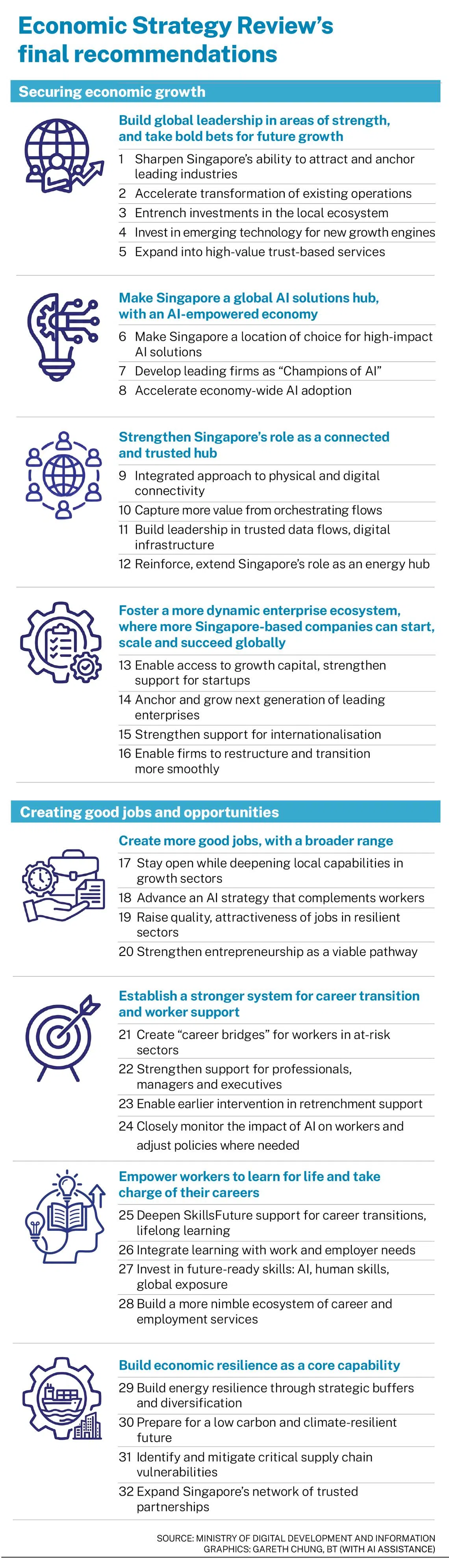
These fall across eight focus areas, of which one is new: building economic resilience, including energy and supply chain resilience.
The rest build upon the ESR’s midterm update in January, with similar calls for Singapore to invest in emerging areas, become an artificial intelligence solutions hub, and broaden the range of good jobs, among others.
Some recommendations are not just about growth, but agility: enabling companies to restructure, pivot or even exit, and helping workers transition into different roles.
The conditions that shaped Singapore’s success have shifted, said Deputy Prime Minister and Minister for Trade and Industry Gan Kim Yong on Wednesday.
He cited rising geopolitical tensions, rapid technological progress, climate concerns and the changing nature of work.
'%3e%3cpath%20d='M12.1475%2025.5262C13.7713%2025.4295%2014.94%2023.913%2014.94%2021.8832C14.94%2019.5359%2013.474%2018.093%2011.5917%2018.093C11.3745%2018.093%2010.9582%2018.093%2010.8393%2018.1413V25.2086L11.8891%2025.5745C11.8891%2025.5745%2012.207%2025.5262%2012.1475%2025.5262ZM11.4934%2017.6281C13.2567%2017.6281%2014.3843%2016.4292%2014.3843%2014.4501C14.3843%2012.372%2013.275%2011.2973%2011.4339%2011.2973H10.8393V17.6305H11.4934V17.6281ZM6.66078%2025.6482L7.39265%2025.5492C8.02617%2025.4502%208.26403%2025.3053%208.26403%2025.1097V11.6149C8.26403%2011.4193%208.1451%2011.3709%207.23484%2011.249L6.68137%2011.173L6.6219%2010.7588H11.9508C15.7153%2010.7588%2017.0624%2012.0797%2017.0624%2014.1578C17.0624%2015.9666%2015.7748%2017.1909%2013.4969%2017.6305V17.7041C16.111%2017.948%2017.6571%2019.5382%2017.6571%2021.7636C17.6571%2024.3318%2015.8937%2026.0417%2012.1109%2026.0417H6.60132L6.66078%2025.6482Z'%20fill='%232B2B2B'/%3e%3cpath%20d='M20.6287%2025.6505L21.5596%2025.5515C22.1725%2025.4779%2022.4104%2025.3076%2022.4104%2025.112V11.249H21.9346C20.073%2011.3479%2018.982%2013.0095%2018.408%2014.6227L18.1907%2015.5018H17.6555L18.1701%2010.7588H29.3837L29.6421%2015.4787H29.1664L28.9491%2014.6227C28.3728%2012.8645%2027.3047%2011.2743%2025.5002%2011.249H24.9856V25.1856C24.9856%2025.3812%2025.1251%2025.4548%2025.9965%2025.5515L26.7695%2025.6505L26.829%2026.0417H20.5693L20.6287%2025.6505Z'%20fill='%232B2B2B'/%3e%3c/g%3e%3cdefs%3e%3cclipPath%20id='clip0_5242_21648'%3e%3crect%20width='24'%20height='16.8'%20fill='white'%20transform='translate(6%2010)'/%3e%3c/clipPath%3e%3c/defs%3e%3c/svg%3e)
These are not passing headwinds but structural shifts, he added in his keynote speech at the Future Economy Conference organised by the Singapore Business Federation (SBF).
“The developments of the past year have reaffirmed and reinforced this new reality.”
DPM Gan noted that the energy crisis has shown how disruptions can cascade through the global economy, affecting energy markets, shipping routes, production costs, inflation and business confidence.
SEE ALSO



“This is why the ESR matters,” he said, adding that it is not just a response to immediate challenges, but about how Singapore positions itself for the longer term.
The ESR identified three “strategic imperatives” in the executive summary of its final report.
First, the Republic must sharpen its value proposition, focusing on where it creates the most value and has “hard-to-replicate advantages”.
Second, its institutions, firms and workers must become more agile and adaptable.
Third, the country must “build resilience alongside efficiency”.
These three imperatives inform the eight focus areas of the ESR. Four are about securing economic growth; three are about creating good jobs; and the last is about resilience.
“Bold bets” for growth
The first thrust is to “build global leadership in areas of strength, and take bold bets for future growth”, even if “not every investment will succeed”.
Singapore should refresh its approach to securing investments, to attract cutting-edge activities and capabilities, said the report.
Citing Singapore’s key role in the semiconductor value chain, the report added: “We should aim to build similar positions of global leadership in other industries.”
Companies with operations here should be helped to transform. Investments should be embedded firmly through tie-ups with public research institutions, local supplier networks and talent.
Singapore must also invest early in emerging technologies, and expand into “high-value trust-based services” such as cybersecurity.
Said DPM Gan: “To be clear, not every bet will succeed. But if we only choose traditionally safe options, we will not break new ground or grow new industries.”
Second, Singapore should become a leader in AI solutions and have an AI-empowered economy. Instead of competing to build frontier models or host data centres, Singapore should position itself as a trusted hub where AI solutions are developed, tested and deployed.
This involves working with industry to develop problem statements, and attracting AI companies to address these.
Third, the government should strengthen Singapore’s role as a connected and trusted hub.
This includes integrating physical and digital connectivity in the country’s sea and air hubs, but also capturing value even when physical goods do not pass through Singapore – through activities such as supply chain management and global procurement.
Fourth, Singapore should foster a more dynamic enterprise ecosystem.
This includes looking at “new investment and partnership tools” to attract high-potential enterprises, such as funnelling demand from large corporates or the public sector to them.
But it also includes helping firms restructure and transition. Government support should “go beyond helping businesses grow”, said the report.
It should also help companies “assess their position early” and transition accordingly, whether through restructuring, offshoring, or pursuing for mergers and acquisitions.
Regulations should be reviewed to reduce friction in such transitions, said the report, citing the example of land reinstatement costs when industrial land is vacated.
The Singapore National Employers Federation said it supports this recommendation, adding: “We must recognise that as businesses transform, some restructuring is unavoidable and we fully support efforts to help both employers and workers navigate this transition.”
Adaptability and resilience
The fifth to seventh focus areas deal with jobs: creating more good jobs with a broader range; building a stronger system for career setbacks and transitions; and empowering workers for lifelong learning.
The eighth and last thrust is to build economic resilience as a core capability. This includes improving energy security by building buffers and diversifying import sources.
Singapore should “balance decarbonisation with energy security”, noted the report. Without technological breakthroughs, the country should “be realistic about the pace of emissions reduction in the near term” even as it makes climate investments in the longer term.
On the supply chain front, the report indicated: “In a more fragmented global environment, we must reassess dependencies that were previously considered acceptable.”
It suggested that the government should work with key industries to identify and mitigate their supply chain risks, perhaps even through stockpiling.
Formed in August 2025, the ESR committees held over 80 engagements with more than 7,700 people across various sectors. While the executive summary of the final report has been released, the full report will only be available at a later date.
In a media statement, the SBF said it supports the ESR’s focus on new growth areas, transformation and workforce adaptation.
In implementing the recommendations, it added, four areas are critical: preserving cost-competitiveness; making it easier for firms to access support for transformation; taking a “Singapore Inc” approach to strengthen the local enterprise ecosystem; and staying open to foreign manpower.
“SBF stands ready to work with the government, unions and industry partners to turn the ESR’s recommendations into concrete action for businesses and workers,” the business chamber said.
Decoding Asia newsletter: your guide to navigating Asia in a new global order. Sign up here to get Decoding Asia newsletter. Delivered to your inbox. Free.
Copyright SPH Media. All rights reserved.