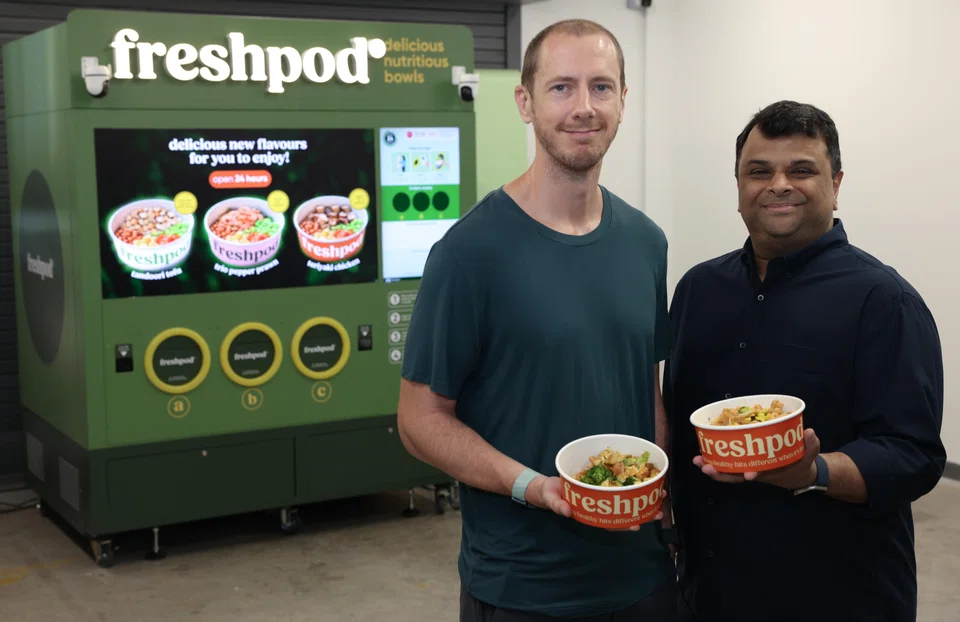
A broken F&B model and Hit Refresh’s bid to reset it with freshpod kiosks
Through this initiative, the startup is rethinking how meals are prepared and served

[SINGAPORE] After investing in various F&B outlets in Malaysia, former investment banker Stephen Dunstan came to a stark conclusion: The industry’s economics no longer worked.
He realised that most establishments were busy only during peak meal periods, with fairly little activity for the rest of the day. And yet, operators still had to bear fixed costs such as rental and manpower, even as demand remained highly variable.
“If you could (fully) utilise the space for 12 or 16 hours a day, then it makes sense,” said Dunstan, a Singapore permanent resident from Malaysia.
This mismatch between fixed costs and uneven demand has left many operators struggling – a trend reflected in government data.
In 2025, the sector recorded a decade-high 4,103 business openings, but closures were also elevated at 3,074 – a 10-year high.
It was revealed in Parliament last year that 63 per cent of retail food establishments that closed between Jan 1 and Oct 23, 2025, had been registered for five years or less, and 82 per cent of these had never recorded a profit in their annual tax declarations.
The government’s latest quarterly labour market report, released in March, showed the sector also posted the highest resignation rate at 2.2 per cent and recruitment rate at 2.9 per cent in 2025, underscoring its revolving-door workforce.
For Dunstan, these trends reinforced his view that the problem was structural rather than cyclical. That realisation led him to reconnect with Joseph Ryan, an ex-colleague and a former F&B operator.
Together, they co-founded Singapore-based engineering startup Hit Refresh in 2021 to address what they saw as fundamental inefficiencies in the traditional model.
Not a vending machine
Over the next few years, the pair worked with a small team of engineers to develop an unmanned, fully autonomous kiosk that assembles food on-site. They rolled it out in 2024 under the brand freshpod.
The first kiosk debuted at Science Park and there are now kiosks at many locations islandwide including Grab’s headquarters at one-north, Gleneagles Hospital, the Singapore National Eye Centre, National Heart Centre and NCS Hub.
The co-founders stressed that freshpod is “not a vending machine” as it assembles customisable chilled food bowls from fresh ingredients – such as fusilli pasta, honey soya tofu and Cajun baked salmon – in a fully enclosed unit without human handling or shared utensils.
“No one globally does customisation. They do presets, pre-processed, pre-packaged,” said Ryan, a permanent resident from the UK.
In contrast, Dunstan said freshpod’s customers get to choose and pay for exactly what they want.
The system can serve up to three customers at a time, takes only about a minute per order, and provides calorie information for each meal. It costs between S$8 and S$12.
It also uses artificial intelligence to track consumption patterns and forecast demand, allowing the team to tailor each location’s inventory.
The customers who frequent the kiosk at Grab, for instance, tend to favour fish, prawns and salmon. Those at Gleneagles, meanwhile, lean towards lighter options such as tempeh or tofu.
This data – complemented by on-the-ground feedback from customers – helps the team reduce food wastage while ensuring sufficient supply during peak periods.
“AI tells you what’s going on, but you still need humans to understand why it’s happening,” said Ryan.
Consistency and cost advantage
Ryan said automation improves consistency by reducing variability in both service and product, while enabling round-the-clock operations.
He noted that in traditional F&B settings, even simple elements such as portion sizes can vary.
In salad or burrito outlets, for instance, how much avocado a customer receives often depends on the staff serving them even though they are paying the same price.
“Where there is human intervention, there is always potential for error, whether accidental or emotional,” he said.
Dunstan added that most kitchen automation today handles only single tasks – such as slicing or frying – and still depends on human labour for the rest of the workflow.
Conversely, freshpod automates the entire assembly process end to end, removing repetitive tasks such as scooping and portioning.
More importantly, the model addresses the sector’s core challenges: high operating costs and chronic manpower shortages.
The unmanned system significantly reduces labour needs, while its compact footprint removes the need for a traditional shopfront – avoiding major renovation costs, long fit-out periods and high rents.
While this may appear unfavourable to landlords, Ryan said the opposite has been true, with the company approached for every location it operates in.
In some cases, buildings lack viable operators for healthier food options due to cost constraints. In others, landlords are seeking round-the-clock offerings or ways to offset declining footfall amid hybrid work.
Ryan said their model breaks this cycle with a low-footprint kiosk that is quick to deploy and relatively low-friction to operate.
While the duo declined to disclose the cost of building each system, Dunstan said freshpod’s cost structure is roughly half that of a traditional F&B outlet, with savings passed on to customers through more affordable meals.
Not replacing dining
The founders stressed that automation is not about replacing workers, but filling a gap that already exists.
“People don’t aspire to be waiters. They don’t aspire to clean tables,” said Ryan. “If the industry was flourishing and it was an attractive career for people to go into, there wouldn’t be as much of a necessity for what we’re doing.”
Nor is the model meant to replace the broader dining experience.
“Being served by a waiter, getting food recommendations, that category will always be there because people pay a premium for that,” said Dunstan. “Freshpod is fast, casual, quick food; lunchtime food.”
Looking ahead, they see freshpod as the first step towards a broader push into food automation.
Dunstan said the company plans to expand beyond kiosks into areas such as back-of-house operations, central kitchens and hybrid restaurant formats.
Over time, the group may scale locally, franchise overseas and explore other formats – including hot food concepts – where processes can be standardised.
For now, the focus is on validating the freshpod concept across multiple environments, using a local test bed spanning hospitals, offices and schools to support its overseas expansion.
“Look at where we fit in… The (F&B) model is broken. So automation, in our context, is now a necessity. The margins are no longer compatible,” said Ryan.