
SGSME logo

From a cafe in Telok Ayer to 12 F&B outlets in Bangkok, Sarnies banks on Thailand for growth

The group’s strategy involves leasing entire multi-storey shophouses to house a variety of concepts under one roof

Summarise
Paige Lim
Published Wed, Jul 15, 2026 · 11:00 AM
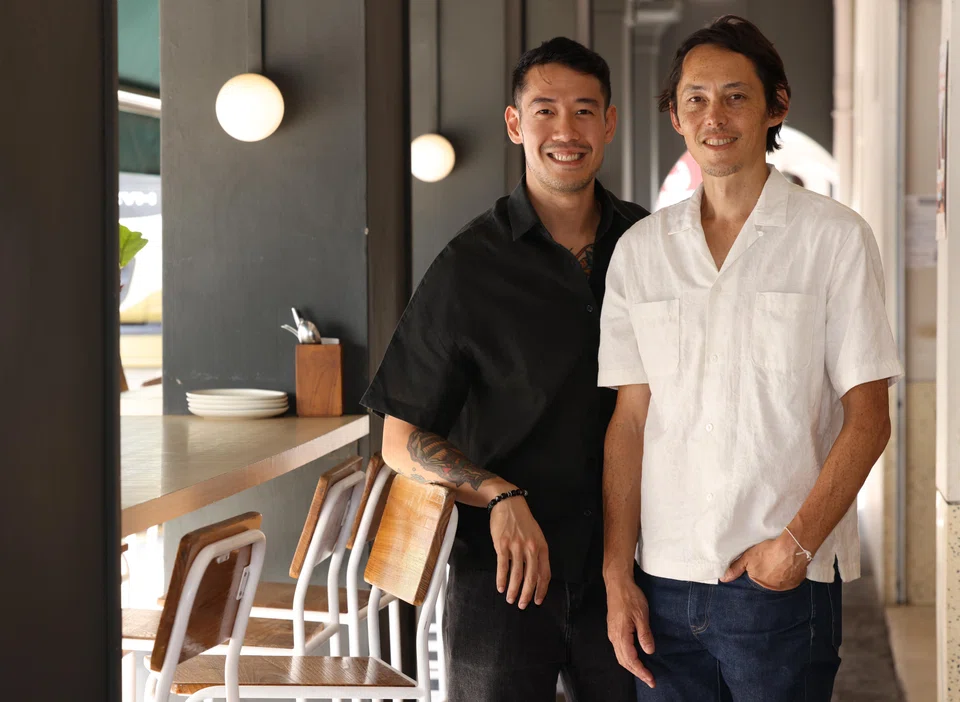
    • Co-founders Eric Chan (left) and Benjamin Lee made a decision to focus on Sarnies' expansion into Thailand, which now accounts for 80% of the group's revenue.
    • Co-founders Eric Chan (left) and Benjamin Lee made a decision to focus on Sarnies' expansion into Thailand, which now accounts for 80% of the group's revenue. PHOTO: TAY CHU YI, BT

    [SINGAPORE] Amid an increasingly challenging F&B landscape, home-grown cafe operator Sarnies has continued to expand – not at home, but in Thailand, where it has 12 outlets in Bangkok spanning multiple concepts.

    Co-founded by Benjamin Lee and Eric Chan, Sarnies began as a single cafe on Telok Ayer Street in 2011. An early entrant into Singapore’s fledgling cafe scene, it quickly gained a following for its Australian-style brunch offerings and speciality coffee.

    From the outset, however, the duo was intent on building something bigger.

    “Our goal was never to open just a cafe… we had much bigger dreams and visions for the business,” Lee told The Business Times in an interview.

    That ambition has since been realised through a strategic decision to focus resources on expansion into Thailand, which now accounts for 80 per cent of the Sarnies group’s total revenue.

    The remaining revenue is from Singapore, where the group operates its original flagship Sarnies cafe and sister restaurant Santi’s Pizza. Besides its F&B outlets, Sarnies’ other key sources of revenue come from wholesale trade and F&B consultancy services.

    Asean Intelligence

    Get insights into businesses across South-east Asia

    Get the free report

    In Lee’s view, Thailand offers better profit margins and risk-reward ratios for F&B players, driven in part by significantly lower overhead costs such as rent and manpower.

    “The economics of building a shop and getting the required returns doesn’t work out as well in Singapore as it does in Thailand,” he said, adding that the group has no plans to open more outlets in Singapore.

    The kingdom also benefits from a steady stream of tourists and a growing population of foreign residents including digital nomads, giving it “a natural wind in its sails”.

    We had to think about these assets in terms of a whole building, not just a space for Sarnies. What would be the best way to monetise the whole building?

    Benjamin Lee, co-founder, Sarnies

    Building on this momentum, Sarnies opened five new F&B outlets in Bangkok in 2025.

    Of these, three were new concepts housed in a multi-storey shophouse it had leased: Latin-American steakhouse Carito’s; Latin-inspired cafe Sarnies Cantina; and cocktail bar Toma y Toma.

    Expanding overseas early

    It was in 2015 that Lee and Chan began exploring opportunities to take Sarnies overseas.

    This was in response to rising F&B competition in the vicinity and declining footfall from the cafe’s largely expatriate customer base, as offices downsized in the wake of the 2008 global financial crisis, they recalled.

    While the Philippines and Malaysia were shortlisted as possible markets, the duo eventually landed on Thailand as a destination.

    In 2017, Chan was hired for a consultancy project in Bangkok to launch and run a fine-dining restaurant. The assignment saw him travelling frequently between Thailand and Singapore.

    Although the restaurant closed in two years, he saw a gap in Thailand that Sarnies – with its food-focused menu – could fill: that of a cafe offering a full dine-in menu, beyond just serving artisanal coffee.

    While Thailand had a burgeoning coffee culture, most speciality coffee haunts served only light bites such as pastries, he noted.

    To test market demand, Lee and Chan opened Sarnies as a seven-seater coffee bar in a shipping container in Bangkok. The concept was well-received, prompting a move to a larger space at Charoen Krung and the establishment of Sarnies’ first outlet in Thailand in 2018: a full-service dine-in cafe.

    The flagship Sarnies outlet at Telok Ayer Street. PHOTO: TAY CHU YI, BT

    Securing leases during Covid-19

    As business took off, the duo began making plans for further expansion – before the Covid-19 pandemic struck.

    But instead of retreating, Lee and Chan used the downtime to lay the groundwork for their next phase of growth. Sarnies’ wholesale trade business in coffee beans and coffee-related products also helped to cushion the impact from the closure of its outlets.

    Capitalising on market conditions, the duo took the opportunity to secure four new leases at attractive rates.

    “When Covid-19 hit, there were a lot of fire sales as people were letting go of their leases. So we snapped up many good deals,” Chan recalled.

    Of these, three were entire multi-storey shophouses; the last was a retail unit in a mixed-use development.

    Chan noted that it is common for Thai landlords to lease entire shophouses to a single tenant. This is because most buildings have only one entrance and a single staircase to serve multiple floors, making it challenging to share the space with other tenants.

    Said Lee: “As a result, we had to think about these assets in terms of a whole building, not just a space for Sarnies. What would be the best way to monetise the whole building?”

    This led them to develop different concepts across floors that visitors could move between: from Sarnies-affiliated spinoff brands such as a bakery to restaurants and cocktail bars.

    Once Thailand emerged from the pandemic, Sarnies hit the ground running, progressively opening its new locations from 2021.

    By then, “the competition had been decimated” as many businesses had shuttered, said Lee, adding: “Inadvertently, it was a silver lining because we could really establish Sarnies as one of the leading cafe brands in Bangkok.”

    Today, Sarnies operates 12 F&B outlets across the city, including several located in its leased multi-storey shophouses. These properties also accommodate the group’s central kitchen, bakery production facilities and creative agency Chow.

    Sarnies Roastery is one of 12 F&B outlets that the group operates in Bangkok, Thailand. PHOTO: SARNIES

    The group typically commits to shophouse leases of nine to 15 years, providing the runway needed to recoup its investments and negotiate more competitive rental rates.

    As part of their Thailand strategy, Lee and Chan have developed several spinoff F&B concepts under the Sarnies banner. These include Sarnies Sourdough, Sarnies Cantina, Sarnies x Pimp My Salad and Sarnies & Friends.

    Chan explained that piggybacking on the Sarnies name allows the group to maintain brand equity, given its track record in the market.

    The strategy has also revived concepts that failed to take off in Singapore. One example is Pimp My Salad, which found success in Thailand after being relaunched under the Sarnies umbrella.

    Growing F&B consultancy work, wholesale trade

    Beyond F&B operations, Sarnies has been gradually building up a name for itself in F&B consultancy services.

    Having found success in developing their own portfolio of brands, Lee and Chan now want to help landlords develop and operate bespoke F&B concepts for their properties.

    This could include launching new Sarnies-affiliated spinoff concepts at the request of landlords, who provide the investment while the group manages the operations.

    Said Lee: “After doing this on our own, it gave us the idea of doing this for other asset owners who want to generate a higher yield off their property than they would get by, say, renting it out.”

    Among the group’s key projects is the development of three F&B concepts for an upcoming four-star hotel in Phuket, set to open in early 2027. The concepts will support the hotel’s breakfast, room service and coffee operations.

    Meanwhile, Lee and Chan have been approached by asset owners and hospitality groups in Dubai, Jakarta and Kuala Lumpur to develop F&B concepts for their properties.

    Some have also expressed interest in bringing the Sarnies brand to their markets through joint ventures.

    After failing to take off in Singapore, Pimp My Salad found success in Thailand after being relaunched under the Sarnies umbrella. PHOTO: SARNIES

    Another fast-growing source of revenue is Sarnies’ wholesale trade business, which grew 60 per cent year on year between the financial years 2024 and 2025.

    The group roasts its own coffee beans and supplies them – along with coffee products and machines – to hotels, cafes and offices in Singapore and Thailand.

    It also manufactures baked goods – including pastries, bread and cakes – through its production facilities in Bangkok, which are supplied to Thai clients.

    Sarnies’ top line grew 20 per cent year on year in FY2025, though Lee and Chan declined to disclose absolute numbers.

    Its F&B outlets currently account for 60 per cent of total group revenue, with the remaining evenly split between its wholesale trade and consultancy pillars.

    But as the latter two businesses scale, the duo expect an equal revenue split across all three pillars over the next few years.

    “Each pillar has a distinct margin profile and growth dynamic, and together they make for a business that’s genuinely diversified, rather than dependent on any single revenue stream,” they said.

    Decoding Asia newsletter: your guide to navigating Asia in a new global order. Sign up here to get Decoding Asia newsletter. Delivered to your inbox. Free.

    Copyright SPH Media. All rights reserved.



