


From capsules to coffee bags, Kim Guan Guan aims to elevate Singapore kopi
Amid its transformation and foray into retail, the coffee supplier was acquired by billionaire Sam Goi’s PSC Corporation in 2024

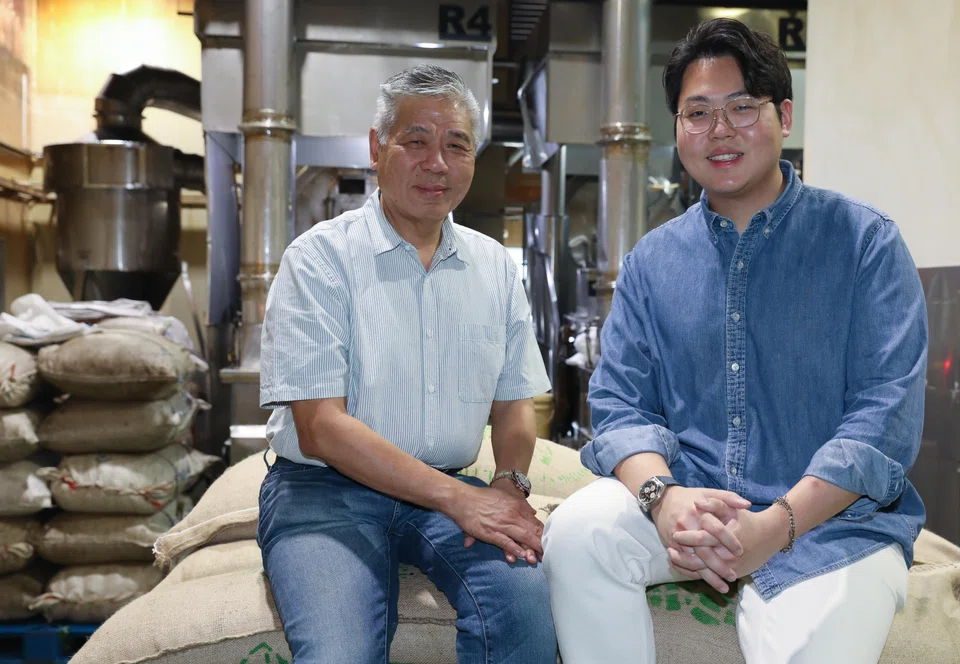
[SINGAPORE] Traditional coffee roasting company Kim Guan Guan wants to raise the profile of Singapore kopi not just abroad, but also at home.
“When you think of local coffee, most Singaporeans think it’s cheap and inferior. Because of its very accessible price point, we don’t appreciate it as much,” said Nigel Soon, second-generation owner of Kim Guan Guan Coffee Roaster.
Established in 1988 as a trading company, it later became a supplier of coffee powder to coffee shops, hawker centres, food courts, catering firms and industrial canteens across Singapore.
In 2021, Kim Guan Guan branched out from its business-to-business (B2B) model to reach coffee drinkers directly, through retail brand Kim’s Duet.
Since 2023, it has exported its coffee to China, Hong Kong, Australia, the Philippines, Japan and South Korea, both supplying businesses and selling to consumers.
Revenue is expected to grow by 20 per cent for FY2025, said Soon, driven by a growth in sales at home and abroad.
The company’s transformation caught the attention of others too.
In April 2024, Singapore-listed consumer goods firm PSC Corporation took a majority stake in the company for S$1.6 million. PSC Corp’s biggest shareholder is billionaire Sam Goi, who owns food manufacturer Tee Yih Jia.
Going into retail
Kim Guan Guan was founded by Soon’s father, Jason, and his business partner. The company started out buying and selling commodities such as coffee, tea, condensed milk and sugar.
In 1993, it bought over a roastery and began a foray into manufacturing: roasting its own beans and producing coffee powder, which it supplied to coffee shops, bowling alleys and snack bars.
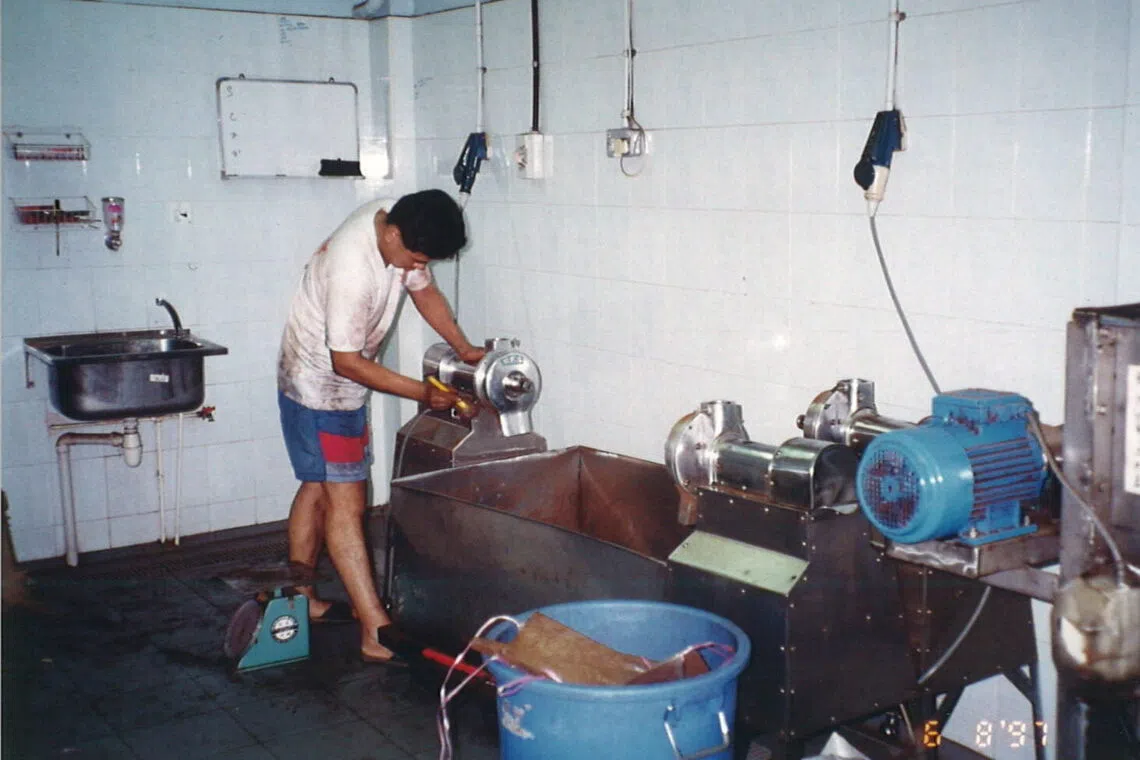
After 2015, the company considered venturing into retail, though no concrete plans were made. But the onset of the Covid-19 pandemic in 2020 hastened the move.
Dine-out restrictions led to lower coffee sales by businesses that Kim Guan Guan supplied, causing its revenue to plunge by 70 per cent.
“Coffee, like beer, is a very social drink – people weren’t consuming as much in the coffee shops or hawker centres,” said Soon, who joined the family business that year.
“When they went out to dabao food, they would head home straight rather than buy a drink.”
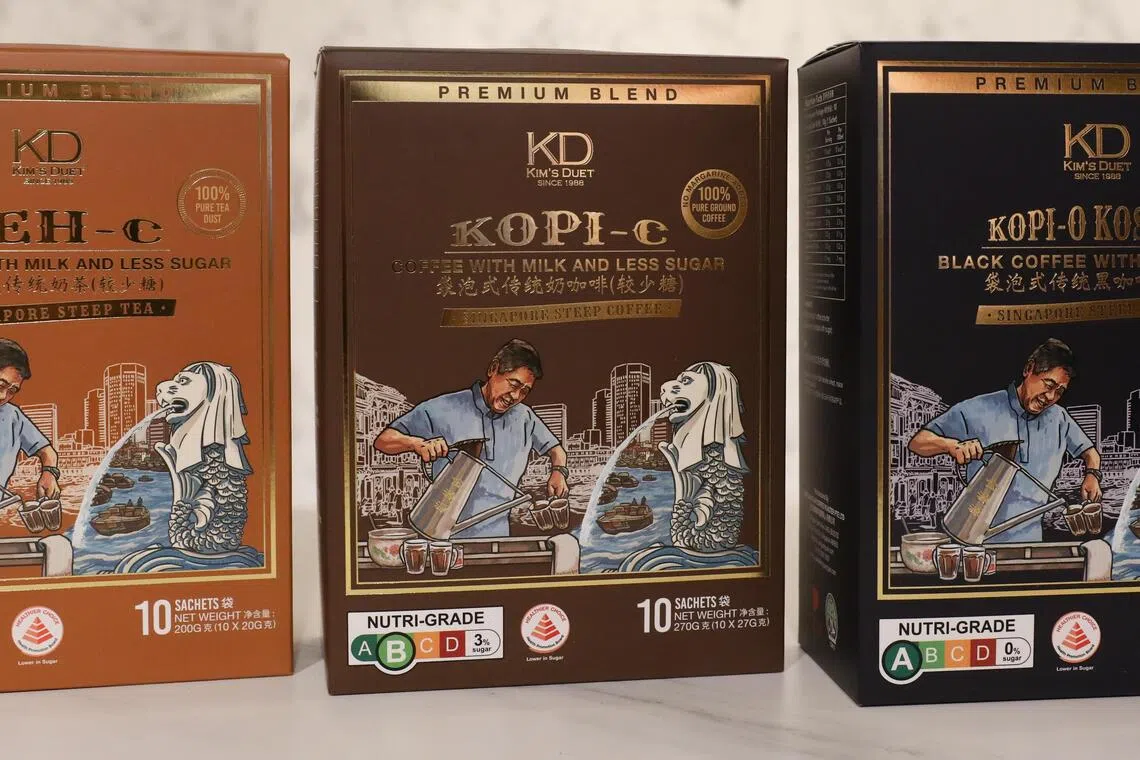
That prompted Soon and his father to diversify sooner than later. The company launched retail brand Kim’s Duet in 2021, offering a range of single-serve steeped coffee bags and tea products.
The company had identified a gap in the market for steeped coffee bags, with many brands selling 3-in-1 instant soluble coffee instead, said Soon.
“We wanted to deliver the authentic kopitiam experience to people in their homes, where every pack of coffee that they drink is as close as possible to the coffee served by coffee shops.”
Today, Kim’s Duet’s products are stocked at department stores, supermarkets and specialty stores across Singapore, such as Design Orchard and the gift shops at Singapore Botanic Gardens. They also retail in the transit and public areas of the Singapore Changi Airport.
Targeting the younger generation
Product innovation remains a key focus for the company, as it seeks to capture a younger generation of coffee drinkers.
This means creating coffee products catered to their lifestyles, said Soon. “We like to push boundaries. We want to change the perception that local coffee can only be made using two metal pots.”
For instance, Kim’s Duet has rolled out traditional coffee in capsules compatible with Nespresso machines.
It also launched oat milk-based kopi-c kosong and hot cocoa for lactose-intolerant individuals, though the line was later discontinued due to weak demand.
In 2024, the brand introduced decaf kopi-o kosong sachets, billed as Singapore’s first ever caffeine-free traditional coffee.
On Nov 17, it launched a nitrogen-preserved shot of traditional coffee concentrate in a pocket-sized tube, which yields a cup of coffee when added to water or milk – whether hot or cold.
Another priority for Soon is to improve the standing of traditional local coffee among Singaporeans.
He said: “There’s always been a low perceived value for traditional coffee – why does it have to stand under gourmet or specialty coffee, just because of its price? Why can’t it stand alongside them?”
He hopes to bring Kim Guan Guan’s coffee into more cafes, which generally brew gourmet coffee or specialty coffee using Arabica beans.
Singapore-style coffee is brewed using Robusta beans roasted with margarine and sugar, which are more coarsely ground, said Soon. Traditional espresso machines may not be able to accommodate these specifications.
So in 2022, Kim Guan Guan created a traditional coffee blend using caramelised Robusta beans that is compatible with espresso machines. It currently supplies this blend to 10 cafes.
Recently, Kim’s Duet collaborated with home-grown roastery Suzuki Coffee to launch a special edition SG60 blend of both Robusta and Arabica beans.
Today, Kim’s Duet accounts for about 15 per cent of total revenue, which Soon hopes to raise to 40 per cent by 2030.
Seeing opportunity in China
The growth of Kim’s Duet also spurred the company to head abroad.
China was its first port of call. Soon saw an opportunity in its growing coffee culture, with a new wave of cafes serving specialty coffee across first-tier and second-tier cities.
“China used to be a very tea-focused country, but ever since brands such as Starbucks and Luckin Coffee opened, consumers there began to develop a love for coffee,” he said.
The company’s first step was participating in the China International Import Expo in 2023, as part of a delegation of home-grown companies led by the Singapore Business Federation. There, it managed to secure a Chinese distributor.
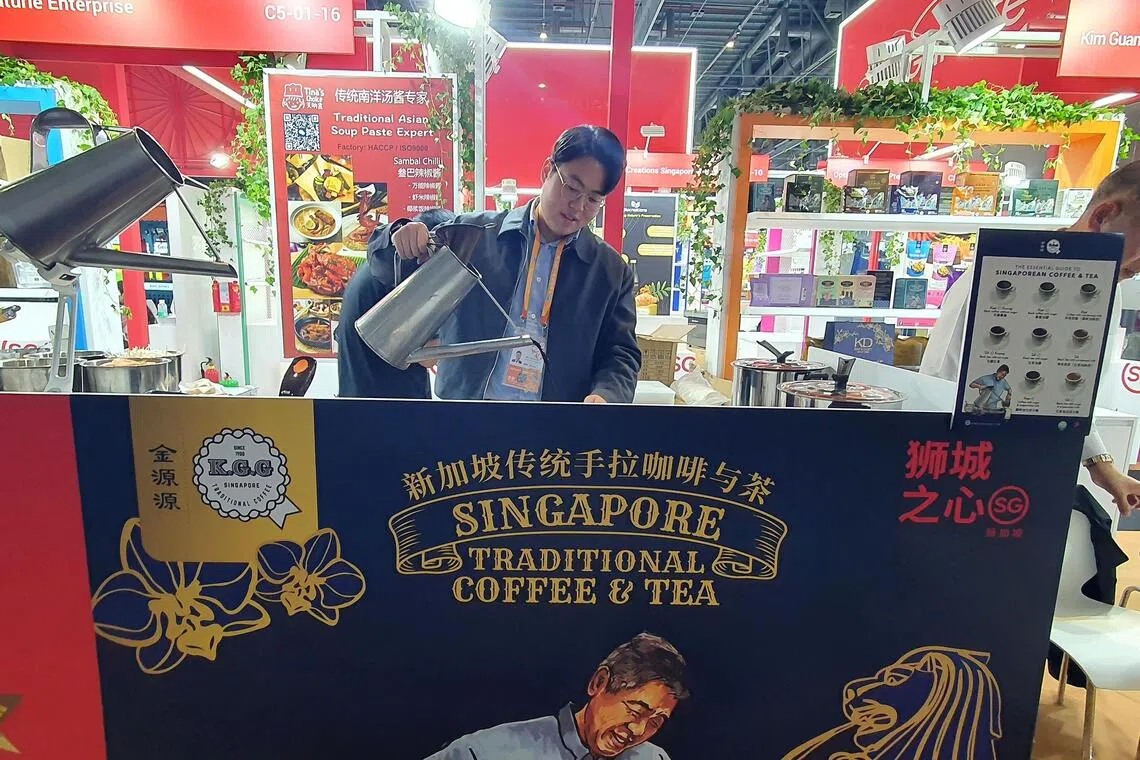
Kim’s Duet’s steeped coffee bags are now sold in supermarkets in cities such as Chongqing, Suzhou, Shanghai, and Fuzhou, as well as on e-commerce platforms TMall and Pinduoduo. The company also supplies Kim Guan Guan’s coffee to restaurants and hotel groups in China.
“Many Chinese are familiar with the taste profile of Americanos and lattes, and the feedback we have received is that our coffee has a ‘kick’ they do not often get from gourmet coffees,” said Soon.
Since then, the company has entered Hong Kong, Australia, the Philippines, Japan and South Korea, selling its coffee under both the Kim Guan Guan and Kim’s Duet brands.
Depending on the market, sales channels include specialty stores, Asian supermarkets and online platforms, as well as food services companies and hotels.
Overseas sales – the bulk of which come from Kim’s Duet – currently contribute to about 10 per cent of Kim Guan Guan’s top line. Soon hopes this will grow to 50 per cent by 2030, as the company looks to expand further in Asia over the next five years.
Next up are Indonesia, Malaysia and Thailand, with Soon now seeking distributors in these markets.
Back home, another ambition is in the works. To bring traditional local coffee to more Singaporeans, Soon aims to open a Kim Guan Guan “experience centre” in a shophouse by end-2026, with the team now searching for a suitable unit.
While the plan is still in its infancy, one idea is for the centre to house a “coffee knowledge” museum and host coffee education workshops and brand collaborations. It will also sell products from Kim Guan Guan and Kim’s Duet.
“We want to bring our roastery experience to people and teach them more about our local coffee heritage, how we came about, and how we are trying to change that landscape,” said Soon.
TRENDING NOW

8 public officers referred to police over property buys near unannounced MRT stations: Chan Chun Sing

Retrenched PMETs who return on lower pay see median 25% wage cut

Grab CEO’s wife Chloe Tong on life with Anthony Tan and finding her purpose

Vietnam’s northern provinces, not Hanoi or Ho Chi Minh City, are powering near 10% GDP growth

