Food delivery platform WhyQ brings AI into its corporate catering niche
New artificial intelligence-powered features will help both client companies and their employees be better informed
Koh Kim Xuan

[SINGAPORE] “Why queue?” is a question that many enterprising firms have turned into a business, by delivering food to customers who want to avoid the hassle of lining up.
Home-grown company WhyQ – whose name was inspired by that very question – has carved out its own niche in a food delivery industry dominated by large players, by focusing on corporate catering.
The company has its origins in the experiences of co-founders Rishabh Singhvi and Varun Saraf, who previously worked in banks. They were weary of the lack of vegetarian options in corporate catering as well as the long lunch queues for hawker food in the Central Business District (CBD).
In 2016, they founded WhyQ, with the intention of bringing affordable hawker fare straight to customers and sparing them from having to queue – for a relatively low flat delivery fee of S$1.50.
The company has since pivoted fully to a full-stack business-to-business (B2B) catering service with hundreds of clients islandwide.
This pivot was made in 2024, after the co-founders saw that more people were returning to work at the office more often.
“I think a lot of employers here are getting serious about retaining people in the office (and) even providing (them) healthier options for food,” said chief operations officer Singhvi. “So we feel like it was a perfect solution to come and help.”
The strategic shift to B2B sales was “the right move” for WhyQ, added chief executive officer Saraf.
The business made net profit in 2025 – though the co-founders declined to reveal exact figures – and generated more than S$4 million in revenue in the first quarter of 2026.
The aim is to increase profit by up to 50 per cent by the end of this year.
How it works
WhyQ delivers corporate meals that range from S$8 to S$25 each to offices in the CBD, Science Park, Pasir Panjang and Paya Lebar Quarter.
Its network of more than 500 F&B merchants includes chains such as Guzman y Gomez, Haidilao and KFC as well as smaller businesses like Gyoza-San.
Restaurants make up 70 per cent of WhyQ’s merchants, followed by hawkers (20 per cent) and caterers (10 per cent).
The company is looking to expand its services to industrial business hubs such as Tuas and Jurong, given the lack of food options available for workers in those areas.
WhyQ’s in-house delivery fleets and optimised delivery routes mean that a sufficient variety of food can be transported fresh and punctually to these areas, noted Singhvi.
The company hopes to deliver 3,000 meals daily by the end of this year, a 50 per cent increase from 2,000 meals now.
Apart from delivery services, WhyQ has also diversified into providing catering and live food stations for events.
Technological edge
WhyQ designs food-ordering sites that are used by the employees of its client companies, so that they do not have to order from external websites.
Each ordering site is incorporated into the client’s own employee platform, and tailored to the client’s needs, for everything from menu options to payment methods.
In creating menus, WhyQ’s in-house algorithms verify allergens, and prepare different combinations of menus based on client specifications such as dietary requirements.
WhyQ also incorporates any meal-plan schemes that companies have to offset meal costs.
“Some clients will tell us they want to show prices (of the food), but they give a meal credit to their employees every day,” Saraf explained. “Some clients want their employees to pay a small portion as well, like a co-payment model.”
Employees can also track their nutritional intake through the ordering platform.
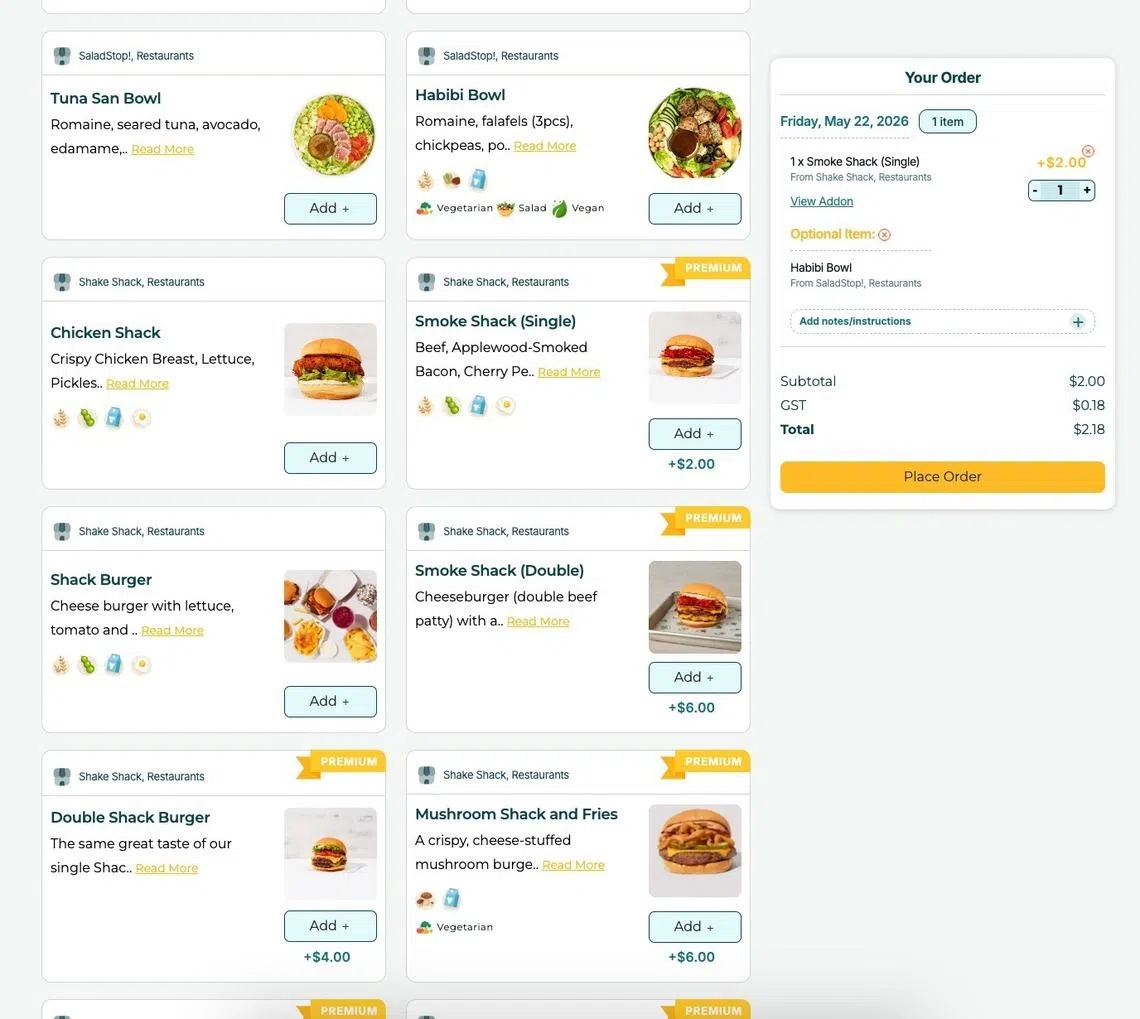
In the next upgrade of the sites, WhyQ will launch an artificial intelligence-powered platform called WhyQ Intelligence in the last quarter of the year.
Existing clients can pay an additional fee to have these AI-powered features integrated into their portals.
WhyQ Intelligence will offer personalised nutrition tracking for each employee, food recommendations and gamified wellness-scoring.
Clients themselves will be able to view a dashboard that links meal participation with attendance trends and employee engagement.
The AI-driven platform also automates audits to ensure that employees’ dietary requirements are met through the food options provided.
“Rather than operating as a traditional food aggregator, we work closely with clients to design customised menus that balance taste, nutrition and operational efficiency,” said Saraf.
WhyQ Intelligence has the potential to become a significant contributor to the group’s revenue in the future, he added.
Some existing clients are already using the AI tool in pilot mode. Through this scheme, WhyQ hopes to achieve an engagement rate of up to 50 per cent among employees within the first year of deployment.
Mutual benefit
WhyQ’s pivot to B2B has benefited not just the company but also its partner merchants, by providing them with predictable recurring revenue, noted Saraf.
Merchants can reach a wider customer base by partnering with WhyQ, and have seen their revenues rise by up to 25 per cent, he said.
“(The added revenue) could be the difference between them running on very thin margins, possibly shutting down, versus actually running a sustainable business.”