
Supergreen targets Singapore’s residential neighbourhoods as expansion plan takes off
The home-grown salad-and-grain-bowl brand will open a total of nine outlets in 2026
Koh Kim Xuan
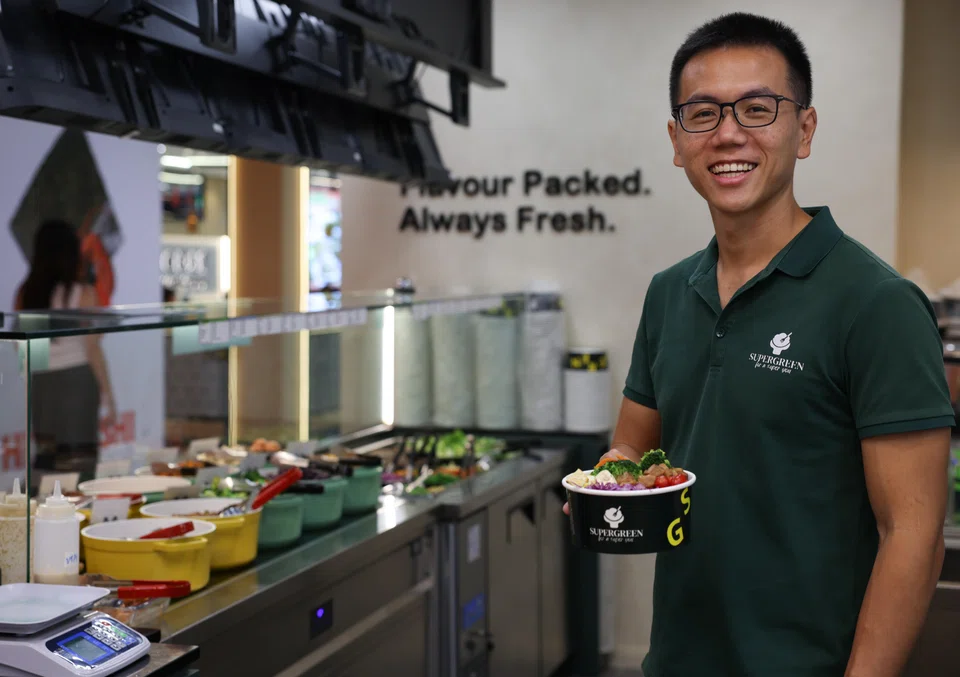
[SINGAPORE] Build-your-own salad bowls have become a staple for those looking for a fast and convenient way to eat healthier meals.
With increasing demand and more brands jumping on the bandwagon to set up shop in Singapore’s Central Business District (CBD), home-grown salad chain Supergreen is ramping up its expansion in various residential neighbourhoods.
Supergreen founder Lee Shao Rong said that beyond the 18 outlets in operation today, the aim is to open five new ones by the end of the year – adding to the four stores that were launched since the start of the year.
“Everybody is more conscious about eating healthy after work. (When they go home), they will want this healthy food (to be) near to them as well,” he told The Business Times in a recent interview.
The company’s newest addition at Parkway Parade – a suburban mall in Marine Parade in Singapore’s east – comes as part of its ambitious growth plans.
“We decided that we needed to move out of the CBD to Parkway Parade. They (have) an office building (at the mall) and we can serve the community around there,” Lee added.
Similarly, the food chain has established outlets in malls such as The Star Vista in Buona Vista and Changi City Point, which have “good office crowds”. Apart from office workers, Supergreen’s store at Kallang Wave Mall targets the athlete demographic, he noted.
Lee said that other dense neighbourhoods such as Tampines and Paya Lebar are on the company’s radar as it expands its footprint further.
“We are trying to increase the number of outlets to make it more accessible, (so that) when people think about healthy food, (Supergreen is at the) top of their minds.”
Starting in the CBD
Supergreen first opened at Nanyang Technological University in 2020 under the name “Mixed Greens”. It later expanded to the National University of Singapore (NUS) and Singapore Management University. However, it closed the NUS outlet in 2023 to establish its first outlet in the CBD – at Marina One.
With prices for salad bowls typically starting at around S$10, the health food chain shifted its focus to the office worker demographic, who possess “spending power” and a desire to eat healthier, Lee said.
The brand has since established several stores in and around the financial district of Singapore, at locations such as Frasers Tower, International Plaza and Raffles Place.
The company turned profitable in 2025 – though Lee declined to reveal exact figures – after breaking even in 2024.
Hybrid business model
The move to further expand despite the competition in the industry is undergirded by Supergreen’s hybrid franchising business model, said the founder.
Currently, eight stores are corporate-owned while 10 are run by franchisees. Out of the five potential outlets, Lee is looking for three to be corporate-owned and the remaining two to be franchisee-operated.
Supergreen, as the franchisor, takes 6 per cent of its franchisee-run stores’ revenue.
“We decided that for us to grow to a certain size, to enjoy certain economies of scale, franchising might be the way to go,” said Lee.
He added that the company built a “support ecosystem”, where franchise outlets are supported like its corporate-owned stores.
Improving health food access
Like other salad-and-grain-bowl brands, Supergreen specialises in build-your-own-bowl meals.
Customers typically choose a base of either lettuce or staple carbohydrates such as brown rice. They can then pick from a variety of toppings consisting of seasoned vegetables, cooked meat or other proteins such as tofu, as well as a sauce to top the meal off.
Despite a focus on health foods, Lee noted that Supergreen is “not trying to be the extreme” in providing “super-healthy (and) low-calorie” options. He cited ingredients with “bold flavours” such as Japanese-style grilled yakiniku meat and mala prawn.
“We (are) not trying to just target the extreme gym-goers or those trying to lose weight. It’s really just trying to be a part of everybody’s lifestyle to eat healthier in general.”
Beyond expansion
Lee said that he plans to open a central kitchen by early 2027 to focus on business-to-business (B2B) sales, and a meal preparation arm to provide ready-to-eat meals for customers.
“We hope to be around for a longer time… We’ve got to continue (innovating) and giving value to customers in order to survive in this tough F&B environment,” he noted.
With the central kitchen, Supergreen hopes for B2B catering to contribute 20 per cent of the group’s revenue, up from the segment’s current revenue contribution of 10 per cent.
“(The food and beverage) business climate is evolving… I hope people know that we are not just a trend; we are here to stay,” Lee said.
TRENDING NOW
Genting Singapore trails MBS, but helps anchor Malaysian parent group’s finances
He built the Vingroup empire. Now South-east Asia’s richest man is handing some key roles to his sons
CDL to invest S$5 billion, target S$6 billion divestments under refreshed strategy
Stocks to watch: CDL, Centurion, Oiltek, Geo Energy Resources



