In the spotlight: Singapore fund manager Capital Asia Investments behind multi-million dollar Thai blue-chip deals
Some of these transactions are linked to a politically connected Cambodian tycoon and a prominent Thai businesswoman

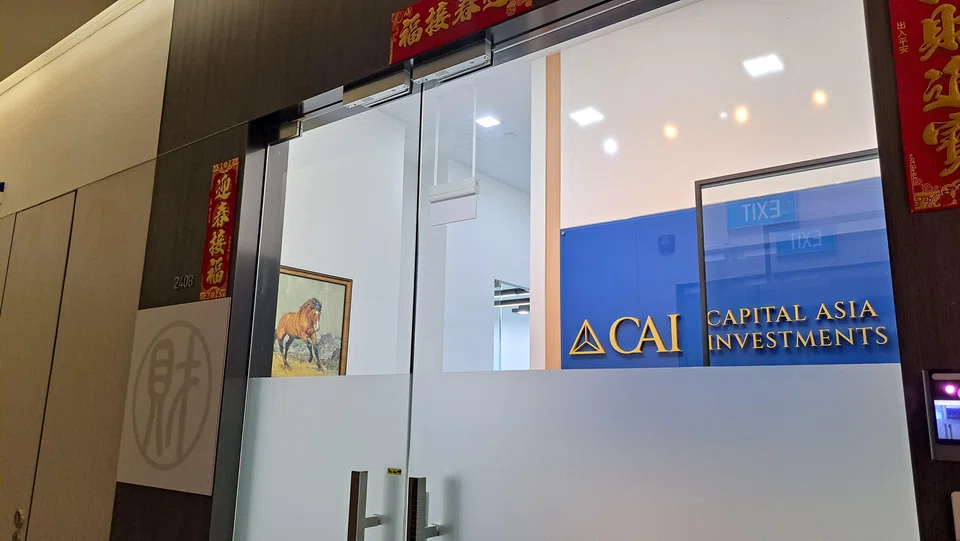
[SINGAPORE] Singapore-licensed fund manager Capital Asia Investments (CAI) has been scooping up and flipping shares of Thai blue-chips and other listed firms, through a series of complex deals. The blocks it has traded are worth about S$658 million at current market prices.
Some of CAI’s Thai share deals – which involve an energy giant, a media firm and a diversified holding company – intersect with Cambodian tycoon Yim Leak, whose family is tied to former premier Hun Sen.
Another deal involved Finansa Investment, a CAI-linked firm that Thai filings list as co-founded by incoming deputy finance minister Vorapak Tanyawong.
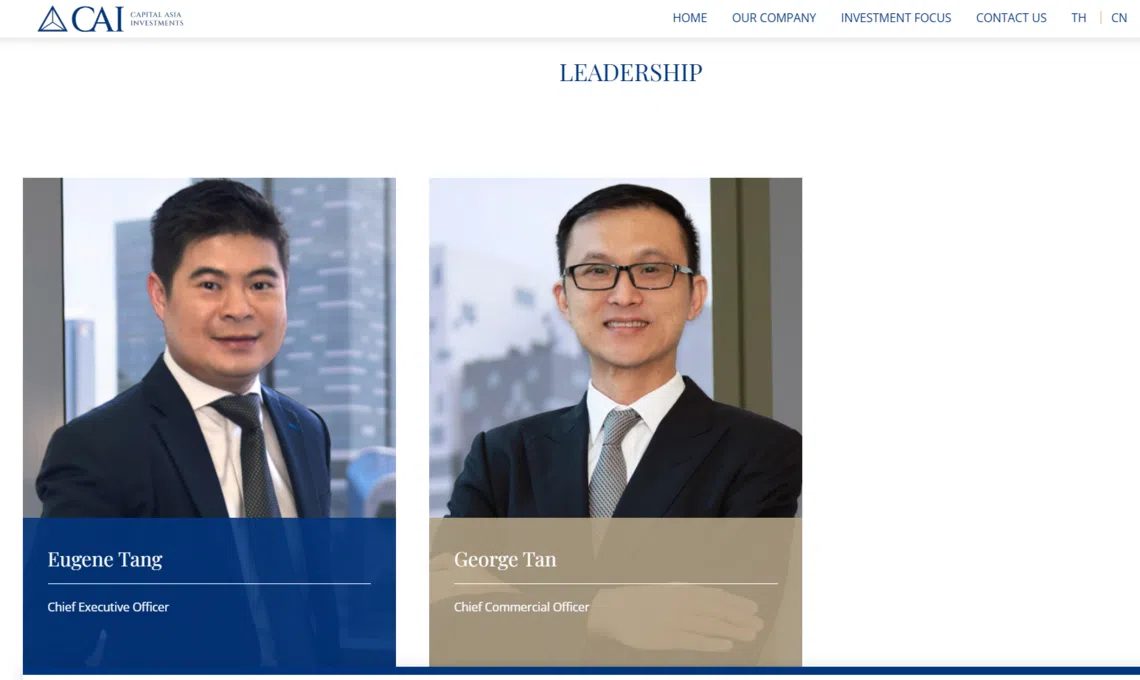
These multiple deals in recent years by CAI, which manages assets over US$1.12 billion and is led by Singaporean co-founder Eugene Tang, 47, and George Tan, 55, are piquing curiosity among the public.
The deals involving Thai’s sector stalwarts have been hogging the headlines in Thai media in recent weeks, with reports highlighting concerns about strategic assets ending up in foreign hands.
This comes as former business journalist Tom Wright – co-author of Billion Dollar Whale on Malaysian financier Jho Low – wrote about convicted boiler-room operator Benjamin Mauerberger and his reported ties to Thai and Cambodian elites. In those pieces, Wright noted Mauerberger’s links to CAI, though these claims could not be independently verified by The Business Times.
Multi-layered transactions
One of CAI’s moves involved BCPG, a Thailand-listed renewable energy firm spun off from Thai energy giant Bangchak.
In February last year, CAI purchased over 50 million shares in BCPG from prominent Thai businesswoman Cattaliya Beevor, lifting its stake from 3.6 per cent to 5.3 per cent, a filing by the fund manager to the Thai Securities and Exchange Commission (SEC) showed.
US SEC documents suggest the deal may have been a related-party transaction, as Tang, Tan and Beevor jointly managed a variable capital company – CAI Optimum Fund – at the time.
CAI then turned its attention to Bangchak itself. In December, CAI picked up nearly 6 per cent of Bangchak from the open market and doubled its stake to 10 per cent within two weeks, filings with the Thai SEC show.
By March this year, a disclosure triggered by the conversion of some voting shares into non-voting depository receipts showed CAI had held as much as 13.9 per cent before dropping back to 4.9 per cent.
Within weeks, CAI sold more than 190 million Bangchak shares to Alpha Chartered Energy, a newly incorporated Thai company. Alpha’s stake jumped from 2.6 per cent to just over 20 per cent after three purchases between March 19 and April 9, making it a major shareholder by the end of June, according to Bangchak’s Q2 2025 statement.
Little is known about Alpha Chartered, which was set up in January with a registered capital of 50 million baht (S$2 million). Company records show it is 51 per cent owned by Alpha Global, a Thai entity incorporated in December 2024, and 49 per cent by Luxembourg securitisation firm Encore Issuances.
Alpha Global initially shared an address with Beevor-owned Apex Equity Ventures before shifting offices in March and July, business records show.
Encore, meanwhile, sits under Opus, whose investment advisor is MAS-licensed fund manager Chartered Investment Managers, part of Singapore-headquartered Chartered Group.
Cambodian link(s)
CAI’s name also surfaces alongside Cambodia’s business and political elite.
The fund manager runs more than 40 vehicles spanning hospitality, fintech, infrastructure and renewable energy, according to a circular VGI, the media and advertising arm of Thai blue-chip BTS Group, sent to shareholders last September ahead of an extraordinary general meeting (EOGM). The EOGM agenda included, among other things, issuing new shares to a CAI fund.
A separate shareholder list of BCPG dated Aug 31, 2022, included Beevor, Cambodian tycoon Yim Leak, and a line that read: “Capital Asia Investments… for Mr Yim Leak.”
Yim chairs Cambodian conglomerate BIC Group. His father, Yim Chhay Ly, was a former deputy prime minister and his sister is married to one of the deputy prime ministers, Hun Many, who is the son of former premier Hun Sen.
More possible ties that bind
The trail also runs through United Power of Asia (UPA) – now Green Tech Ventures (GTV) – where filings show a circular flow of shares.
Weeks after Beevor amassed over a billion shares in October 2020, she sold most to an intermediary, who months later disposed of almost his entire stake to CAI. GTV is an investment holding firm that spans power, real estate and information services.
Beevor had picked up a third of the four billion newly issued shares in a UPA rights offering. The sale raised over 500 million baht, UPA told the Thai bourse days later.
Less than a month on, UPA disclosed that the proceeds were used to part-fund its investment in a Phnom Penh tower project, through the purchase of 450 million baht worth of shares from Yim.
At the time, Yim chaired One Central Tower with a 23.34 per cent stake, which he exited entirely after the sale, filings showed.
The Cambodia tower project’s performance has been volatile. It posted a 3.86 million baht loss in 2021, a profit of 18.69 million baht in 2022, and a 3.66 million baht loss in 2023, according to its filings.
In November 2021, UPA also notified the Thai exchange that it had shifted its registered address to match that of Beevor-owned Apex Equity Ventures.
CAI’s direct dealings with Yim are also on record.
In November 2021, CAI bought 20 million shares in events and media firm M Vision from Yim, then four months later took up 45 million newly issued shares worth 189 million baht, making it a major shareholder. M Vision said it would use most of the proceeds for bitcoin mining.
As at March 2025, CAI held 13.3 per cent, though its stake could be diluted to under 4 per cent after a private placement that will give control to IT retailer Com7 and make TR Partners the second-largest shareholder.
All roads lead to CAI
CAI has also surfaced as the second-largest shareholder in VGI, the media and advertising arm of Thai blue-chip BTS Group, after joining a massive private placement of 8.8 billion new shares in November last year.
Four investors, including CAI, subscribed to the placement, giving them a combined 44 per cent of the enlarged company. Two of those investors – Opus-Chartered Issuances SA (Opus) and Thai IR – also appear to have CAI links.
Thai IR is managed by Finansia Investment Management, a unit of listed Finansia X, whose largest shareholder as at July 29 was “CAI for Pilgrim Finansa Investment”, according to Finansia X’s filings and the Stock Exchange of Thailand.
Pilgrim Finansa Investment has since changed its name to Finansa Investment.
Registry records list Finansa Investment at the same address as CAI, with Tang as a director.
Filings further show that Finansa Investment was co-founded by Thailand’s incoming deputy finance minister Vorapak Tanyawong, a former president of state-owned Krungthai Bank.
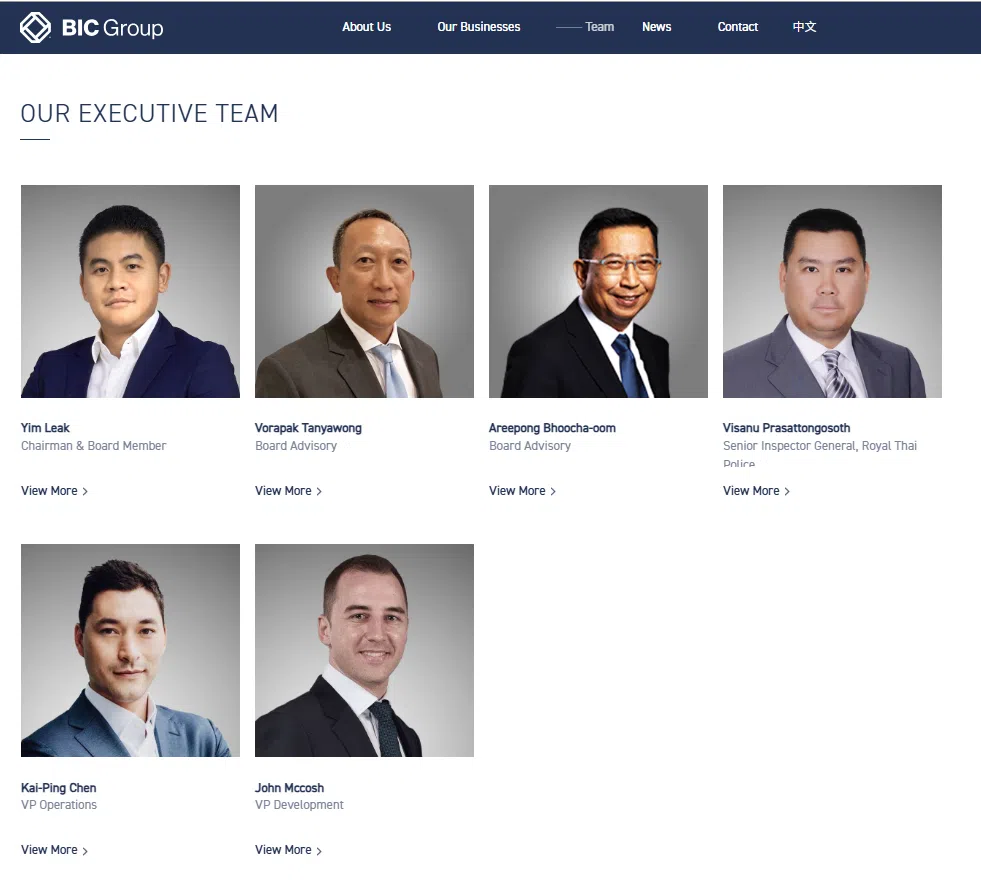
On Sep 10, Vorapak posted on Facebook responding to what he described as allegations of involvement with Cambodia’s BIC Group. He said he had met Yim many years ago for banking advice but denied holding any director role in the company, receiving compensation, or having further contact with Yim.
But an archived version of the BIC Group website accessed via the Wayback Machine dated Aug 10 showed Vorapak as board advisory, alongside two other Thai nationals. As at Sep 12, the BIC Group website listed only Yim and Chen Kai-Ping as its executive team. Only Yim was left as at Sep 15.
One of them, police general Visanu Prasattongosoth, is also recorded as a director at BCPG and Finansia X.
Meanwhile, Opus is a special purpose vehicle connected to Encore – the 49 per cent shareholder in Alpha Global, whose subsidiary became Bangchak’s largest shareholder after buying a block from CAI.
Following VGI’s cash call, its parent and largest shareholder BTS saw its stake diluted by almost half.
Converging interests
CAI, Yim and Beevor also cross paths at Thai financial service provider Finansia X.
As at Jul 29, its largest shareholder was CAI on behalf of Finansa Investment, holding 24.14 per cent, according to the Thai stock exchange. Public filings do not show how CAI built this stake.
Previously, Cambodia-listed BIC Bank, controlled by Yim, held nearly 20 per cent in Finansia X as at Mar 18, while Beevor owned close to 10 per cent in July 2024 before selling out seven months later.
Who are Tang and Tan?
Before co-founding CAI in June 2017, Tang formerly worked at UBS and UOB Kay Hian, and was vice-president of wealth management at One Asia Investment Partners (OAIP) – a fund manager that wound up after MAS revoked its licence for mismanagement in April 2017. A former OAIP executive was later jailed for defrauding investors.
Tan held senior roles at Standard Chartered, EFG Bank, Pictet and CA Indosuez Wealth Management, according to CAI’s website.
BT attempted to reach CAI for comment by phone and visits to its Robinson Road office, but received no response.
BT spoke with several employees on Sep 9, who said that Tang was not present while Tan was in a meeting.
BT also reached out via e-mail, LinkedIn and/or mobile number to Tang, Tan and eight other former or current employees and shareholders – some of whom removed mentions of CAI that were earlier seen on their public profiles.
In response to BT queries, an MAS spokesperson said the financial regulatory authority does not generally comment on its supervisory dealings with specific financial institutions.
“All financial institutions in Singapore, including fund managers, are required to put in place controls to mitigate money laundering/terrorism financing risks.”
The spokesperson added: “This includes conducting due diligence on their customers and establishing the sources of wealth and funds of higher-risk customers and their beneficial owners, prior to entering into any fund management arrangement.”
A spokesperson for CAI said that they decline to comment at this juncture.