

Tiger Beer, brewed in Vietnam – but still Singaporean?
If the national tipple is no longer brewed here at scale, what anchors its Singapore identity?

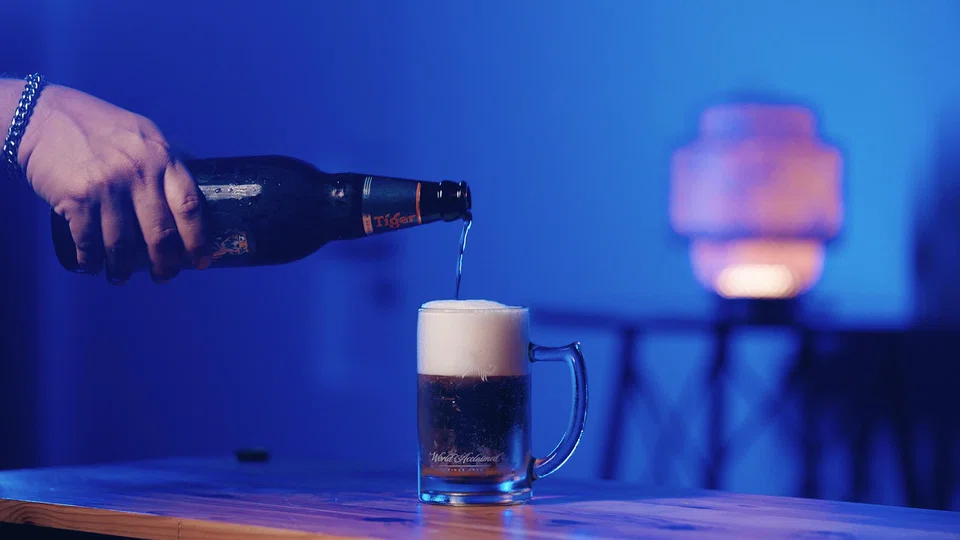
[SINGAPORE] There are few – if any – consumer exports that wear the “Made in Singapore” label with as much pride and global recognition as Tiger Beer.
Certainly, there are familiar names: Khong Guan biscuits, Super 3-in-1 coffee sachets, and the similarly named – yet entirely different – Tiger Balm ointment. Each carries its own legacy.
Yet, in terms of sheer scale and reach, none quite rival Tiger Beer. Millions of cans, bottles and pints of the lager are sold across more than 60 markets worldwide each year. Few Singapore-bred products have travelled as far, or as widely.
Today, Tiger Beer is brewed in multiple markets to serve local demand. But Singapore has long been a key anchor of its identity. Its history, after all, runs deep, with the first pint rolling off the production line in Alexandra Road in 1932.
That identity, however, has not always been unquestioned.
When Dutch brewer Heineken acquired Fraser & Neave’s stake in Asia Pacific Breweries Singapore (APBS) – Tiger Beer’s maker – in 2012 in a S$5.6 billion deal, questions emerged over whether one of Singapore’s most recognisable consumer brands could retain its local character under full foreign ownership.
More than a decade on, those concerns appear, at least in part, to have eased. Tiger Beer has remained firmly positioned as a Singaporean brand, not least in its marketing, storytelling, and continued brewing presence here.
But if ownership did not dilute that identity, production might.
Heineken, through its subsidiary APBS, said on Tuesday (Mar 24) that it will progressively wind down “large-scale” brewing operations at its Tuas facility over the next two years.
Production will instead shift to established regional breweries in Malaysia and Vietnam, while the Tuas site will be repurposed for regional logistics and innovation work, including a pilot brewery.
About 130 workers, out of a workforce of 540, will be laid off as Heineken transitions towards an “import-based supply model” in Singapore.
The move raises a broader question: if Tiger Beer – a Singapore-born brand owned by a global brewer – is no longer brewed here at scale, what anchors its Singapore identity?
Cost realities
To be sure, the business logic behind the move is hard to dispute.
Beer consumption is slowing, especially among younger consumers. When volumes soften, cost discipline becomes the most immediate lever.
Heineken did not spell it out explicitly, but cost differentials would have loomed large, particularly against Malaysia and Vietnam, where existing facilities can absorb production without fresh capital expenditure.
Consider the basic ingredients of beer: water, malted barley, sugar and hops. Beer, as the old quip goes, is mostly water. And in Singapore, water does not come cheap.
Potable water for non-domestic use costs S$3.24 per thousand litres, based on figures from national water agency PUB.
A few hundred kilometres across the Causeway, in Selangor – home to a Heineken brewery – the same volume costs just RM3.83 (S$1.24), more than 60 per cent lower.
Electricity costs tell a similar story. Brewing is energy-intensive, with tightly controlled temperatures and automated systems running almost continuously.
In Singapore, where wholesale electricity tariffs are among the highest in the region, the cost burden quickly adds up.
Then there is manpower. The roughly 130 jobs being cut in Singapore could, in cost terms, be replicated more cheaply elsewhere, even if more workers are needed.
Globally, Heineken said in February it plans to cut up to 6,000 jobs over the next two years to “unlock significant savings” amid “challenging market conditions”. The layoffs in Singapore are likely part of that broader effort.
To its credit, Heineken appears to have handled the retrenchment exercise in an exemplary manner, with early, proactive engagement of its union and robust support measures to help affected workers transition – a reminder that how companies restructure can matter as much as why they do so.
More than beer
Beyond the layoffs and economics lies a deeper question of identity.
Singapore has moved steadily up the value chain, from manufacturing to services, and towards finance, technology and headquarters functions. In many ways, this has been both deliberate and necessary.
As production shifts elsewhere, Singapore is increasingly a place where products are conceived and designed, but no longer physically made – where the “software” is created, but not the “hardware”.
In that regard, Australia’s Foster’s offers a glimpse of one possible future. Once synonymous with Australian beer, it is now brewed largely abroad and far less prominent at home.
Tiger Beer will remain Singaporean in name and identity. But if it is no longer brewed here at scale, its link to Singapore may come to rest more on history than on reality.
And when that happens, the identity may not disappear – but it could begin to lose some of its fizz. That would be a pity.
TRENDING NOW

DBS, OCBC, UOB rout lops billions off STI as inflation, rate concerns spook investors

Grab CEO’s wife Chloe Tong on life with Anthony Tan and finding her purpose

OCBC sheds S$8 billion in value as shares close nearly 6% down; analysts cautious on banks

Deal between tycoon friends sparks scrutiny of Philippine power sector

