

Trickier across borders: Why commercial disputes are getting more complex
Ahead of Singapore Convention Week 2026, legal experts explain what’s driving the shift – and how Singapore’s dispute resolution ecosystem aims to help
Kareyst Lin
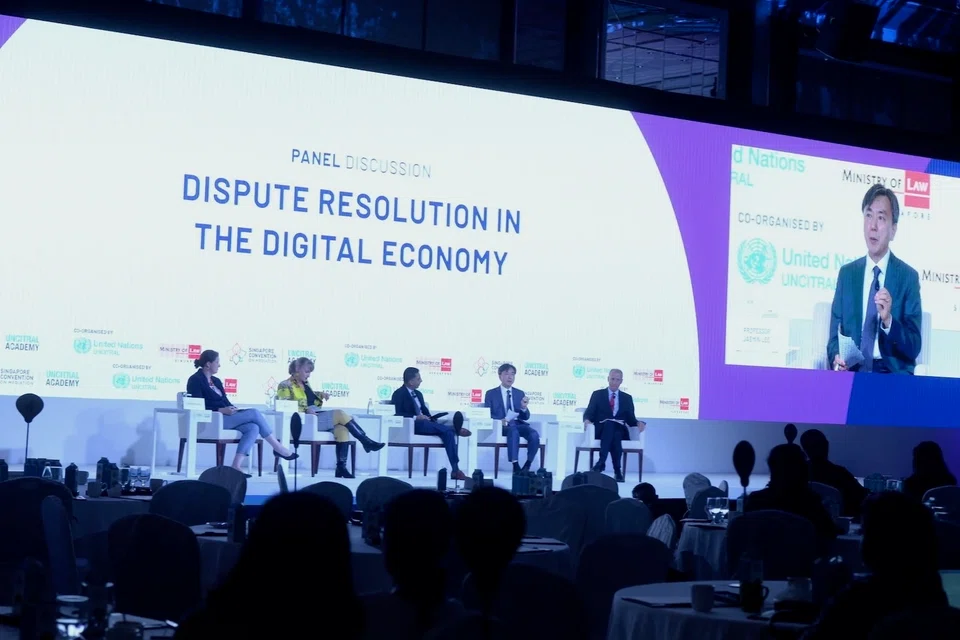
What happens when years of trust break down into two different stories about the same paperwork?
In a case heard by Singapore’s courts, a commercial relationship had soured after a dispute centred around a Singapore holding structure – and over substantial payments made.
The parties had largely documented the arrangement themselves, at a time when considerable mutual trust still existed.
But the documents were “negotiated across languages, without the parties always sharing the same legal vocabulary,” said Ng Sook Zhen, director at Zenbridge Law, who acts for the executive.
The entities and individuals involved spanned several jurisdictions across Asia, with parallel proceedings taking place abroad. The case is ongoing, and Ng said she can only speak about it in general terms.
Such complexities are becoming the norm in cross-border disputes in Asia, said Ng.
The topic will take centre stage at Singapore Convention Week (SC Week) 2026. Organised by the Ministry of Law (MinLaw), the event runs from Aug 24 to 28 under the theme “Timeless principles, timely solutions: Nurturing trust in a changing world”.
SC Week will be held across locations including Shangri-La Singapore, Gillman Barracks and Marina Bay Sands.
New fault lines in cross-border fights
Three trends are reshaping cross-border business disputes, legal experts said.
- Shifting supply chains Geopolitical tension is pushing businesses to diversify where they manufacture, invest and hold assets. This has led to more cross-border joint ventures and shareholder arrangements, and more complex disputes when they break down.
- More regulatory layers Sanctions, data localisation and governance rules are increasingly part of disputes.
- Disputes over artificial intelligence New categories of disputes are emerging, in areas like data rights, model outputs and technology transfer. AI is also increasingly used in legal processes including document review and contract analysis – raising issues such as accuracy and transparency.
In the business of trust
SC Week debuted in 2019 in conjunction with the Singapore Convention on Mediation, an international treaty for the cross-border enforcement of settlement agreements resulting from mediation, opening for signature. (See box below)
The event has since grown into a broader forum that brings together legal, business and policy communities. Last year, SC Week drew over 5,600 participations across across 60 partner and associated events.
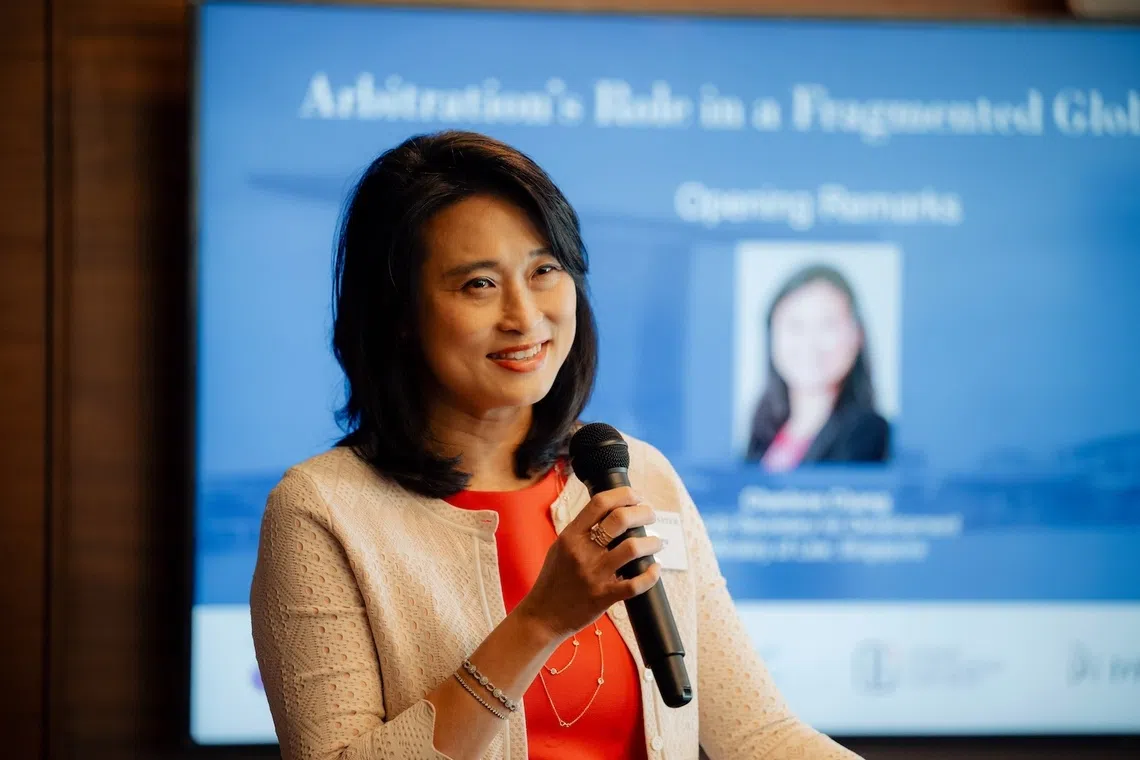
This year’s forum also commemorates two major legal milestones, noted MinLaw’s deputy secretary (Development) Charlene Chang:
- SGLaw200, which marks 200 years since the foundation of Singapore’s legal system was laid; and
- The 60th anniversary of the United Nations Commission on International Trade Law (UNCITRAL), which developed standards to harmonise trade laws across countries and resolve cross-border disputes.
As AI and geopolitical uncertainty reshape global commerce and the type of disputes that arise, said Chang, “the values that underpin effective dispute resolution – fairness, impartiality, due process, integrity and the rule of law – are timeless and more important than ever.”
She added: “The rule of law is the bedrock on which (Singapore’s) legal foundations are built.”
The country’s cross-border dispute resolution ecosystem includes:
- The Singapore International Arbitration Centre (SIAC), an internationally recognised institution providing arbitration services – where a neutral third party is appointed to settle a dispute – to parties around the world;
- The Singapore International Commercial Court (SICC), part of the Supreme Court of Singapore, is designed to deal with transnational commercial disputes; and
- The Singapore International Mediation Centre (SIMC), which promotes dispute resolution through mediation, capacity building and thought leadership.
Together, they give businesses operating in Singapore “the strong confidence that there will be a fair, efficient, transparent and trusted path to resolution (when disputes arise)”, said Chang.
Policy meets practice
The headline event of SC Week is the UNCITRAL Academy – jointly organised by MinLaw and UNCITRAL. UNCITRAL Academy sessions are designed for international leaders from the legal, business and government sectors.
Its programme includes a government capacity-building workshop on mediation and the SCM, with a dedicated session for government officials.
The UNCITRAL Academy sessions are among what legal practitioner Ng, who has attended more than three editions of SC Week, looks forward to most.
Ng noted that the event has grown increasingly relevant to businesses over the years. “The conversations are (now) no longer only about doctrine, but about what general counsel and business leaders actually need,” she said.
Gitta Satryani, managing partner (Singapore) and head of disputes for South-east Asia at Herbert Smith Freehills Kramer, attended SC Week 2025. “What I find particularly valuable,” she said, “is that the conversations are as much about commercial realities as they are about legal developments.”
Satryani added that “much of the real value happens outside the formal programme”, pointing to conversations on the sidelines “where relationships are built, ideas are tested and future collaborations take shape”.
Chuan Wee Meng, chief executive officer of SIMC, said SC Week gives the organisation “an important platform” to connect its international panel of mediators with users of dispute-resolution services, exchange best practices, and strengthen cooperation among institutions in Singapore and overseas.
SIMC has been a partner organisation of SC Week since 2019. This has led to concrete initiatives, Chuan added.
In 2023 and 2024, SIMC signed collaborations to promote mediation with alternative dispute resolution institutions and associations from China, India, Indonesia, Japan, Turkey and Vietnam. This year, it signed with the Commonwealth Secretariat, a voluntary association of 56 countries that evolved out of the British Empire.
Enforcing across borders
Singapore Convention on Mediation (SCM) provides a uniform framework for invoking and enforcing international settlement agreements resulting from mediation.
Adopted by the UN General Assembly in 2018, the landmark international treaty opened for signature in Singapore in 2019. As of August 2026, SCM has 60 signatories and 23 contracting parties.
In mediation, a neutral third party helps disputing parties negotiate a settlement.
Before SCM, parties had to file a new breach-of-contract lawsuit in local courts if the other party breached a mediated settlement. SCM enables disputing parties to easily enforce and invoke settlement agreements across borders.
Ministry of Law’s deputy secretary (Development) Charlene Chang said SCM gives businesses “greater certainty that mediated outcomes can be enforced across jurisdictions”. This helps strengthen confidence in global commerce, she added.
In partnership with the Ministry of Law
Decoding Asia newsletter: your guide to navigating Asia in a new global order. Sign up here to get Decoding Asia newsletter. Delivered to your inbox. Free.
Share with us your feedback on BT's products and services
TRENDING NOW

Government to bring forward raising of retirement age, give employers more financial support to create flexi-load jobs
Former minister Maliki Osman, Revolut chairman join Asia Gulf Holdings advisory board

Is Manila Asia’s new dining hot spot?
Simba at risk of losing operating licence over spectrum misuse

