Volvo shutters Singapore research hub after 8 months; 14 staff affected
The Volvo Tech Hub Singapore has been closed due to global business difficulties, the carmaker says

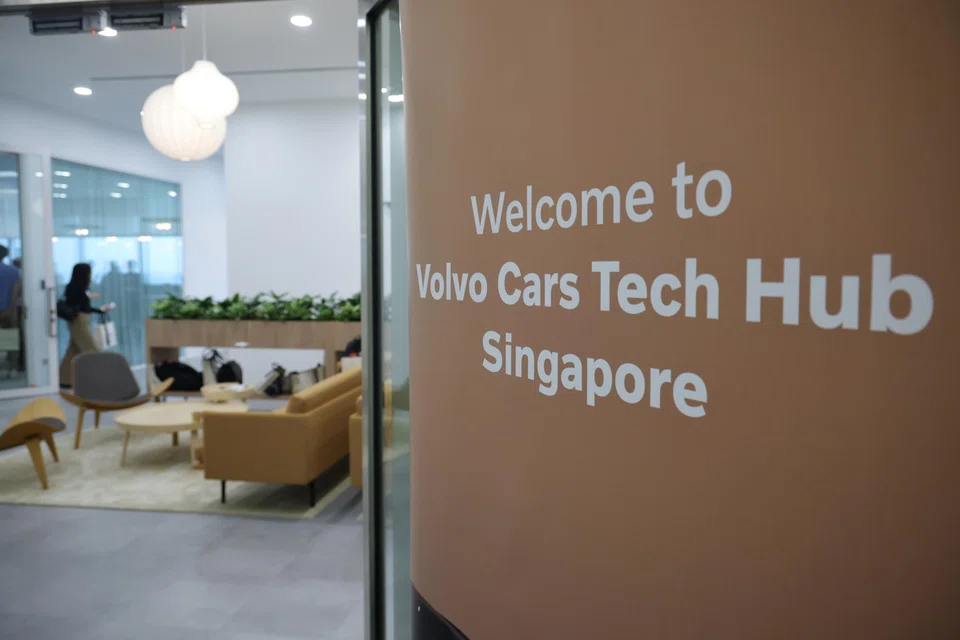
[SINGAPORE] Volvo Cars has shuttered its satellite research and development (R&D) office in Singapore, around eight months after it opened.
The Swedish carmaker confirmed the closure of the Volvo Tech Hub Singapore – which employed 14 staff – in a statement to The Business Times on Friday (Sep 26).
The closure “reflects the turbulence in global markets and the challenging external environment facing the automotive industry at large”, it said. In response to this, it has “initiated an accelerated cost and cash action plan designed to drive long-term structural efficiencies across the organisation”.
Volvo, which is owned by China’s Zhejiang Geely Holding Group, did not address queries on the exact date of the closure or whether staff were laid off or reassigned to other roles in the company.
“While the specific roles at the Singapore tech hub will be discontinued, the competencies and expertise developed there will be integrated and leveraged across other parts of the company,” it said, without elaborating.
First announced in September 2023, the hub was set up with the support of the Singapore Economic Development Board (EDB). Volvo did not reveal the total cost of the development, nor the nature or magnitude of EDB’s support.
An EDB spokesperson said the board, Workforce Singapore and the National Trades Union Congress’ Employment and Employability Institute are working closely with Volvo to support the affected employees, including facilitating job placements.
A challenging year
Officially opened on Jan 22, the hub was located in Aperia Tower 2 in Kallang, and had 9,432 square feet of space.
At the time, it employed around 15 people; the company said that headcount would be expanded “in accordance with business requirements”.
Research at the site concentrated on robotics, artificial intelligence (AI), data analytics, as well as power and engineering electronics. Solutions developed there were to be integrated into Volvo’s upcoming vehicles.
Volvo maintains four other tech hubs globally – two in Sweden, and one each in Poland and India.
This has been a challenging year for Volvo globally.
In the second quarter of 2025, its sales dipped 12 per cent year on year to 181,600 units; revenue was down 8 per cent to 93.5 billion Swedish kronor (S$12.78 billion). Its earnings before interest, tax, depreciation and amortisation slipped 44 per cent to 7.6 billion kronor.
Volvo cut 3,000 jobs globally in May; these were mostly white-collar positions in R&D, communications and human resources, among others.
Hakan Samuelsson, the carmaker’s president and chief executive officer, said: “The market trends we saw in the first quarter continued in the second quarter. Demand remains under pressure from the macroeconomic environment, tariff-related uncertainties and tougher competition.”
He previously held the CEO role from 2012 to 2022, and was reappointed on Apr 1, 2025. He will serve a two-year term to guide the company through its latest challenges, having replaced Jim Rowan as the carmaker searches for long-term leadership.
Volvo’s performance in Singapore has been more positive.
From January to August this year, the brand registered 426 cars, with sales buoyed by the introduction of the EX30 electric vehicle, which uses a mainstream Category A Certificate of Entitlement.
The brand’s registrations have increased in the past few years, to 557 in 2024 from 338 in 2022; this is largely thanks to the introduction of a range of electric vehicles.