

What can help give businesses more confidence to expand across borders?
New survey reveals that businesses are increasingly linking mediation to enforceable outcomes even as they navigate a more uncertain world
Kareyst Lin
A company raises money through a sustainability-linked bond, with its interest rate tied to meeting specified sustainability targets by a fixed date.
What happens when the borrower falls short of the targets – and the parties disagree over how the targets were measured, or whether the sustainability claims were accurate?
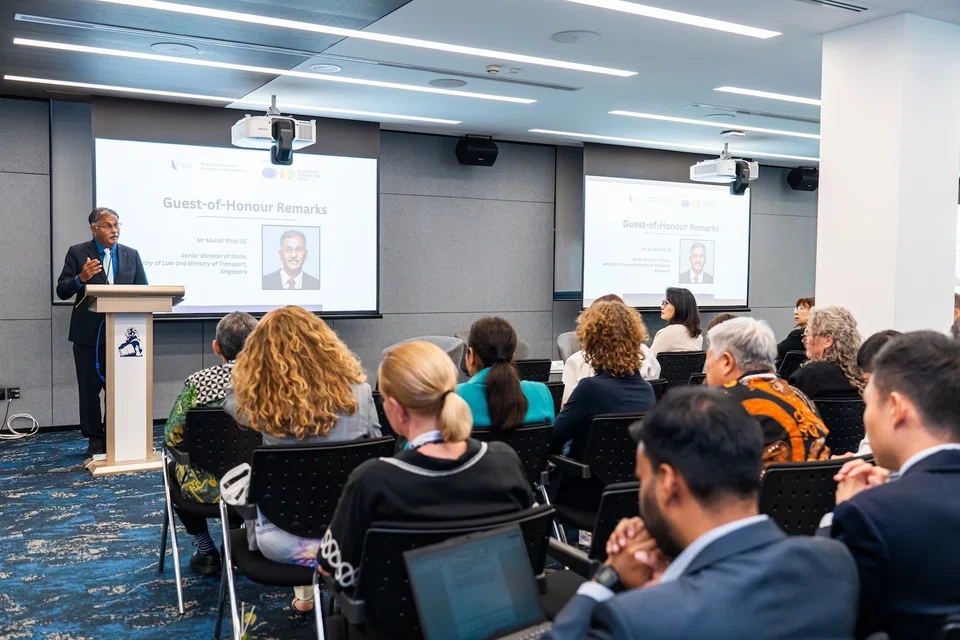
Climate change is one of several factors – including growing trade restrictions and geopolitical shifts – creating new categories of cross-border business disputes, said Senior Minister of State for Law and Transport Murali Pillai.
He was speaking at the launch of the Singapore International Dispute Resolution Academy’s (SIDRA) 2026 survey on global dispute resolution practices. The launch was held at Maxwell Chambers on Aug 26.
The event was part of Singapore Convention Week (SC Week) 2026, organised by the Ministry of Law, which took place from Aug 24 to 28.
While businesses may not always be able to anticipate what disputes could arise, a strong dispute resolution system can give them greater certainty over how those disputes will be handled, Pillai said.
“Businesses need confidence that if agreements are not kept or contracts are not honoured, there is a trusted and reliable means of seeking recourse.”
Such a system, he added, must be able to “provide binding awards and judgments, even in areas such as climate change and trade, where there is a lack of international consensus on tackling these challenges”.
Clarity in enforceability
This emphasis on enforceability is reflected in SIDRA’s latest survey findings.
Direct enforceability was rated “absolutely crucial” or “important” by 96 per cent of respondents when selecting litigation and arbitration, compared with 87 per cent for mediation.
Now in its fourth iteration, the survey polled 276 respondents across 25 countries from January to December 2025. The respondents were lawyers and in-house counsel who engaged in cross-border commercial dispute resolution between the years 2023 and 2024.
While the figures for litigation and arbitration remained broadly in line with earlier reports, the corresponding figure for mediation rose by 20 percentage points from 67 per cent in 2024.
The report attributes this increase to the growing impact of the Singapore Convention on Mediation. (see box below)
Timely solutions, broader perspectives
The Singapore Convention on Mediation (SCM) provides a uniform framework for invoking and enforcing international settlement agreements resulting from mediation.
Adopted by the UN General Assembly in 2018, the landmark international treaty opened for signature in Singapore in 2019, in conjunction with the debut of Singapore Convention Week (SC Week).
As of September 2026, SCM has 60 signatories and 24 contracting parties.
Over the years, SC Week has grown into a broader forum bringing together practitioners across business, policy and legal communities.
This was a shift that Cathryn Neo, head of Contingent and Litigation Risks at global insurance brokerage Howden, has witnessed firsthand as an attendee since 2019.
What began largely as a gathering of disputes lawyers discussing mediation and arbitration, said Neo, now draws in-house counsel, legal practitioners and experts across the intellectual property, and restructuring and insolvency space globally to participate.
It is in this exchange – where people from different disciplines bring different perspectives on cross-border transactions, collaborations and partnerships – that creative solutions can emerge, Neo said.
“(SC Week) brings people together to think about solutions, think outside the box, think about issues that have been happening, but from a different angle.”
Trust for cross-border businesses
For businesses, enforceability of a dispute settlement agreement is not simply a remedy when a deal goes wrong. It is part of the infrastructure that makes cross-border commerce possible.
“When businesses have trust in the rules that govern their operations,” said Law Minister Edwin Tong, “(and) in the institutions that resolve their disputes, they will be more willing to invest, trade, and enter into long-term relationships across borders.”
Tong was addressing about 500 participants at the United Nations Commission on International Trade Law (UNCITRAL) Academy Conference, held at Shangri-La Singapore on Aug 25.
The conference is a headline event of SC Week 2026, held under the theme: “Timeless principles, timely solutions: Nurturing trust in a changing world”.

Tong also announced two initiatives that Singapore is embarking on:
- A bid to host the proposed Multilateral Investment Tribunal (MIT) which would hear disputes between foreign investors and states; and
- A new Centre for Arbitration and International Dispute Resolution (CAIDR) by the Ministry of Law and National University of Singapore to drive thought leadership and innovation in international dispute resolution.
“Singapore has benefitted greatly from an international system in which disputes can be resolved according to rules, rather than power,” Tong said. “We want to contribute to keeping it strong, trusted and relevant.”
In partnership with the Ministry of Law
Decoding Asia newsletter: your guide to navigating Asia in a new global order. Sign up here to get Decoding Asia newsletter. Delivered to your inbox. Free.
Share with us your feedback on BT's products and services
TRENDING NOW

Grab CEO’s wife Chloe Tong on life with Anthony Tan and finding her purpose

Hwa Seng Builder, two China companies win S$1.2 billion Tuas Road Viaduct phase two contracts

Deal between tycoon friends sparks scrutiny of Philippine power sector

Canada is upping oil flows to Asia, but South-east Asia’s refineries aren’t ready to handle them yet

