



The AI arms race and China’s bid to stop Manus’ US$2 billion sale to Meta, explained
The startup’s parent company moved its headquarters to Singapore in June 2025, shortly before the deal

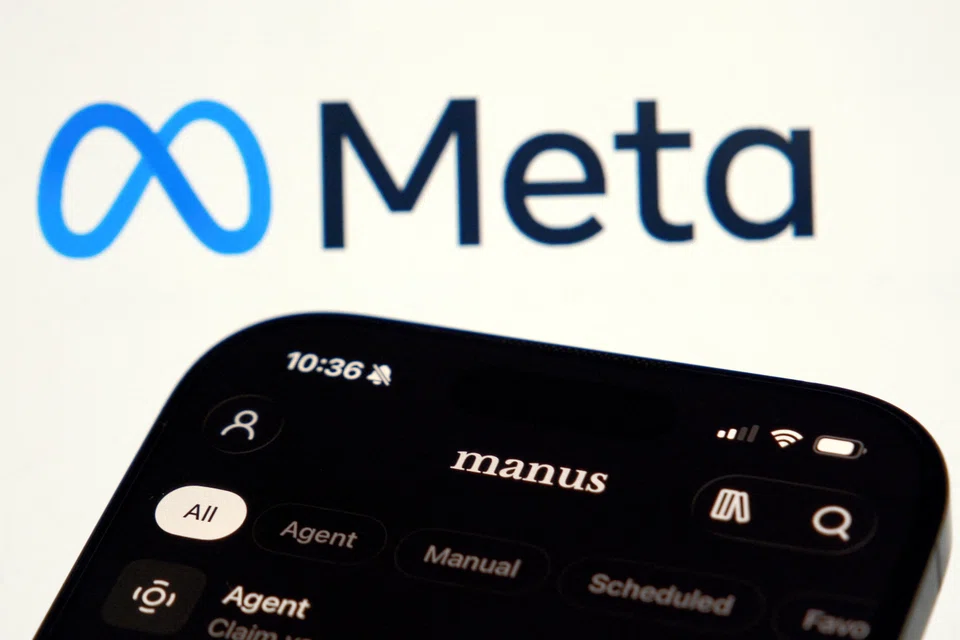
[SINGAPORE] China on Monday (Apr 27) ordered Meta to unwind its US$2 billion acquisition of Singapore-incorporated artificial intelligence startup Manus, scuppering a deal widely seen as a test of how far Beijing would go to keep Chinese-origin AI technology out of American hands.
The ruling by the National Development and Reform Commission (NDRC) came four months after the deal closed, and after Manus had already begun integrating its staff and technology into Meta’s operations.
Earlier on Tuesday, Reuters reported that Meta is preparing to comply and unwind the deal.
What is the significance of this agentic AI startup, and how did it end up at the centre of a US-China technology dispute? The Business Times breaks it down.
What is Manus?
Unlike traditional AI chatbots, Manus takes a high-level goal, breaks it into sub-tasks, navigates the Web, writes and executes code, analyses data, and delivers a finished result without requiring human oversight at each step.
Manus’ parent, Butterfly Effect, said it achieved an annualised average revenue of more than US$100 million just eight months after launch, with a revenue run rate exceeding US$125 million.
It also said that its agent outperforms OpenAI’s ChatGPT Deep Research on the General AI Assistants (Gaia) benchmark.
Who is behind Manus?
Butterfly Effect was co-founded by chief executive officer Xiao Hong, chief scientist Ji Yichao and chief product officer Tao Zhang.
Xiao, a graduate of Wuhan’s Huazhong University of Science and Technology, first made his name building WeChat productivity tools as a student.
SEE ALSO





In 2015, he founded Nightingale Technology and launched Yiban Assistant, a WeChat management tool backed by seed investor ZhenFund.
By 2019, he had developed a follow-on product, Weiban Assistant, an enterprise WeChat tool that attracted interest from Sequoia Capital China and Youzan before being acquired by Minglue Technology.
Xiao left Minglue in 2022, sensing an opportunity in large language models, and developed Monica.ai, initially conceived as a browser plug-in that brought ChatGPT-style functionality to Google search.
In late 2024, ByteDance made a US$30 million acquisition offer, which Xiao declined, choosing instead to raise a new funding round that valued the company at close to US$100 million.
Co-founder Ji dropped out of high school at age 17 to build Mammoth Browser, a project that caught the attention of Sequoia Capital China partner Zhou Kui, who introduced him to veteran investor Xu Xiaoping. Recognising the potential of large language models, Ji joined Xiao in late 2022.
Tao brings expertise in product from previous roles at ByteDance, Light Year (Meituan), and Sensors Data. He was head of global product at ByteDance from 2022 to 2023, and also served as a product manager at Tencent.
Where does Singapore fit in?
In June 2025, Butterfly Effect announced it had changed its operating entity to Butterfly Effect Pte Ltd and moved its headquarters to Singapore. Of the 120-person team in China at the time, around 40 core staff were invited to relocate; the rest were laid off.
In mid-2025, Butterfly Effect had secured funding at a valuation close to US$500 million in a round led by US venture capital firm Benchmark.
The Meta deal
Meta announced the acquisition of Manus in late December 2025, saying it was aimed at accelerating AI innovation for businesses and integrating advanced automation into its consumer and enterprise products, including its Meta AI assistant.
“There will be no continuing Chinese ownership interests in Manus AI following the transaction,” a Meta spokesperson confirmed to Nikkei Asia at the time.
More than 100 Manus employees moved into Meta’s Singapore offices in early March 2026.
Under the acquisition terms, Xiao was to serve as a vice-president at Meta, reporting to the US tech giant’s chief operating officer Javier Olivan.
How did Beijing respond?
China’s Ministry of Commerce launched an investigation in January into whether the deal complied with laws and regulations on export controls, technology import and export, and overseas investment.
The scrutiny escalated in March. Xiao and Ji, who are usually based in Singapore, were called to a meeting in Beijing and told they were not allowed to leave China because of the regulatory review.
On Monday, the NDRC issued its ruling. In a one-line statement, the commission said it was prohibiting a foreign acquisition of Manus and required all parties to withdraw from the deal. Meta said the transaction “complied fully with applicable law” and anticipated “an appropriate resolution”.
What happens next?
Meta is preparing to unwind the acquisition, according to media reports, though details of how this will be done have yet to be revealed.
Manus’ investors including Benchmark have already received their returns. Several of its former backers in Asia – including Tencent, HSG and ZhenFund – are expected to cooperate with the process.
Beijing has given both parties a preliminary deadline of several weeks to reverse the transaction and fully restore Manus’ Chinese assets to their original state.
BT has reached out to Manus and Singapore’s Ministry of Trade and Industry for comment.
Decoding Asia newsletter: your guide to navigating Asia in a new global order. Sign up here to get Decoding Asia newsletter. Delivered to your inbox. Free.
Copyright SPH Media. All rights reserved.






