



‘How many will survive?’: Bubble fears arise as China’s humanoid robotics face reality check
Industry leader Unitree soared during its Shanghai IPO, but has since plunged more than 50% from its peak
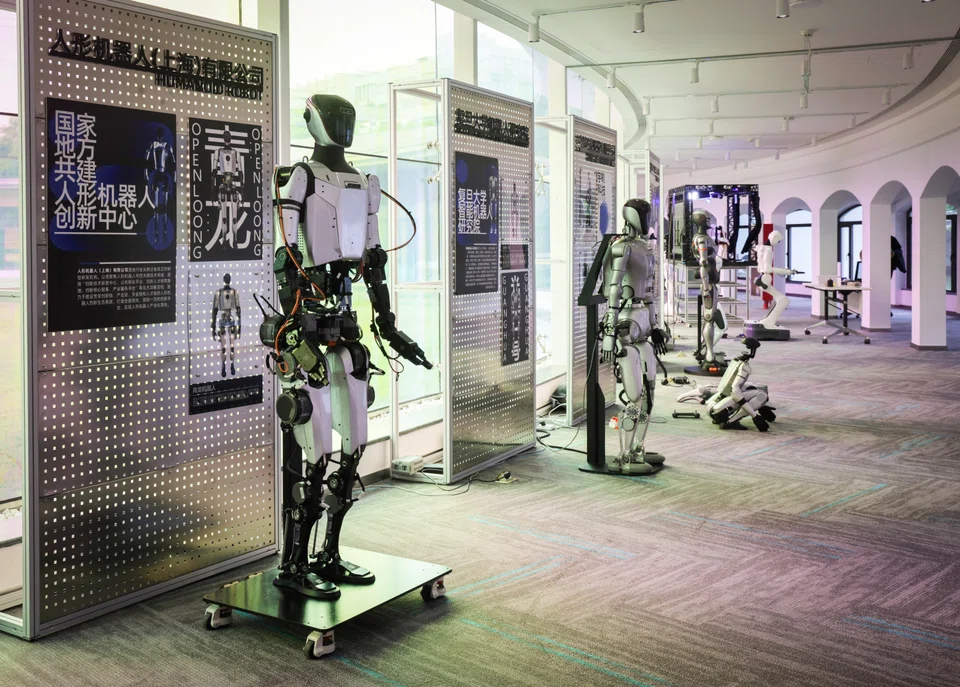
[SHANGHAI] From robots for healthcare and companionship, to those used in malls and hotels, China’s humanoid robotics industry is growing rapidly – although some in the industry caution that this area is nowhere near maturity.
The number of humanoid robotics companies has expanded from just a few dozen startups a few years ago to more than 150 companies currently.
Significant funds are pouring into this sector, with at least 50 upcoming artificial intelligence and robotics initial public offerings in China and Hong Kong by the end of 2026.
Unitree, one of the top humanoids startups in this area in China, soared during its Shanghai debut in August, but has since plunged more than 50 per cent from its peak.
Other competitors that have filed IPO applications include Leju Robotics and Deep Robotics.
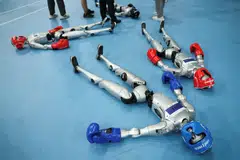
China’s humanoid robots first captured global attention for their extremely life-like movements in their dance routines.
Now, Chinese companies are showing off such robots’ capabilities to dish out caregiving services and emotional companionship, make coffee and provide room service at hotels.
Many robots are being researched and developed within universities. Fudan University in Shanghai is one of them. One of its humanoid robots, a traditional chinese medicine model, can also provide caregiving, and has been deployed in some hospitals.
Liu Lizheng, the professor in charge of Fudan’s robotics projects, said that the university is moving beyond healthcare to industrial, manufacturing and winemaking purposes.
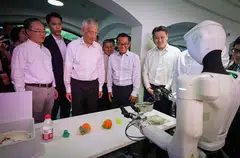

According to Morgan Stanley, commercialisation was already happening in the first half of 2026 in China, with government, enterprise users and humanoid integrators pushing out commercial verification or adoption.
“(There’s been a) stronger push towards commercialisation... the focus of the humanoid industry is shifting from demonstrations to commercialisation and real business value creation,” said Morgan Stanley equity analyst Sheng Zhong, who added that, nevertheless, commercialisation was still at an early stage.
“In H1 2026, we have observed accelerated progress,” she added, with initial use cases broadening across areas such as production lines, sorting lines and commercial services.
For instance, China’s State Grid, which is among the largest utilities firms globally, placed a 6.8 billion yuan (US$1 billion) order for humanoid, dual-armed and other types of robots.
Logistics and postal providers China Post and SF Express are deploying humanoids across logistics centres, according to Sheng.
She also noted “continuous livestreams” of humanoid robots working in factory settings, and in unmanned retail stores.
“As business verification typically takes several months, we expect projects that began testing in H1 2026 to translate into adoption from H2,” said Sheng.
She added that half-size humanoids, such as Unitree’s G1 model, could account for about 70 per cent of such robot shipments this year. According to Morgan Stanley estimates, China’s humanoid robot market will hit US$2 billion this year, growing to US$15 billion by 2030.
China, which is dominating the humanoid robot market, released its new Five-Year Plan in March with a focus on adopting AI tech and dominating emerging tech, such as humanoid robots and quantum computing.
This comes amid an ongoing battle with the US for tech supremacy on chips and other tech, with the US blacklisting Chinese humanoid robots in its latest move.
Risk of turning into a bubble?
The critical issue, however, is if the frenzy gets ahead of fundamentals.
Wang Bing, CEO of the Shanghai Humanoid Robot Innovation Incubator, said that while China is “moving very quickly” in AI and robotics, it needs to first establish safety standards and industry regulations.
For example, humanoid robots may first need to be tested in the field, such as in homes, before they get commercialised.
“Personally, I think it may take another 10 years,” he said. “But that’s a very optimistic estimate – it could take longer. After all, we haven’t achieved it in the past 10 years.”
“Hardware, software and data all need continuous iteration and upgrading...
“So optimistically, humanoid robots may enter households within 10 years. But nobody has fully answered a key question yet: Would you really want an unsafe machine serving your family at home?”
James Ong, group head of asset management, private equity, at Chinese investment firm CGSI, noted that while the Chinese are “really throwing money” behind AI and robotics, robotics itself is definitely still in “an exponential curve”.
“Are we anywhere near? I think we are not. So I still believe that it’s still in a nascent stage for the investments at this moment in time.”
AI moves a lot faster, but it is a little harder for robots to do tasks in an industrial setting, he said.
“You can make a robot dance, you can make a dog jump, but to do housework and things like that, I think there’s still some way there.”
Ong noted it’s a “very crowded base” at the moment.
“How many will survive? I think there’ll be only a fraction of the huge base,” he said.
Those that can industrialise their products and monetise the robots as early as they can will likely be the winners, he added.
Chinese regulators are reportedly tightening the approval for humanoid startups planning IPOs after a volatile debut by Unitree.
Rong Guoqiang, general manager of Shanghai Humanoid Robot Innovation Incubator, said that the state of the industry should be viewed from a long-term perspective.
“Comparing today’s actual state of industry development with where the trend is heading creates a mismatch in timing,” he said. “The industry’s current level of development, profitability, business scale and adoption all represent only an early snapshot of a much larger future trend.”
“In that sense, today’s reality should be viewed as an important indicator – preview – of where the industry is headed.”
At present, robots have already demonstrated outstanding performance in specific locations, particular application scenarios and for certain types of tasks – with development moving quickly.
However, if the benchmark is how closely robots resemble or match humans in a general sense, there is still a considerable gap.
What’s next?
Real-world data is key to the widespread implementation of robotics, said industry players.
“Robots must be integrated into specific use cases. That means combining real-world demand, digital infrastructure and large AI models,” said Rong.
“China already has manufacturers producing these robots, as well as suppliers of large language models, specialised AI models and intelligent agents,” he said. The incubator’s plan to expand into Singapore will increase its capabilities and allow these elements to be integrated.
“This combination could significantly accelerate the deployment of robots into real-world applications,” he said.
Decoding Asia newsletter: your guide to navigating Asia in a new global order. Sign up here to get Decoding Asia newsletter. Delivered to your inbox. Free.
Copyright SPH Media. All rights reserved.






