

Bluebird’s answer to Grab and Gojek? Not discounts
The Indonesian taxi company is sticking to delivering consistent and reliable service
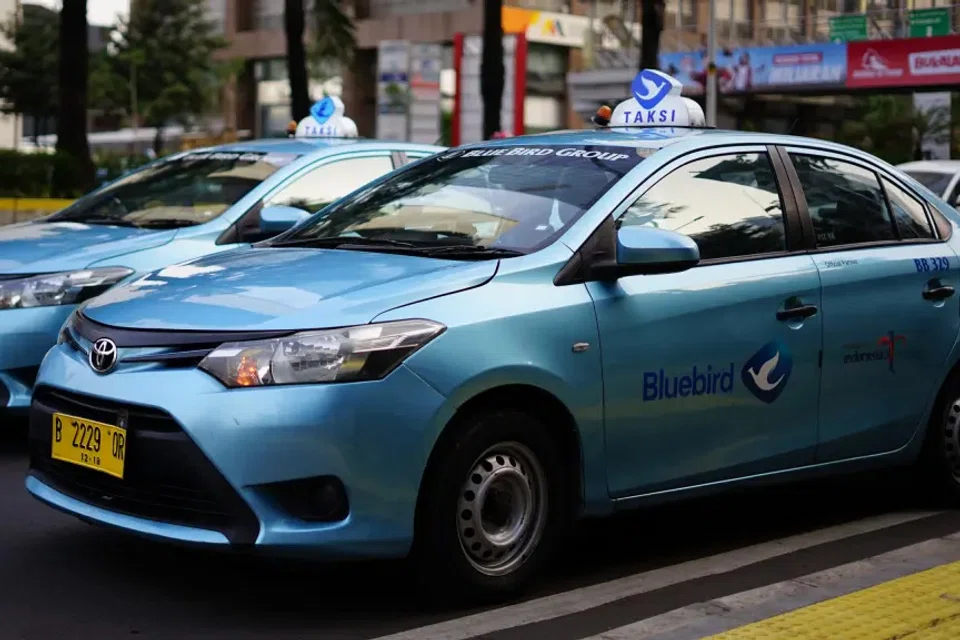
[JAKARTA] Bluebird, one of Indonesia’s oldest taxi companies, has been around for 53 years. Today, it faces competition from tech giants such as Grab and Gojek as well as emerging players like Vietnam’s Xanh SM, an electric vehicle (EV) startup that operates as Green SM in Indonesia.
But rather than racing to match these newer competitors on price or scale, Bluebird is sticking to delivering consistent and reliable service.
“We’re not targeting every segment and we’re not (entirely) premium either,” says Andre Djokosoetono, CEO of Bluebird Group, in an interview with Tech in Asia during the Asia Economic Summit in Jakarta. “We serve the non-price-sensitive market.”
Judging by Bluebird’s financials, the strategy works.
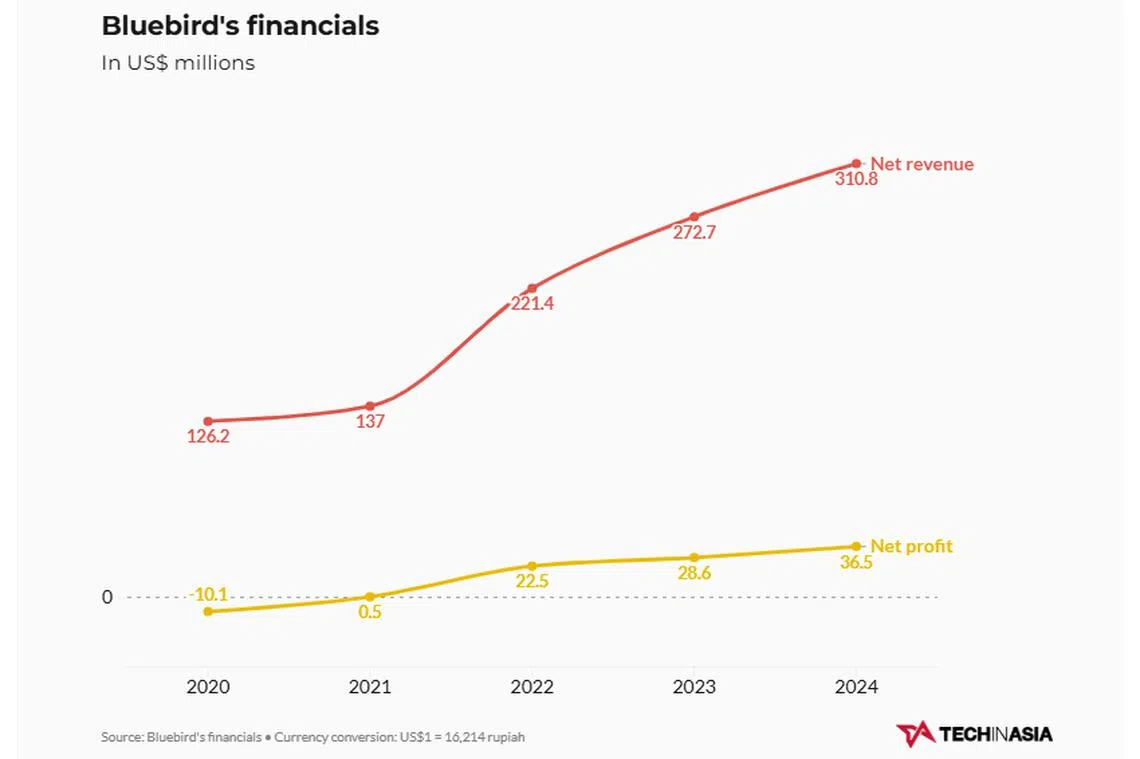
The company has consistently been profitable since its November 2014 initial public offering, aside from Covid-era blips. In 2024, it earned 592.7 billion rupiah (S$46.6 million) in net profit out of five trillion rupiah in net revenue.
Against price wars
Bluebird sees its segment as more focused on customers who prioritise consistency and service over cost.
As players such as Xanh SM enter the market with fully electric fleets and aggressive promotions, Bluebird is deliberately steering clear of competing on price. Djokosoetono says the company has “never been tempted to do price wars”.
“You can’t lower your prices and deliver a consistent quality,” he points out.
Amid competition from Gojek and Grab, Xanh SM has made aggressive moves. In December 2024, the Vietnamese company revealed its plan to operate 10,000 vehicles in Indonesia by the end of 2025.
In comparison, Bluebird had a fleet of 24,500 taxis as at April this year.
“We are delivering the service with certain standards of quality that require a lot of infrastructure,” says Djokosoetono, adding that the company also has to train its drivers to meet those standards.
To be clear, Grab and Gojek are much bigger companies in terms of size. Grab, for instance, earned US$643 million in Indonesia revenue in FY2024 – more than twice Bluebird’s, though that amount also includes other verticals like food delivery and financial services.
But matching Grab and Gojek’s scale may mean compromising quality and, in turn, hurting the Bluebird brand. Plus, despite the competition, Bluebird has chosen to partner its venture capital-backed rivals.
Its fleet is available on both Gojek and Grab – the former even acquired a 4.33 per cent stake in Bluebird back in 2020.
That does not mean Bluebird has not had to evolve to stay competitive with Grab and Gojek. In 2015, the company rolled out the MyBluebird app, which saw more than 40 per cent year-on-year growth in usage in the first quarter of 2025.
Djokosoetono reveals that the app has already been downloaded more than 1.5 million times this year.

That digital growth is mirrored in its financials. In 2024, Bluebird reported a 14 per cent increase in revenue and a 28 per cent growth in net profit, with a margin of around 12 per cent.
It aims to exceed those figures this year and is on track to do so, with Q1 revenue up 16 per cent year on year, the CEO says.
Bluebird’s offline services – such as street-hailing – also offer it some measure of differentiation with Grab and Gojek. Customers can still book a ride through the company’s call centre, with Djokosoetono pointing out that even new users avail of this option.
The company says it is “agnostic” about how rides are booked or paid for.
From EVs to AI
Bluebird started experimenting with EVs as early as 2019, long before most of the industry paid attention.
Today, it has about 500 EVs on the road. That number could grow to 1,000 by year-end, depending on whether vehicle supply and pricing align with its service standards.
Bluebird is also quietly working on an autonomous driving project, though it acknowledges that Indonesia is still far from ready for mass adoption. Notably, the company believes that road conditions, not regulation, are the bigger barrier to autonomous vehicles in the country.
In the meantime, Bluebird is investing in artificial intelligence (AI) to improve how its fleet operates. The company uses AI to predict demand and move vehicles to passenger hot spots in advance, sometimes 15 to 30 minutes ahead.
It is also using algorithms to detect and address inconsistent driving behaviour. This is important because poor driver attitude is now easily amplified online and poses greater reputational risk in the long term.
In addition, Bluebird has experienced a shift in customer transactions. More than half of payments are now made through cashless methods, whether through the app, QR code scanning, or partner platforms.
But the company is not dropping cash payments anytime soon, with Djokosoetono pointing out that “some customers still want to pay in cash”.
Bluebird is open to mergers and acquisitions. It acquired intercity shuttle bus operator Cititrans in 2019, which has expanded to 10 cities in Java.
Djokosoetono says another deal is in the works, though he declined to share details.
“Organic and inorganic growth are always options for us,” says the CEO. “If we can accelerate with inorganic options, we will do it as well.”
TRENDING NOW

Britain’s mansion tax shows the difficulty of targeting wealth

Once staunchly pro-China, Malaysian Chinese businesses are now distancing themselves from Beijing

The only common thing in S-E Asia is that we all eat rice: Cisco’s Asean president
Singapore data centre operator DayOne opts for US IPO at likely US$20 billion valuation

