

Investors keen on regional biotech, but are cautious about deal terms

AFTER raising record amounts of capital in 2021, South-east Asian biotech companies continue to draw in investors this year. However, deal terms are getting tighter, as venture capitalists seek more protection against macroeconomic headwinds.
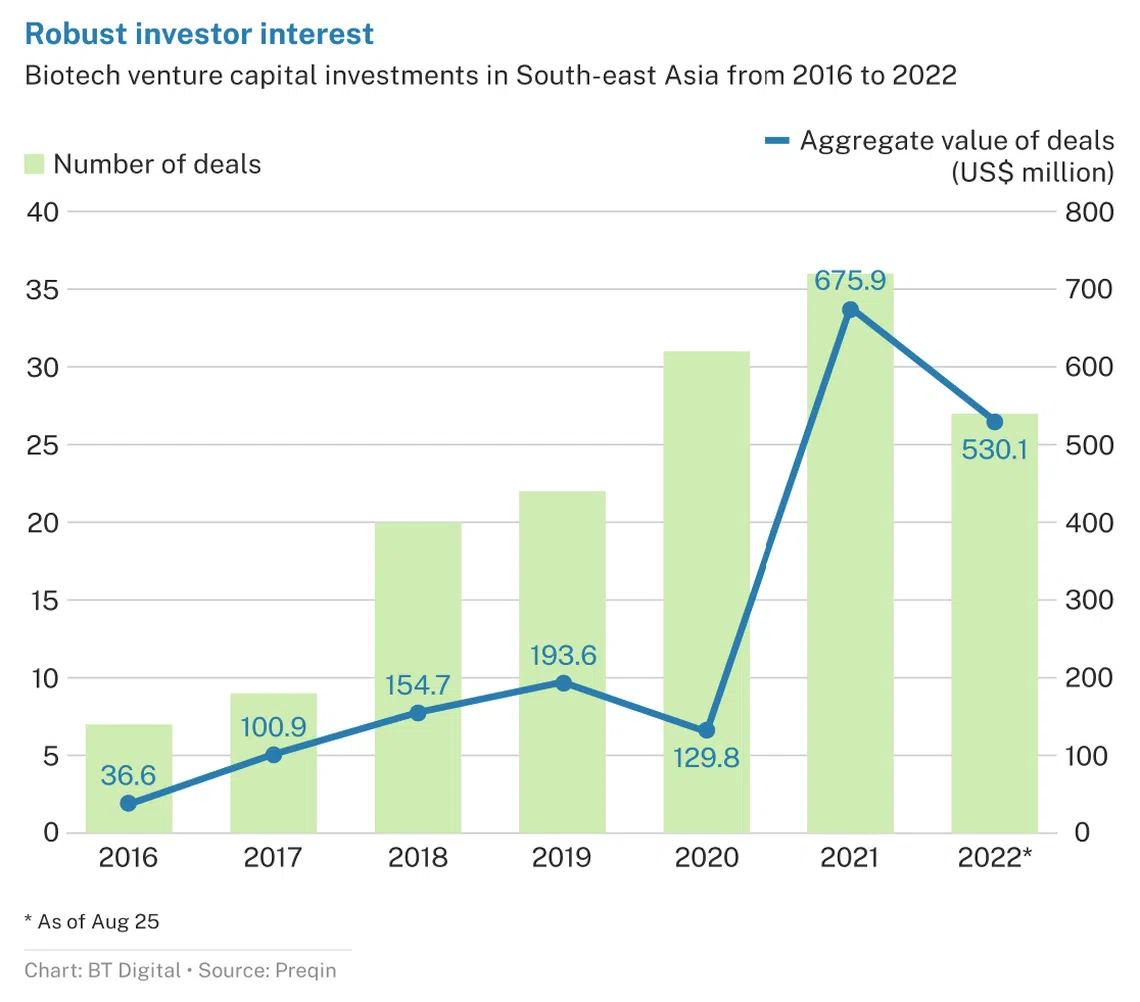
According to data from private markets specialist Preqin, 2021 was a breakout year for regional biotech, with US$675.9 million worth of venture deals, more than 5 times that of 2020 (see chart).
Fundraising this year remains strong, with 27 biotech venture investments worth US$530.1 million in South-east Asia – mainly Singapore – as of Aug 25. Notable deals include cancer treatment firm Tessa Therapeutics’ US$126 million Series A raise in June, as well as mRNA player RVAC Medicines’ US$140 million Series B round.
There are signs of strong institutional interest. On Sep 15, Temasek’s CLA Real Estate established a new company called ClavystBio to invest in life sciences companies and develop an innovation district in Singapore.
Biotech deal-making “has not really – as what a lot of people thought – fallen off a cliff”, said Tong Hsien-Hui, executive director of investments at deep-tech investor SGInnovate. He cited mRNA technology, gerontology and genetics as segments of interest, even past the pandemic hype.
Khoo Shih, senior investment advisor at ClavystBio, likewise noted that global biotech funding has been moderate this year due to market concerns, but highlighted that early-stage venture funding for breakthrough innovations remains healthy.
ClavystBio is, for instance, bullish on CoV Biotechnology, an under-a-year-old Singapore-based biotech that develops vaccines against future coronavirus variants.
Khoo said: “Biotech companies in Singapore, particularly those backed by great science and technologies that can transform healthcare, will continue to attract funding from investors with a longer-term outlook.”
Chik Wai Chiew, the chief executive of Heritas Capital, is similarly optimistic on biotech deals, having backed several players such as Tessa Therapeutics. But investors like him are also treading carefully amid macro uncertainties such as rising interest rates, inflation and supply-chain disruptions.
“We are a bit more cautious because any deal we put money behind also has to factor in the future fundraise. This whole environment does make us think twice and be more prudent,” he said.
The fine print
Investors’ cautious outlook has had an impact on deal terms. Valuation bumps are not as common as they once were and term sheets are coming with more protective clauses.
Thomas Chou, co-head of the Asia private equity group at law firm Morrison Foerster, said: “In the last few years, a lot of companies in this sector raised very large sums of money at very high valuations. I’ve seen several companies come back to my desk in 2020 and 2021, and their valuations would have doubled or sometimes tripled during that time.
“It’s very hard for (these) companies to be able to accept a lower valuation, because so many of their existing investors would be underwater.”
Flat rounds, where the valuation of the company is unchanged, are “not a bad thing” in this current market, said Chou. Such rounds can be structured as an extension of the last equity round, with the pre-money valuation of the company staying the same.
“But even in these extensions, there is a lot of concern about downside risk. We are seeing, for example, more aggressive liquidation preferences; we see people asking for redemption rights with fairly broad triggers to activate such rights,” said Chou.
In cases where the round is structured with convertible notes, investors are also requesting discounts of as much as 30 per cent upon conversion, whereas the threshold would normally be set at 20 per cent.
Tong of SGInnovate observed that investors are taking longer to do due diligence, and “with inflation going up, the need for a higher return is becoming more important”. This presents a challenge for biotechs, many of which are pre-revenue and have longer exit timelines.
“(With) biotech companies, you get a 6-month break after your last fundraise and that’s about it,” noted Zhou Lihan, co-founder and CEO of Mirxes, a Singapore biotech focused on early cancer detection.
“But we are not under pressure; I won’t be spending 50 per cent of my time talking to investors, because I know the market is uncertain and people are anxious,” he said, adding that the focus has been more on what opportunities the company can capture. Mirxes last year raised US$77 million in a Series C round.
Du Fang, co-founder and chief operating officer of Breathonix, which last year came up with a Covid-19 breath test, is optimistic that the biotech space will be resilient in the face of macro uncertainties. More investor caution may also not be a bad thing, he said.
“I think it’s normal that investors tend to be more conservative and cautious, and also they may look more at the value of the projects, because we know that in the past, some startups’ valuation can be a bit inflated.”






