

Don’t underestimate Singapore: Gojek co-founder on missed chances
SOUTH-EAST Asia is often seen as the next growth frontier for tech companies. Over the last two decades, it has been the third-fastest-growing region in terms of annual gross domestic product (GDP).
But billing the region as the next China or India is “misguided”, according to Lightspeed Venture Partners.
In a report titled Resetting Expectations, the global multistage VC firm challenges this portrayal of South-east Asia and shares why the region has not delivered on this expectation 10 years in.
Kevin Aluwi, venture partner at Lightspeed and co-founder of Gojek, co-authored the report. Speaking to Tech in Asia, he discusses how Gojek could have approached regional expansion differently, why many who invested in South-east Asia got “burned”, and why projections from many tech companies in the region ultimately did not materialise.
Now based in Singapore, Aluwi stepped down from GoTo’s board of commissioners in 2023. He joined Lightspeed in January of this year.
What Gojek got wrong
In its early years, Gojek made missteps in the way it navigated South-east Asia.

As its co-founder, Aluwi has a few regrets about the strategies the company implemented in the past, particularly the timing of its regional expansion.
In its early years after launching the app in 2015, Gojek chose to focus on Indonesia first. Aluwi said it was not realistic for the company to build regionally from the start because its fleet initially consisted only of motorcycles. Unfortunately, ride-hailing services using such vehicles are banned in Malaysia and Singapore.
In 2016, Gojek launched its car-hailing services in Indonesia. Aluwi believes it should have expanded overseas after that to capture cities with high GDP earlier, but instead, it waited two more years before entering Vietnam, Thailand, and Singapore.
Internally, the company believed that “as long as you win Indonesia, you win everything”, Aluwi recalled. But that was “a huge mistake”, and it was “way too premature to make that assumption”.
“It might be true in 10 years but very, very wrong back then and today,” he added.
Aluwi also shares that at the time, he was confident that cities outside Jakarta would grow quickly in their take-up of consumer services. But in reality, most Indonesian tech companies, including Gojek, still relied on Jakarta as their biggest revenue contributor.
In contrast, Grab aggressively pursued regional expansion from the start. Established in Malaysia in 2012, the firm began entering neighbouring markets as early as 2013. Grab’s focus on taxi services in the beginning made it easier for the company to expand in the region.
Gojek has since exited Vietnam and Thailand. It sold its Thai operations in 2021 and then left Vietnam in September of this year.
According to Aluwi, Gojek’s problem with its regional expansion was that even after it penetrated neighbouring markets, the firm was still too focused on Indonesia.
“We didn’t take it seriously in the beginning,” he said, describing the move as something like “a second priority”. “We didn’t spend enough of our engineering and product resources to make it successful until a year after our expansion.”
Singapore is the “most important” market
For Aluwi, Singapore – not Indonesia – is the most important market in South-east Asia.
He points out that people often view the city-state as a small market and believe Singapore companies have to go global from the start to be successful. In contrast, some think companies in Indonesia can do well by focusing on the country alone.
“We have actually seen over the last few years that’s not true,” Aluwi said.
The Lightspeed report indicates that the metropolitan area with the highest GDP in the region is Singapore, which generated US$462 billion last year. This is higher than Greater Jakarta’s US$276 billion and Bangkok’s US$236 billion.
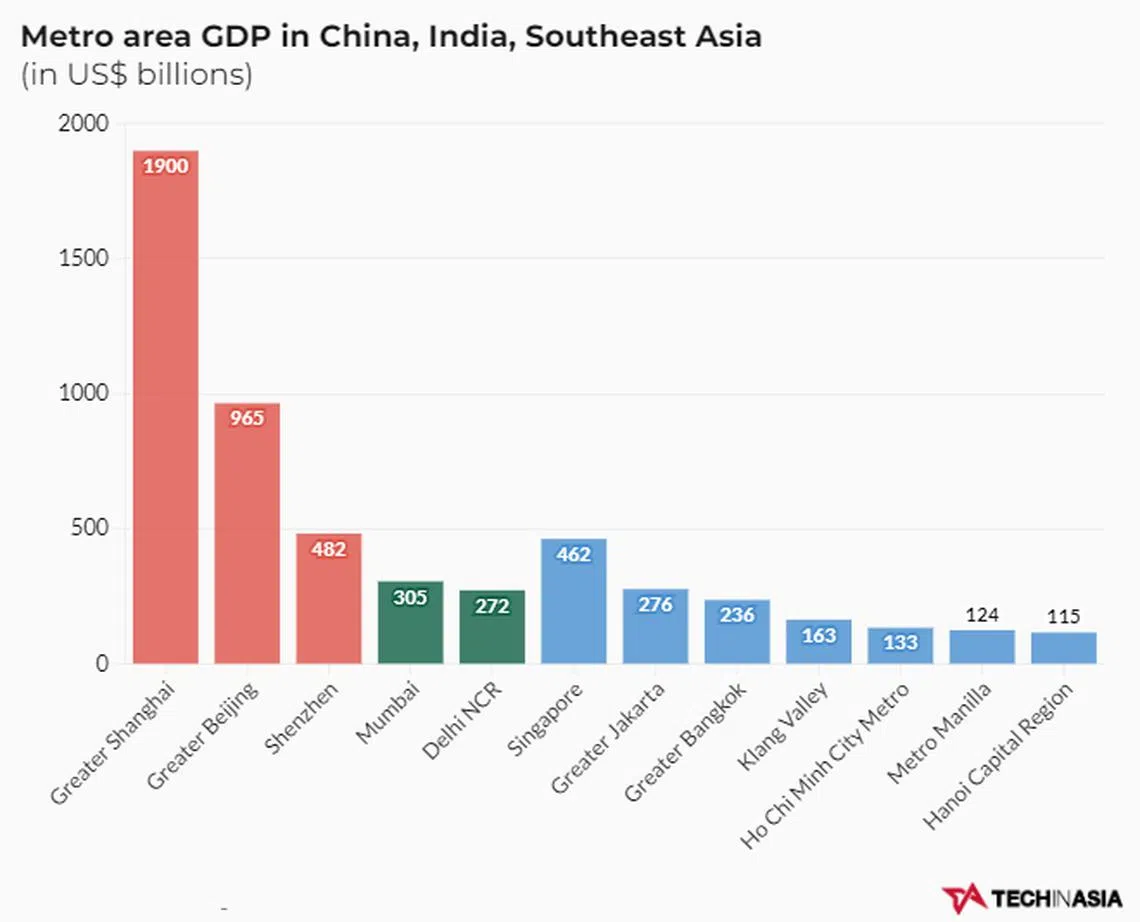
Although Singapore’s population of around six million corresponds to only 1 per cent of South-east Asia’s total, the city-state has significantly higher purchasing power.
In Singapore, the top 1 per cent of the population earns an average monthly income of US$61,000, compared to Indonesia’s US$5,700. That trend is true even for the bottom 90 per cent of earners in the two countries.
Grab, for instance, derived 23 per cent of its revenue in 2023 from Singapore, not far behind Indonesia’s contribution of 29 per cent, the report reveals. Companies such as Traveloka, YouTrip, Gojek, Carro, Shopee, and Lazada have also recorded more than US$50 million each in revenue from the city-state alone.
“If you were a consumer tech founder and you had to choose which market to win today, you should win the six million people in Singapore,” Aluwi said.
Notably, 90 per cent of households in Singapore are potentially power users – those who are willing to spend for added convenience, comfort, and quality. Businesses focusing on this market do not have to overwhelmingly rely on discounts. Instead, they need to differentiate themselves on innovation, user experience, and convenience.
Still, even if Aluwi believes that companies targeting the consumer market should prioritise Singapore over Indonesia, he conceded that it will ultimately depend on the firms’ business models and products.
“There are definitely certain models that work better in lower income and larger populations such as Indonesia,” he said.
Why SEA is not the next China or India
Funding for South-east Asian tech companies has dropped sharply after reaching its peak in 2021. In the past two years, many firms have also laid off employees or shut down operations.
Most of the region’s tech companies have seen significant declines in value after going public as well. As at September, Bukalapak, GoTo, and Grab have recorded 90 per cent, 86 per cent, and 65 per cent drops in market capitalisation since their listings.
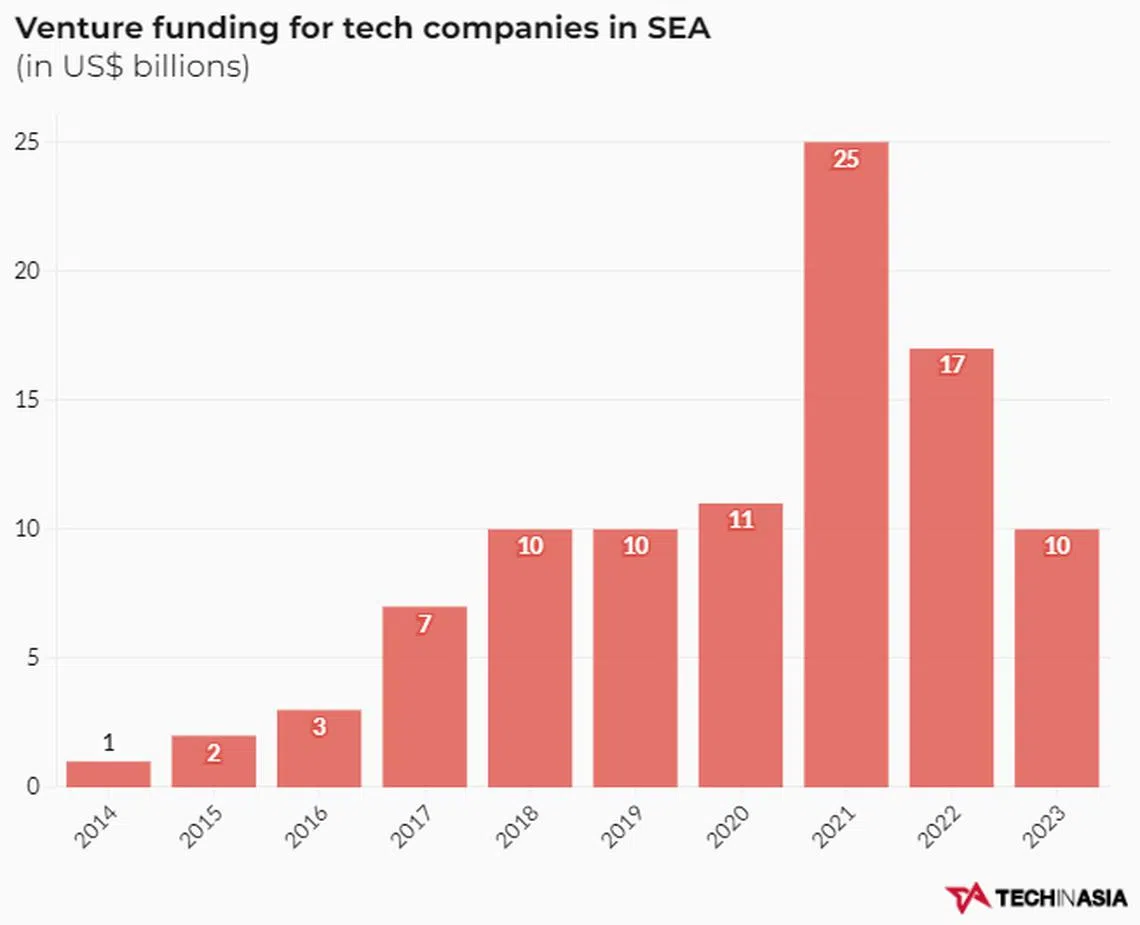
Rising interest rates in the US and global geopolitical challenges have contributed to the decrease in tech valuations. However, the primary reason for this trend among South-east Asia’s tech companies is the lack of consumer buying power, Aluwi explained.
Consumer buying power has not been able to support the revenue and profitability predictions made by these firms between 2018 and 2020, he said, adding that many of GoTo’s and Grab’s original projections “did not end up coming true”.
According to the Lightspeed report, South-east Asia’s demographics are “fundamentally different” from that of China and India.
Despite the region’s large population size, most of its tech companies are consumer tech firms that require large urban centres and a thriving middle class with spending power. This is something China and India have at a much greater scale than South-east Asia.
Reality check
Like many tech firms, GoTo and Grab are now focusing on pursuing profitability.
“Before, I would say there was very little focus on the sustainability of revenue growth and what future profitability looks like,” said Aluwi. “We just assumed that unit economics could be improved while maintaining growth and transaction frequency.”
Now, there’s a bigger focus in the industry on answering these questions, including what strategies to implement to attain much better unit economics and even how to demonstrate it much earlier, he added.
While it is possible to build a business that is valuable at scale right now in South-east Asia, founders should employ strategies that take into account the different income levels of users.
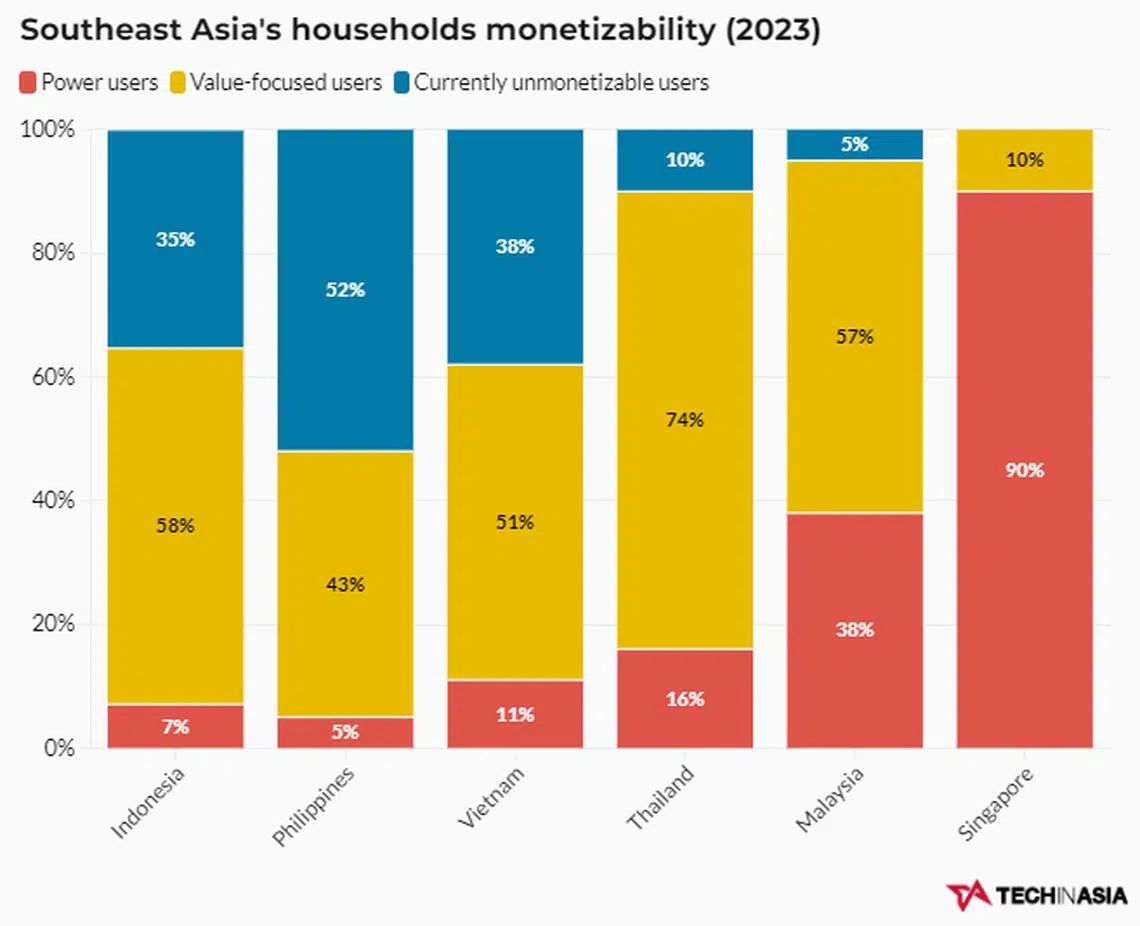
As per the Lightspeed Venture Partners report, 52 per cent of South-east Asia’s households are value-focused users who prioritise costs over convenience. They pay close attention to discounts when purchasing something, such as those frequently offered by e-commerce platforms such as Shopee and TikTok Shop. Meanwhile, only 10 per cent are power users.
Grab and Gojek initially offered massive discounts, but these promotions are now more limited or targeted, either requiring minimum transaction amounts or being valid only during certain hours.
As for funding in the industry, it “will come back when founders build companies that deliver profitable customer cohorts at scale, the middle class grows meaningfully, and investors have a good sense of what kind of companies can be sustainably built in this region”, according to Aluwi.
“We are at a phase right now of trying to recalibrate what the accurate expectations for company revenue and profitability are in the region, which I would argue is based on how much spending power the middle class here has,” he said. TECH IN ASIA
TRENDING NOW

Britain’s mansion tax shows the difficulty of targeting wealth

Once staunchly pro-China, Malaysian Chinese businesses are now distancing themselves from Beijing

The only common thing in S-E Asia is that we all eat rice: Cisco’s Asean president
Singapore data centre operator DayOne opts for US IPO at likely US$20 billion valuation

