

Indonesian third-party logistics players say Shopee antitrust fix falls short, urge action
M&A might become their best option and ‘necessary for their survival’, says co-founder of local logistics firm

THE rise of e-commerce platforms’ in-house fleets continues to erode shipment volumes for Indonesian third-party logistics (3PL) players, many of whom are now asking the government to do more to protect them.
Nearly all major e-commerce companies in Indonesia have in-house fleets, including Shopee, Lazada, Tokopedia, and BiliBili.
Shopee even faced allegations of monopolistic behaviour in the country, being accused of prioritising its logistics service SPX Express over 3PL players on its platform.
However, the case – which was handled by Indonesia’s antitrust agency – was resolved after Shopee made it easier for customers to choose their preferred courier for their purchases.
But local 3PL companies say that more action is needed to ensure the industry’s survival.
Competition with in-house players has led to an “unhealthy” price war, said a co-founder of an Indonesian logistics business who asked to remain anonymous. The co-founder alleges that Shopee’s changes are unlikely to significantly benefit 3PL companies.
The boom that did not come
In-house logistics services can offer lower rates to end-users because they receive subsidies from their parent companies, which have other revenue streams. Meanwhile, 3PL players are heavily reliant on revenue from shipping services, the co-founder explains.
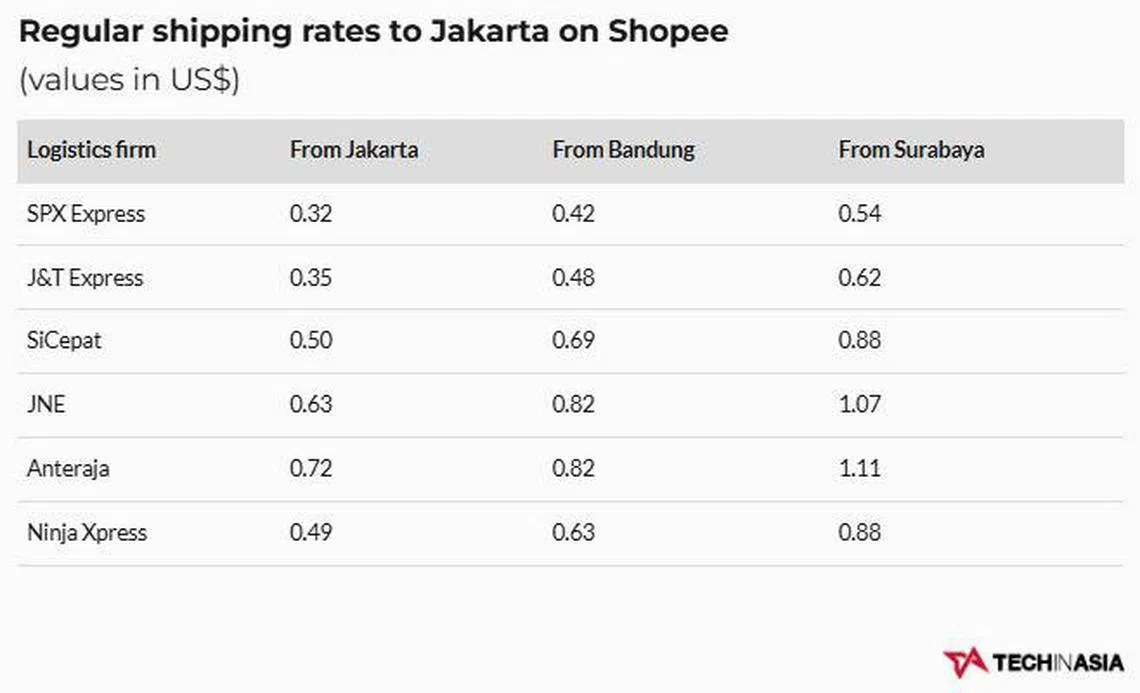
The situation has become even more challenging for 3PL companies as their shipment volumes have fallen after the pandemic, according to the co-founder. Additionally, funding for logistics startups in the country remains scarce amid the tech winter.
“During Covid, all last-mile or 3PL companies increased capacity expecting volumes to keep rising, but they dropped sharply once the pandemic subsided,” the co-founder said.
This decline is reflected in the financial performance of companies such as Ninja Van and Anteraja. The former’s revenue in Indonesia fell by 33 per cent year on year in its 2023 financial year, and the latter has seen its revenue drop in 2023.
Layoffs have also affected several players in the 3PL industry, including SiCepat in 2022 and J&T Express over the past year.
Minimum price regulation
To address the current situation, logistics associations in Indonesia are urging the government to set a price floor for courier services on e-commerce platforms and general courier deliveries.
This would help eliminate “price wars and predatory pricing” in the logistics industry, said Jimmi Krismiardhi, vice-chairman of the Digital Economy Logistics Association of Indonesia (Aldei).
Krismiardhi said that Aldei, along with the Indonesian Association of Express Delivery, Post, and Logistics Companies (Asperindo), has raised this issue with the Ministry of Communication and Digital (Komdigi). The ministry is currently reviewing and analysing relevant data.
“We don’t know the government’s target completion date, but we hope it will be finalised by early 2025,” Krismiardhi said.
However, it remains uncertain when, or if, the government will actually issue this regulation, and it has yet to announce anything to the public. Tech in Asia has reached out to Komdigi for comment, but has yet to receive a response.
The implementation of a price floor would “create a level playing field” for all players, enabling fair competition in an industry plagued by severe price wars, said Asperindo secretary-general Tekad Sukatno.
It “is necessary to ensure industry players prioritise service quality rather than just compete on low prices”, he added.
Should the government intervene?
However, the fact is that sellers, including those on Shopee, have the freedom to choose the shipping services they want to use.
In fact, sellers on the platform can even disable SPX Express as a delivery option for buyers if they wish.
Following Shopee’s changes after the case, shipment volume at SiCepat has remained stable, said Imam Sedayu, its chief commercial officer and chairman of Aldei. There have been no significant changes to SiCepat’s volume on Shopee, he added.
SPX’s continued popularity suggests that buyers simply appreciate its low cost and reliability.
Sugi Purnoto, a senior consultant at Supply Chain Indonesia (SCI), offers a different perspective.
According to him, pricing involves negotiations between e-commerce platforms and their 3PL partners. “This is driven by business competition and supply-and-demand dynamics,” he explained.
Considering this, he argues that the government should not interfere with pricing. Instead, he suggests that it should focus on ensuring that e-commerce platforms do not have logistics subsidiaries at all.
“The main issue is that e-commerce companies with their own logistics make it difficult for 3PLs to compete,” he said.
Couriers become victims
Price wars in the logistics sector also occurred in China before regulators took action. In 2021, they prohibited courier companies from offering shipping rates below the cost of delivery.
Players such as ZTO Express, YTO Express, Yunda Express, and J&T Express all pledged to increase their rates to provide more income for delivery workers.
In Indonesia, most couriers are classified as partners and are paid per package delivered – similar to the system in China.
The anonymous co-founder said that couriers have become victims of the ongoing price war, as their per-package earnings have been steadily declining since the pandemic.
“To earn the same income as during Covid, they now have to deliver more packages, even working from morning until night,” the co-founder said.
Low wages and extreme work patterns could push delivery workers to seek jobs in other industries that offer better pay. This could, in turn, lead to a shortage of delivery workers.
“We believe a maximum price floor is also needed to protect consumers and maintain the industry’s overall competitiveness,” said Aldei’s Sedayu.
Currently, SPX Express and J&T Express offer the cheapest shipping rates, with the latter being a 3PL player.
While SPX is supported by subsidies from Shopee, J&T Express offers low prices due to its strong capital backing.
Before raising US$450 million through its initial public offering (IPO) in October 2023, it had already secured billions of US dollars in funding from venture capital. Indonesia is J&T’s second-largest market after China, and it handles around four million packages daily across the archipelago.
This raises the question of whether the issue is really a question of in-house versus 3PL players, or simply which firms have more to invest in their business.
Tech in Asia reached out to Shopee and Lazada for comments, but it has yet to hear back.
Indonesia’s antitrust agency has also been investigating Lazada for similar anticompetitive practices as Shopee since May. However, there have been no updates on the status of this investigation.
M&A a final option?
If the situation does not change, Indonesia’s 3PL players will “die slowly”, said the anonymous co-founder. Mergers and acquisitions (M&A) might become their best option and “necessary for their survival”, the co-founder believes.
Sedayu agrees that M&A deals would “benefit the industry” and could foster the emergence of a “local 3PL champion”. Such a company might have the potential to compete with foreign-owned players as well as J&T Express, which has significant capital backing from its IPO in Hong Kong.
That said, e-commerce companies will likely still need the presence of 3PL partners on their platforms to handle areas that are not yet covered by their in-house fleets, or to meet demand during peak shopping seasons.
“The most reliable source of 3PL volume is serving as the last mile for e-commerce,” added SCI’s Purnoto. “But given the current situation, they need to adopt a different approach.”
TRENDING NOW

Once staunchly pro-China, Malaysian Chinese businesses are now distancing themselves from Beijing

Stocks to watch: HPL, Aims Apac Reit, Zico, Advanced Systems Automation, ComfortDelGro

‘How many will survive?’: Bubble fears arise as China’s humanoid robotics face reality check

Smaller board lots can’t fix a market run by three banks

