

The trillion-dollar question behind the AI trade
Anthropic’s listing shows investors’ belief in AI. But will customers pay enough to cover the capex build-out?
ARTIFICIAL intelligence is real. I know because it has changed how my own team works.
Venture capital used to start with a lot of digging. We trawled databases and news flow for companies worth a call. A first read of a sector used to eat most of an associate’s week.
Now, AI agents do the first pass. It takes an afternoon, and the time saved goes into calling customers and checking what the founder told us. Our investment committee papers are drafted by AI and edited by people. It used to be the other way round.
We even built our own software. Using AI coding tools, our team put together a venture operating system that tracks every deal from first lead to portfolio, and prepares our limited partner (LP) reports.
Nobody on the team is a software engineer. A year ago, this would have meant a six-figure contract with a vendor. This year, it was a side project.
However, being useful and making money are different things. That gap is what the AI trade now hinges on.

A record listing in a nervous market
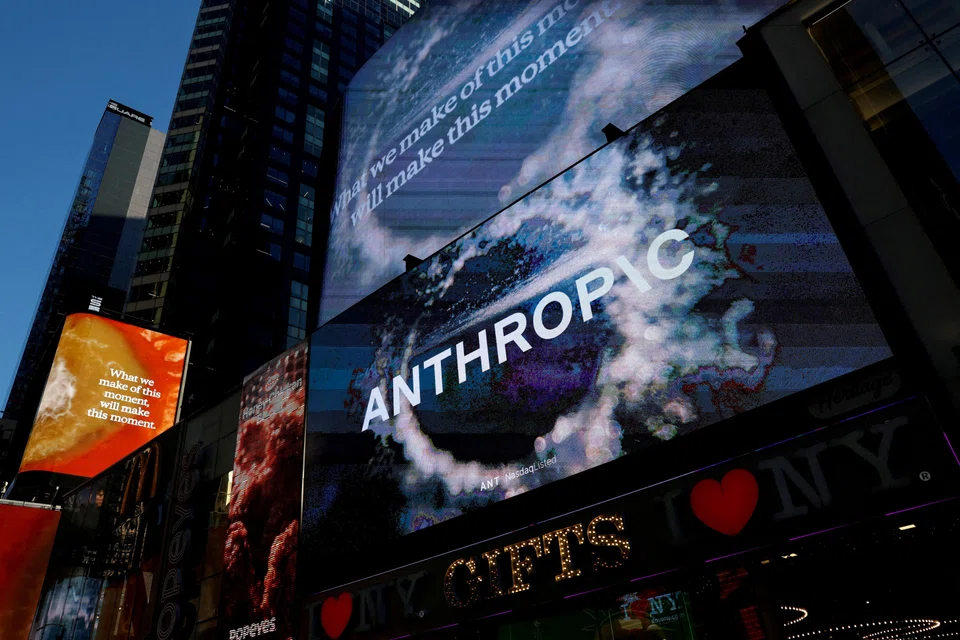
On Nov 19, Anthropic, the maker of Claude, listed on Nasdaq in the largest initial public offering (IPO) on record, raising about US$81.3 billion. Its shares closed the first day 17 per cent above the IPO price, valuing the company at roughly US$1.76 trillion.
That vote of confidence came in a nervous market. The Nasdaq 100 had fallen about 13 per cent from its early-October peak. Two days before the listing, Nvidia reported quarterly revenue of US$115.8 billion, more than double that of the year before, yet its shares kept sliding.
Jensen Huang had resigned as chief executive the week before. Washington also tightened export controls, requiring licences for advanced chips shipped to several countries, including Singapore and Malaysia.


There is also a deeper worry about money. More and more of the build-out is financed through what look like circular deals between chipmakers and the AI labs that buy from them.
Alongside the IPO, Anthropic raised another US$26 billion through a private placement with strategic partners including Google and Nvidia. That is not irrational, but it makes it harder to tell how much demand comes from real customers and how much is money circling within the industry.
The listing tells us investors will pay a premium for an AI lab with fast-growing revenue. It does not tell us whether the infrastructure behind it will earn a return.
How big is the hurdle?
Moody’s expects hyperscaler capital spending to reach about US$785 billion this year and approach US$1 trillion in 2027. Goldman Sachs is more bullish, expecting the five largest to spend about US$1.2 trillion on AI infrastructure in 2027.
Call it US$1 trillion a year, and assume for simplicity that three-quarters goes to AI, since about a quarter will probably go to replacing ageing servers and storage in the traditional cloud business. That is US$750 billion a year.
Now some rough maths. Microsoft and Google depreciate their servers over six years in their own accounts, so I will use the same life. Each year of spending adds about US$125 billion of depreciation. Keep spending US$750 billion a year from 2027, and by the early 2030s, you would end up with about US$4.5 trillion of AI infrastructure, depreciating at US$750 billion a year.
Depreciation is only part of the bill. At AWS, other operating costs, from power to staff and sales, run at roughly twice depreciation. Apply the same ratio, and US$750 billion of depreciation comes with about US$1.5 trillion of other costs, for total operating costs of about US$2.25 trillion a year.
Now assume a 25 per cent operating margin, below the roughly 30 per cent AWS earned before the boom in large language models. Covering those costs at that margin takes US$3 trillion of AI revenue a year.
And that is only what the cloud providers must earn. Apps like Anthropic’s Claude pay them for compute and keep their own margin on top. Assume a 50 per cent gross margin for the apps, roughly midway between Anthropic’s and its Chinese rivals’. Then end-users would have to spend about US$6 trillion a year.
So where are we today? Anthropic’s annualised revenue reached about US$81 billion at the end of October, according to its prospectus. OpenAI’s is about US$50 billion on Bloomberg’s count. Add the big cloud providers’ own AI businesses, and Western AI revenue comes to roughly US$200 billion a year.
Getting from there to US$6 trillion means growing around 30-fold within seven years, or about 63 per cent growth a year. On this year’s form, that growth looks almost easy: Anthropic’s run rate has grown about nine-fold since January. However, no industry has kept up that pace from this base for years on end.
To be fair to the labs, the economics at the top can work. Anthropic’s prospectus showed an operating profit of US$974 million on US$11.6 billion of revenue in the second quarter, its first quarterly operating profit.
Its gross margin is about 85 per cent, which means it keeps about 85 cents of every revenue dollar after the cost of serving customers.
The question is whether the whole system can earn its keep at the level of capex already committed.
Can productivity gains alone justify the investment?
AI can automate a lot of tasks, but I do not believe it can completely replace jobs. Judgment and accountability still matter, and these stay with people. Someone still has to sign the investment memo and face the LPs when a deal goes wrong.
What AI does is make people faster, and stretch what one person can do. A venture investor can run more deals at once, and can now be a novice UI designer and a novice engineer at the same time.
Which brings me to my favourite test. If Vertex cut off my Claude access tomorrow, would I pay for it myself? Almost certainly, because it buys me back precious hours with my family. To me, that is the truest measure of whether an AI tool is worth anything.
Companies sign off software budgets without much thought. People are far stingier with their own money.
But apply that test to everyone, and the price gets steep. International Labour Organization data puts the world’s knowledge workers at roughly 800 million. Assume every one of them uses AI and spread US$6 trillion among them; each would need to pay about US$7,500 a year, or roughly US$625 a month.
That is a far cry from what companies pay today. A standard business seat for Claude or ChatGPT lists at US$20 to US$25 a month, and even the premium seats for heavy users cost about US$100.
For a professional on US$60,000 in Singapore or New York, US$625 a month is about 12.5 per cent of pay. That is a real bite, even for an enthusiast like me. For a worker on US$25,000, it is 30 per cent. And if only half of knowledge workers sign up, the bill per head doubles.
What about agents taking over work outright? They may not replace whole jobs, but they can take over chunks of them, from customer service to routine coding.
Bank of America puts global wages in seven white-collar functions, from sales to IT, at about US$18.6 trillion a year, and expects agents to handle a 10th of that work by 2030. Yet even this will not cover the capex.
Employers will switch to AI only if the savings are meaningful, so the AI bill has to come in well below the wages it replaces. Bank of America assumes the companies selling these agents capture only about 8 per cent of the roughly US$1.9 trillion that this work is worth, or about US$155 billion a year by 2030. Spending on AI will be a fraction of the wage bill it displaces.
So neither selling seats nor taking over tasks is likely to close the gap on its own. For that, AI has to do things that simply are not possible today.
From productivity to breakthroughs
AI can create value in two ways. The first is doing existing work faster or cheaper. Make a lawyer a fifth faster, and most of the gain goes to the law firm or its clients.
The second – and far bigger – prize is doing work that was not possible before. There are early signs that this is arriving. In May, an OpenAI model disproved a conjecture in geometry first posed by Paul Erdos in 1946, overturning what mathematicians had believed for nearly 80 years.
It was the first time AI had autonomously solved a prominent open problem in mathematics, and it came from a general-purpose model, not one built for the task.
A far bigger claim came last week. Levent Alpoge, a mathematician at Anthropic, released a proof of the Riemann hypothesis that he says he found working with Claude. Posed in 1859, it is arguably the most famous open problem in mathematics, with a US$1 million prize attached.
The proof was written in Lean, a language that lets computers check every step, and the Lean community certified it the next day. Mathematicians are still digesting what it means.
Science is moving the same way. The scientists behind AlphaFold, which predicts how proteins fold, shared the 2024 Nobel Prize in Chemistry, and models are now designing new proteins from scratch. A new drug typically takes a decade and billions of dollars to develop, cutting years off that is worth far more than a faster scientist.
Problems like these are hard and long unsolved, and some could be worth trillions of dollars. Think of developing better cancer treatments. When the prize is that big, the willingness to spend on tokens, the units AI companies charge by, will be far higher than for any productivity tool. A drugmaker chasing a cure will gladly pay for as much compute as it takes.
Beyond the lab, robots that can see and reason could take on work that has resisted automation for decades, and AI doctors and tutors could reach millions in our region who have never had good access to either.
If I were a public investor, I would be looking for more data points that these breakthroughs are coming, and that customers are paying enough for them to start closing the spending gap behind the capex.
For those of us in South-east Asia and India, there are two lessons. First, the region is hosting a big slice of the build-out, from data centres in Johor to chip assembly in Penang.
Hosting the capex is not the same as owning the returns, and we should be honest about which side of the ledger we sit on. If the hyperscalers overbuild and then pause, it is the data centres in Johor and the plants in Penang that will feel the hangover.
Second, be wary of startups that simply resell productivity seats. If even the giants struggle to charge US$625 a month, a local wrapper will struggle more.
Our best opportunity lies in companies that use AI to do what could not be done before in our own markets, such as diagnosing patients where doctors are scarce, and that charge for the result. If the infrastructure has been overbuilt, falling compute prices will be a gift to them.
The railway booms of the 19th century ruined many of the investors who financed them, yet they built the modern economy. AI can be real and still disappoint the people paying for it. The trade will be vindicated only if what customers get turns into revenue big enough to pay for the infrastructure.
The writer is executive director of investment at Vertex Ventures South-east Asia and India. The views expressed are his own.
Decoding Asia newsletter: your guide to navigating Asia in a new global order. Sign up here to get Decoding Asia newsletter. Delivered to your inbox. Free.
Share with us your feedback on BT's products and services






