


‘You buy more picks and shovels because you keep hitting gold’: Why AI spending needs to see results
Having viable use cases and tangible improvements in productivity is crucial for the current AI boom to sustain, say analysts

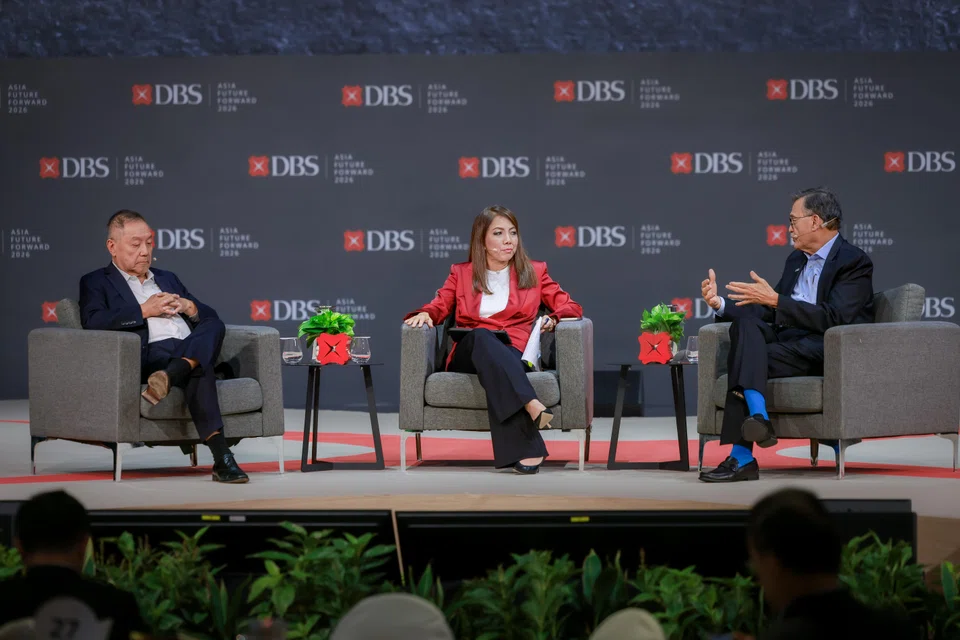
[SINGAPORE] It was just a comment from Broadcom’s CEO Hock Tan at a conference but it summed up the recent investor uncertainty around the current artificial intelligence-driven boom.
At a forum organised by DBS in Singapore earlier this month, Hock Tan argued that most companies are struggling to find any return on investments and that many are just spending money on tokens trying to understand AI.
“Ever thought when you are a kid, you go to the arcade, your parents give you S$10, you finish it in 10 minutes, and you haven’t learnt anything? That’s what’s happening in enterprises today,” he said during a panel that included Intel’s CEO Tan Lip-bu and was moderated by DBS’ CEO Tan Su Shan.
Those comments arguably drove some of the global market sell-off around AI and tech-related counters in recent weeks.
But justifiable or not, Hock Tan’s comments can also be read as him really wanting companies to find tangible use cases where generative AI (GenAI) applications can be used to increase productivity that can also help drive an increase in a company’s bottom line.
Why AI spending needs tangible productivity gains
For AI companies and those that drive it such as Broadcom, a lack of real return across industries could bring an end to the current AI-driven tech boom.
“Having viable use cases and raising ROI (return on investment) of model developers are crucial for hardware manufacturers like Broadcom and Intel to continue benefiting from the AI boom,” said Makoto Tsuchiya, senior economist at Oxford Economics.
“While AI investments are substantial, the expected productivity gains have not yet fully materialised, raising concerns about the boom’s longevity.”
This is increasingly the view emerging among investors and fellow economists.


Monetary Authority of Singapore deputy managing director (economic policy) Edward Robinson highlighted on Oct 20 that AI applications have quickly diffused across the wider economy.
But these applications have yet to deliver significant productivity improvements across the wider economy, said Robinson, who is also the chief economist of Singapore’s de facto central bank, at the Financial Street Forum in Beijing.
Companies such as Broadcom and Intel are considered as the pick and shovel companies because they support the underlying hardware and infrastructure that power the tech and AI industries.
These picks and shovels that companies such as Broadcom design and produce can be expensive, yet Rakesh Kumar, author of The Chip Age: How Semiconductors Became the World’s Most Powerful Resource, said the cost can be justified if companies are able to use them and hit gold.
“You buy more picks and shovels because you keep hitting the gold right? That’s the Nvidia promise, that’s the Broadcom promise,” Prof Kumar argued.
But access to AI tools is already getting so expensive that even tech companies such as Microsoft are limiting token usage by its own employees. An issue could arise when people decide that these picks and shovels they bought do not lead them to gold. This could translate to lower sales for companies such as Broadcom.
What is Broadcom’s Hock Tan driving at? He arguably wants companies to be more thoughtful about how they deploy AI applications, to make sure they are thinking through potential use cases and ensure that AI tools can be used to raise productivity.
“Effectively what Hock Tan is saying is that we’re not seeing a high enough revenue base,” Prof Kumar said. And that could be down to companies not yet defining or figuring out how to use AI tools well.
In that same panel, Hock Tan said he could use ChatGPT to write a love poem for his wife. “Happy wife, happy life” as the saying goes. It may be a huge return on his investment, but hardly beneficial for the business.
The interest in using GenAI applications is currently high, at least in Asia, as the consultancy Bain & Co has found in a recent study. Yet the consultancy also found that many companies are muddling through the roll-out of AI applications, and those that do it well are often from the financial services sector.
Prof Kumar said a situation that suppliers in the AI industry would not want is for companies to take an interest in adopting AI tools, spend a lot of money on it, and then not get any returns on it because its employees are using the AI tools to create pictures or PowerPoint slides, but not improving processes.
What non-tech and AI companies need to do is to define what productivity result they want – improving a product for example – and figure out the best way to use AI tools that achieve this as that will benefit the tech industry.
For example, Broadcom co-develops the custom Tensor Processing Units (TPUs) that Google uses for its AI workload. Anthropic has a partnership with Google that allows it to use these TPUs to train and run its AI models. So hypothetically, good business for Anthropic may also be viewed positively by both Google and Broadcom.
The end-goal is for AI companies to increase their revenue base especially as some of these AI companies currently have high capex-to-revenue ratios. This would be the real tangible improvement that investors would welcome.
Decoding Asia newsletter: your guide to navigating Asia in a new global order. Sign up here to get Decoding Asia newsletter. Delivered to your inbox. Free.
Copyright SPH Media. All rights reserved.
TRENDING NOW

Government to bring forward raising of retirement age, give employers more financial support to create flexi-load jobs

If Europe goes to war, the fallout will be felt in East Asia

Indonesia stocks suffer worst plunge in nearly 30 years as MSCI proposes standalone status

Vietnam’s northern provinces, not Hanoi or Ho Chi Minh City, are powering near 10% GDP growth

