
Proposed COE changes: What they could mean for your first car

Straight to your inbox. Money, career and life hacks to help young adults stay ahead.
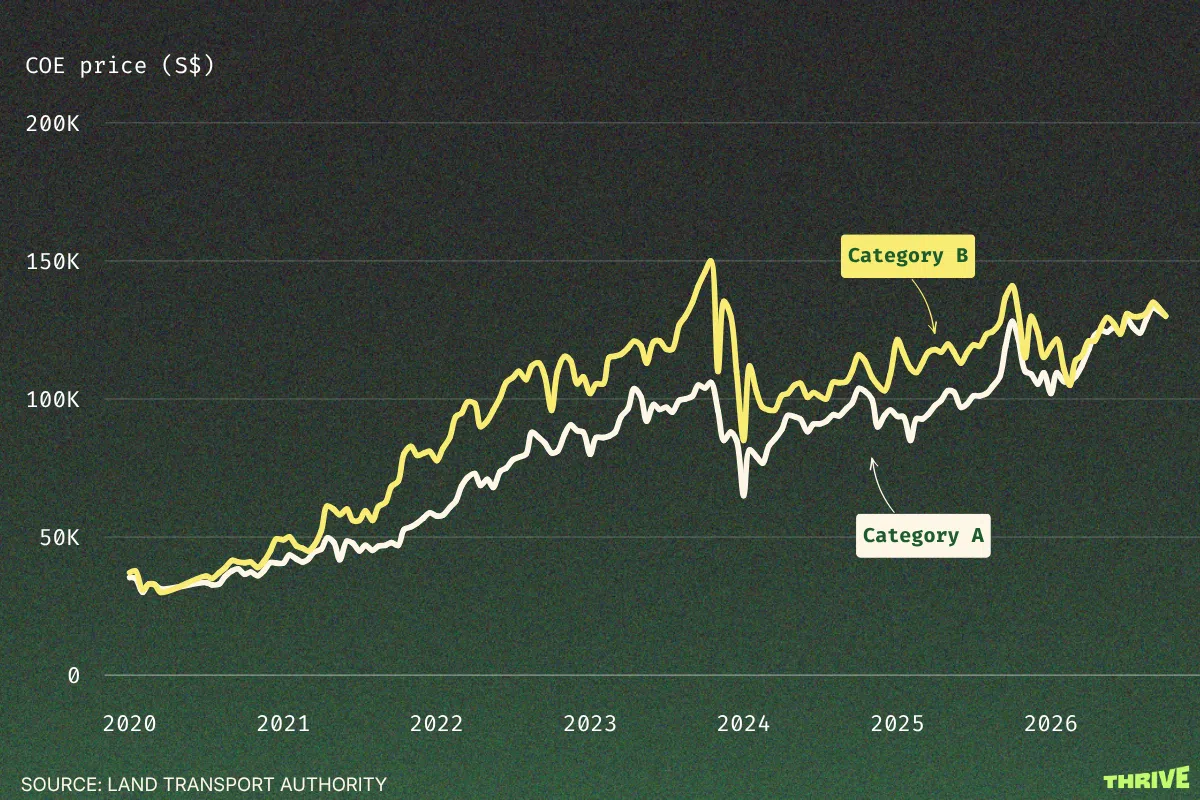
[SINGAPORE] There has been a fair bit of talk about Certificates of Entitlement (COEs), with premiums rising and the gap between categories A and B narrowing.
In the latest COE tender exercise on Oct 7, the Category A premium was S$130,001, while a Category B certificate cost S$130,100.
The two categories are meant to distinguish mainstream passenger cars from luxury models.
But today, buying a cheaper Toyota may leave you paying almost as much for a COE as someone buying a Mercedes-Benz.
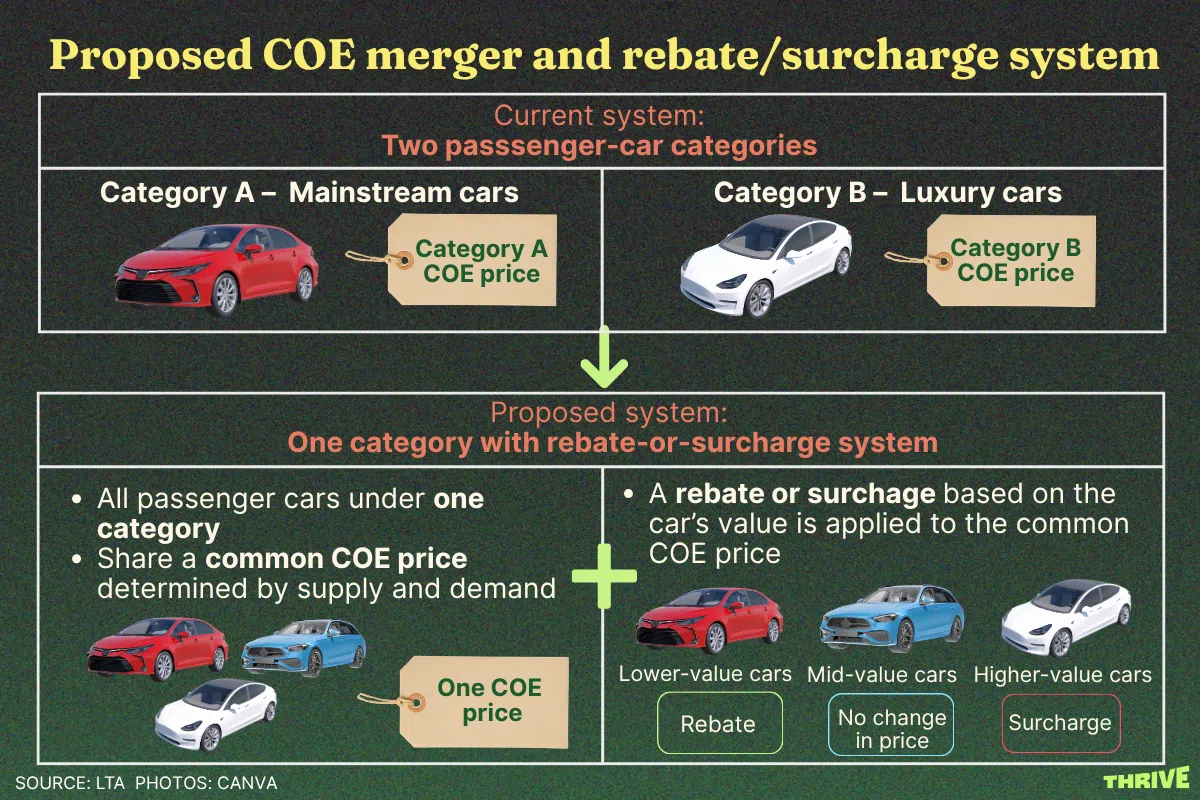
Now, the Land Transport Authority (LTA) has proposed merging both categories A and B into a single passenger-car category, with tiered rebates or surcharges applied to the final COE price.
Here’s what could change, and how it might affect prices for those looking to own a new car.
Why change the system?
First, a quick refresher: A COE gives you the right to own and use a vehicle in Singapore for 10 years. Its cost comes on top of the price of a vehicle.
Drivers secure certificates through bidding exercises conducted twice a month by LTA, with a limited supply of COEs up for grabs.
There are five COE categories in total. Passenger cars generally fall into two categories: Category A for smaller, less-powerful models; and Category B for larger, more-powerful models.



But with electric cars, it has become easier for carmakers to adjust power specifications to fit within Category A’s threshold.
That puts more buyers in competition for Category A COEs, fuelling the price hike and narrowing the premium gap.
Say Kwee Neng, an automotive consultant, tells Thrive that there is also a rush to switch from petrol cars to electric vehicles, before the EV Early Adoption Incentive – which allows new EV buyers to receive rebates – ends this year.
“(This) has jacked up prices beyond what the current allocation of COE quota can handle,” Say adds.
Category B premiums have historically been higher by at least S$20,000.
But since early 2026, the premium difference between the two categories has been under S$5,000. Category A premiums have even exceeded those of Category B three times this year.
What do the proposed changes mean?
Merging the categories would mean that buyers of mass-market cars will compete directly with those buying luxury cars.
To level the playing field, LTA is proposing a rebate-or-surcharge system that will reduce or increase the final COE price that buyers pay, based on the car’s open market value (OMV).
💡OMV is the price you pay to import a vehicle into Singapore, including freight, insurance and all other sales and delivery of the car, before major taxes.
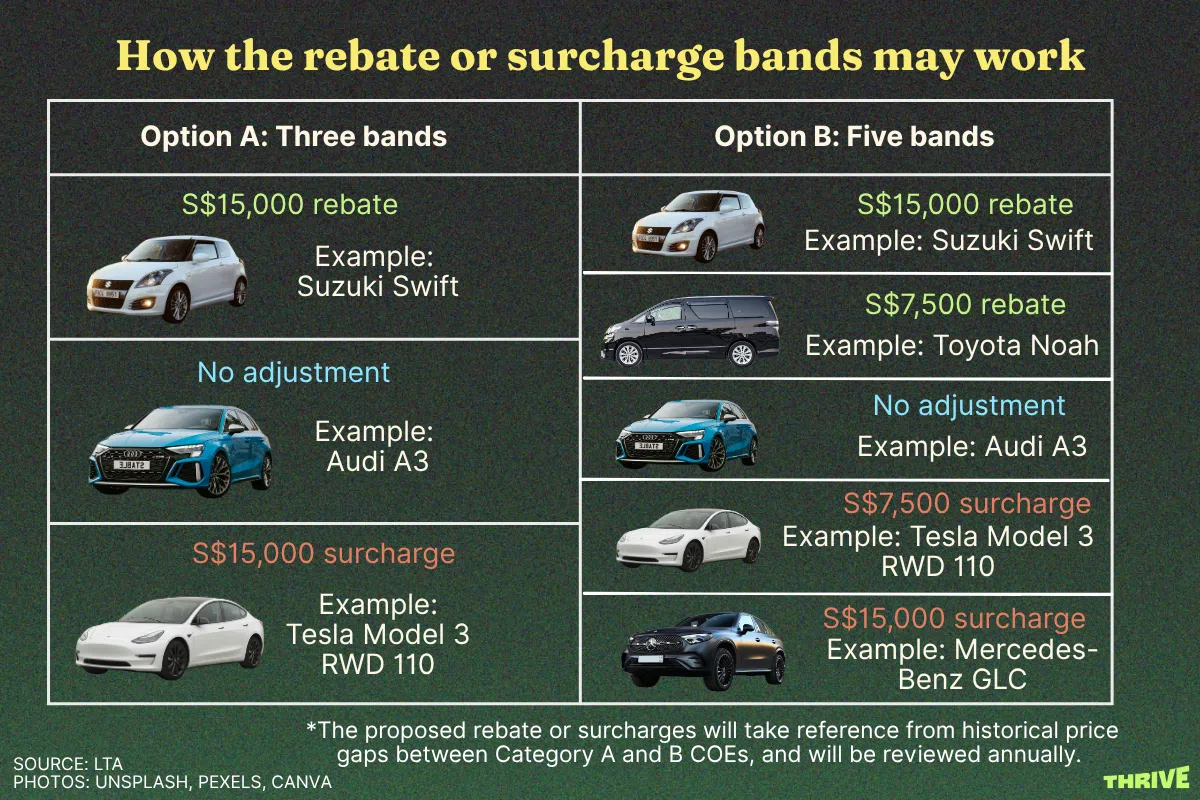
Someone buying a lower-value car, such as a Suzuki Swift, may be eligible for a rebate, while Tesla buyers may have to pay a surcharge on top of the COE price.
LTA has proposed to use historical OMV data to assign each car model to a band, determining whether it qualifies for a rebate or surcharge, and if so, by how much.
Two band structures are currently being considered:
- Three bands: Models may receive a S$15,000 rebate or surcharge
- Five bands: Models may receive a S$7,500 or S$15,000 rebate or surcharge
The proposed changes have been put up for consultation, and members of the public have until Nov 2 to share their feedback. LTA will share its findings and recommendations by the first half of 2027.
Impact on prices
For now, the impact on prices remains uncertain.
The majority of industry observers who spoke to The Business Times say the move could lead to an overall rise in premiums.
As the merger would not increase the total passenger-car COE quota, mainstream car buyers will be competing directly with luxury car buyers for a limited supply of certificates.
Those willing to pay more may raise their bids, pushing prices up.
Buyers expecting rebates may also be willing to bid more, knowing that part of their COE bill may be offset, allowing them to have more bandwidth to place higher bids.
Additionally, introducing rebates may make lower-value cars appear more affordable, which may increase the demand for mass-market cars and, in turn, increase COE premiums.
Ng Lee Kwang, a veteran of the motor trade, told The Straits Times that if the changes kick in, dealers will need a few rounds to figure out the appropriate COE price.
“This might be a good window to secure a not-so-expensive COE,” he said.
Can you afford a car?
Perhaps the bigger question on many a young Singaporean’s mind is: Can I afford a car at all?
Take the Suzuki Swift, which costs about S$170,000 with COE for a new car. As far as car prices go, that’s entry-level.
If you take the maximum 70 per cent loan, you’ll need to pay S$51,000 in cash for the down payment.
Assuming the maximum seven-year loan tenure and a 2.48 per cent interest rate, you’d be borrowing about S$119,000 and paying around S$1,663 per month.
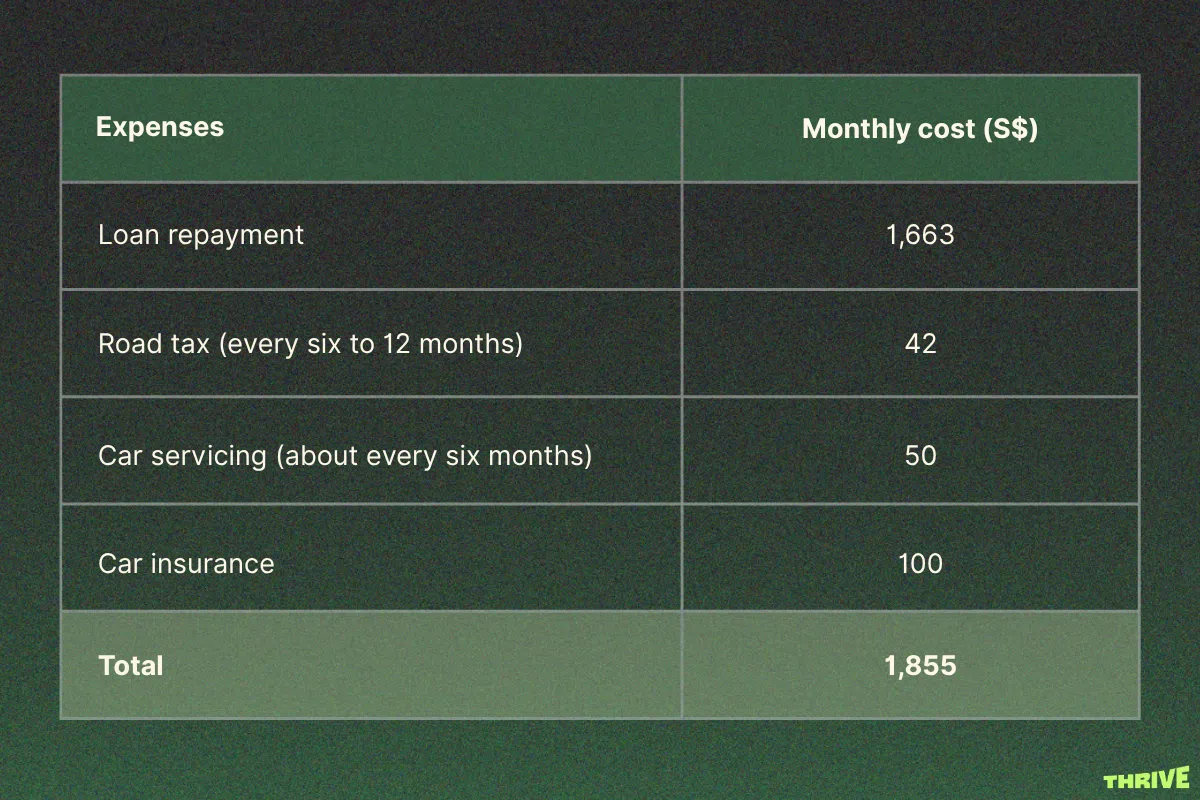
Still, this is a conservative estimate, which does not include other expenses such as petrol, Electronic Road Pricing and parking.
Say tells Thrive that as a general rule of thumb, young drivers shouldn’t spend more than 10 to 15 per cent of their take-home pay on a car.
This means that if you’d need about S$2,000 a month to comfortably afford the running costs of owning an entry-level car, your monthly take-home salary would need to be at least S$13,300 – or S$6,650 if you’re splitting the payments equally with a partner.
And that’s with COE prices as they are now.
Steven Lim, an independent car broker, says that’s why many young buyers turn to used cars, which cost less – largely because they have fewer years left on their COEs. Young buyers who come to him spend about S$100,000 on a used car.
So unless COE prices fall drastically – which observers aren’t expecting – an entry-level car looks set to remain anything but entry-level.
Decoding Asia newsletter: your guide to navigating Asia in a new global order. Sign up here to get Decoding Asia newsletter. Delivered to your inbox. Free.
Copyright SPH Media. All rights reserved.







