

LTA proposes combining car COE categories, adding rebate-surcharge system
New system would combine Categories A and B, and see rebates or surcharges of up to S$15,000 on premiums

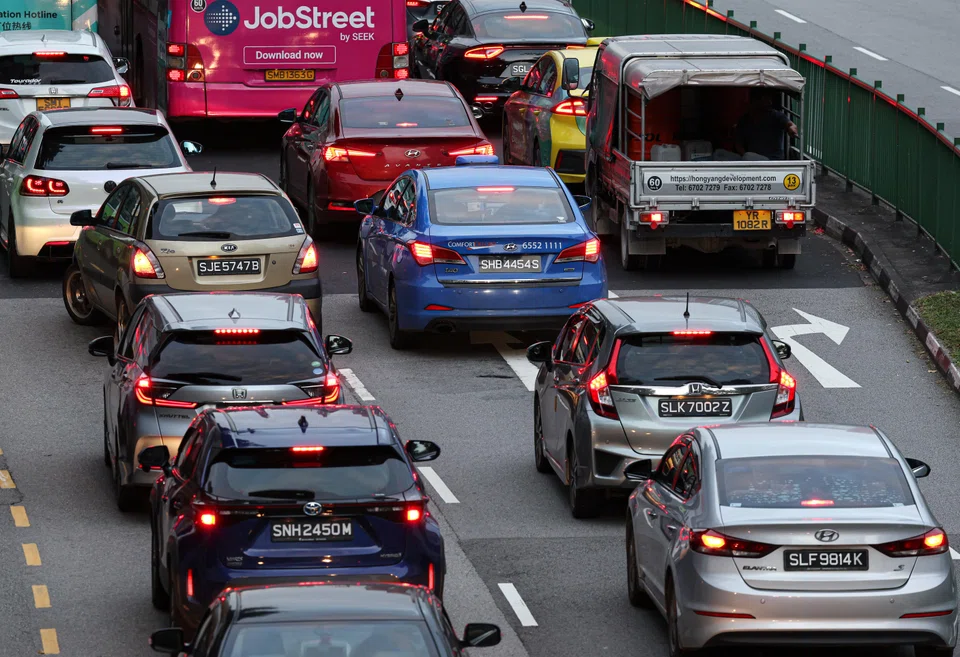
[SINGAPORE] The Land Transport Authority (LTA) is proposing to merge two passenger car Certificate of Entitlement (COE) categories, A and B. This would be implemented alongside a car-value-based fee or rebate system that would help differentiate mass-market and higher-end cars in the COE system. On Thursday (Oct 8), the regulator revealed details of the proposed changes alongside the opening of a public consultation that runs until Nov 2 that seeks feedback on the new approach.
LTA chief operating officer Lim Zhijian said that as vehicle technology and the market continue to evolve, it is “timely to review” whether the current categorisation of cars remains fit for purpose.
“Through this consultation, we invite the public to share their views on the proposed changes and trade-offs involved, so that the COE categorisation framework can remain relevant and continue to appropriately distinguish between mass-market and higher-value cars,” he said.
Members of the public and industry stakeholders may go online to submit feedback and find more details on the proposal, including the assessment of other solutions in LTA’s public consultation paper.
The consultation is part of LTA’s review process, and follows smaller-scale engagements involving more than 200 members of the public, industry and academics that were conducted from April to August.
During those sessions, some suggested combining the passenger-car categories, while introducing other means to have a price difference between mass-market and higher-end cars.
The COE review is targeted for completion by the end of the year, and LTA will reveal its findings and recommendations by the first half of 2027.
Rebates, fees tied to car values
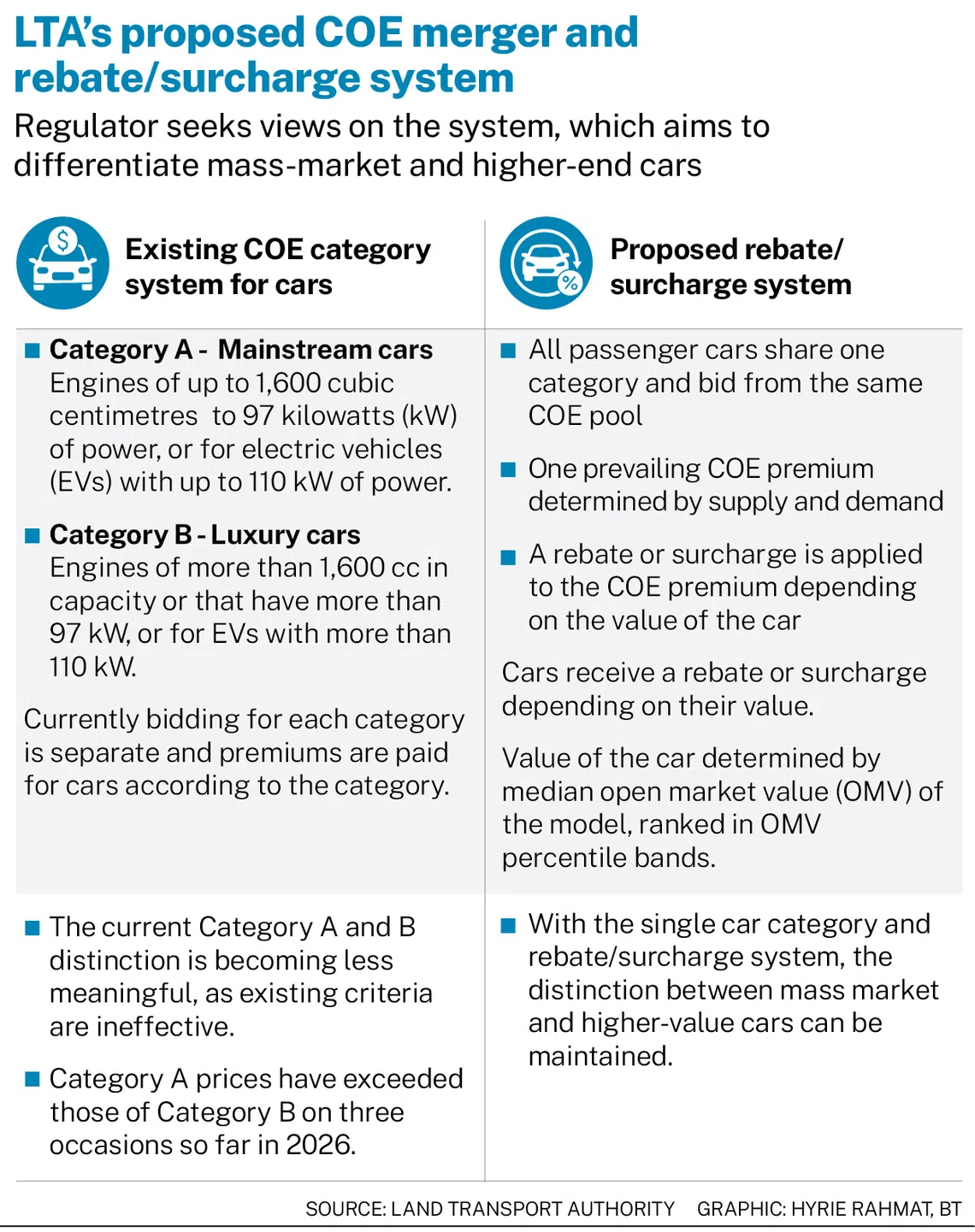
In March this year, Transport Minister Jeffrey Siow mooted a review of the COE system during his ministry’s Committee of Supply debate in Parliament, citing the converging prices of cars in categories A and B.
Since early 2026, vehicle prices in these categories have been closely matched, with the difference being less than S$5,000. In fact, the prices of cars in Category A exceeded that of Category B cars on three occasions this year – in February, April and June.


The gulf between these categories was typically at least S$20,000 in previous years, even reaching as wide as S$42,000 in October 2023.
Advances in vehicle technology, particularly the advent of electric vehicles, have made these criteria less effective, said LTA on Thursday.
The regulator is seeking feedback on the following: Whether the single car category and rebate/surcharge system should be introduced, if it should use open market value (OMV) to determine the surcharge/rebate scheme bands, and if it should apply to COE renewals.
OMV is the value of a car inclusive of shipping when it lands in Singapore, before any major taxes. The proposed scheme would use the median OMV of past registrations of the same model, sorting each car model into different bands.
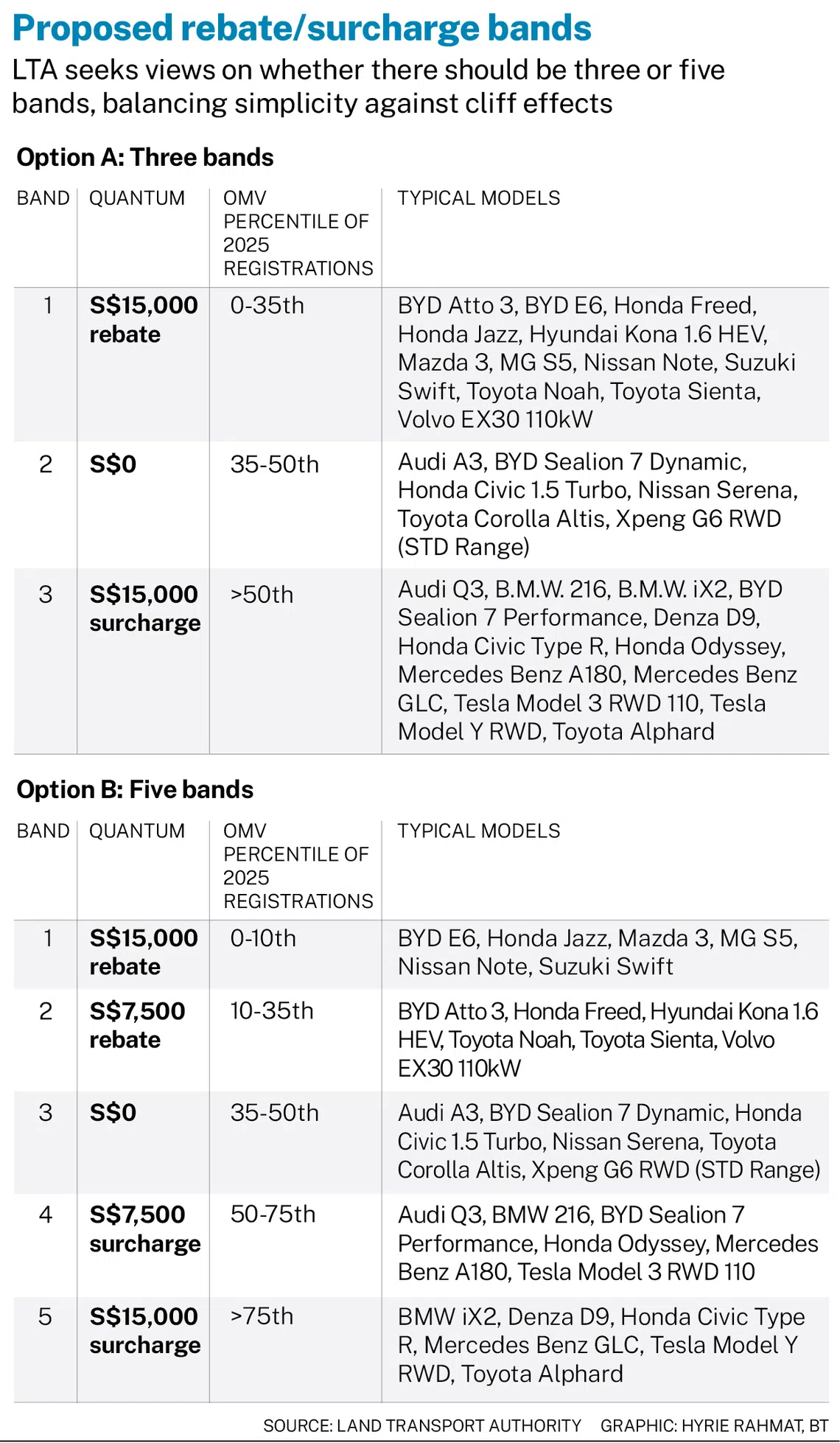
The bands would be determined by the percentile of vehicles registered in the previous year, while the proposed COE rebate or fees take into account historical price gaps between the two car categories. Both the bands and rebates/surcharges would be reviewed annually.
Two banding systems have been proposed, both of which operate in a similar way, but have a differing number of OMV bands.
The bands take into account the entire distribution of OMVs for passenger car registrations in 2025, which means that more expensive cars must pay a surcharge, while less expensive ones do not, or may enjoy a rebate.
For example, with the three-band system, cars with an OMV up to the 35th percentile would receive a S$15,000 rebate. This includes mainstream models such as the BYD Atto 3, Mazda 3, Toyota Noah and MG S5.
The rebate/surcharge scheme would address the issue of premium or luxury cars in Category A and vice versa.
For example, the BMW 216i and Tesla Model 3 RWD 110 – both premium models which are currently in Category A – would receive a surcharge, while a Nissan Serena, a mainstream multipurpose vehicle that is a Category B car, would have no rebate or surcharge.
Other COE issues addressed
Related issues that LTA is also seeking feedback on are over COE renewals and Category E.
COEs have a 10-year lifespan and the prevailing quota premium – which is the three-month average of the respective COE premium – must be paid to renew it, but if the categories are merged there would be one prevailing quota premium.
That raises the question of how the renewal of existing Category A or B cars would be handled. LTA said “transitional arrangements” for existing owners could therefore be considered if the proposal is implemented.
Meanwhile, Category E – the open COE category – can be used to register any vehicle, including commercial vehicles, except motorcycles.
It is meant to provide flexibility to accommodate changes in demand for different categories. Typically, Category E COEs are used to register Category B cars, since that is typically the most expensive category.
With one car category, E would likely continue to be used predominantly to register cars alone. This is at the expense of commercial vehicles, so possible moves could be the removal of Category E, or limiting it to car purchases only.
No separate private-hire car category?
The regulator also addressed feedback on other proposed changes to improve the COE system.
With regard to a separate COE category for private-hire cars, it said that this would require quota to be taken from car categories. Too few would mean a reduced supply of such cars and increased rental fees and fares, but too many would reduce quota to private car buyers and raise premiums.
In response to a suggestion of a surcharge on multiple-car owners, LTA said that since such owners are not a key demand driver in today’s COE market, a surcharge would not have a significant impact on prices and would be difficult to administer fairly.
With regard to the suggestion to allocate COEs based on household circumstances, the regulator said it would require difficult judgments about whose needs should receive greater priority.
“Giving priority to one group would also mean fewer COEs for other groups with compelling transport needs. Household circumstances may also change over the lifespan of a COE, making such a system difficult to administer fairly,” it said.
Decoding Asia newsletter: your guide to navigating Asia in a new global order. Sign up here to get Decoding Asia newsletter. Delivered to your inbox. Free.
Copyright SPH Media. All rights reserved.
TRENDING NOW

DBS, OCBC, UOB rout lops billions off STI as inflation, rate concerns spook investors

Grab CEO’s wife Chloe Tong on life with Anthony Tan and finding her purpose

OCBC sheds S$8 billion in value as shares close nearly 6% down; analysts cautious on banks

Deal between tycoon friends sparks scrutiny of Philippine power sector

