
🏘️ What’s the deal with Reits?

- Find out more and sign up for Thrive at bt.sg/thrive
🧓 So… why Reits?
It seems that a lot of older folks really like Reits, so the big question here is why.
Unlike stocks and shares that represent a single company’s value, a Reit works differently as it represents not one, but a number of different properties that earn income.
When you invest in a Reit, your money is pooled together with other investors in a collective investment scheme that invests in a portfolio of income-generating real estate assets that can include shopping malls, offices, hotels, or serviced apartments.
So, what this means is that you don’t need to purchase an entire mall or a hotel to gain access to real estate. It’s an affordable and scalable way for investors who want in on the action.
Darren Chan, research analyst from Phillip Securities Research, told Thrive: “These assets are professionally managed and revenues generated from the assets – mainly through rental income – are normally distributed at regular intervals to Reit holders, after accounting for fees incurred to manage the properties and the Reit itself.”
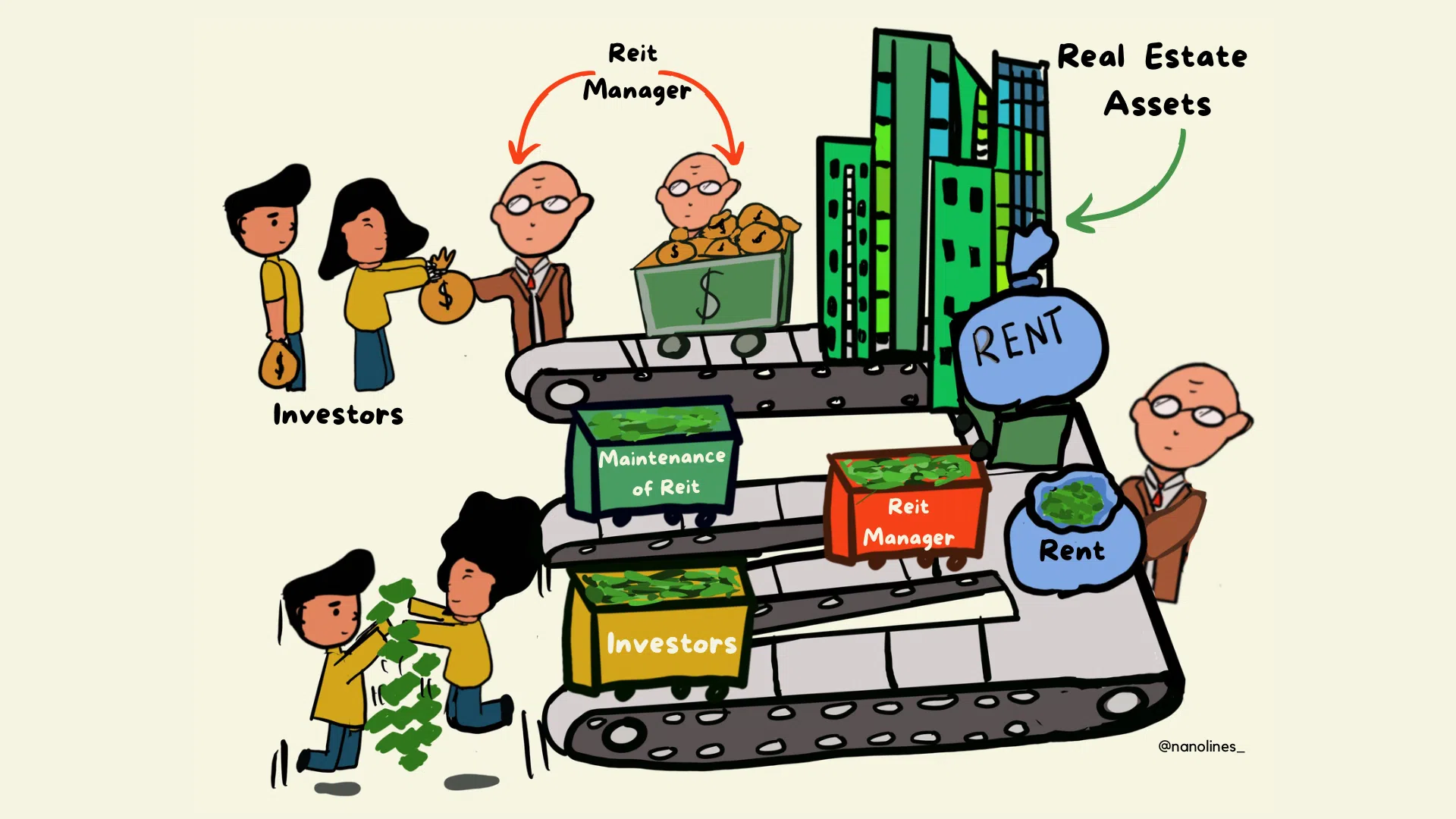
Frankly, the older generation might really be on to something with their proclivity towards Reit investments. One unique feature of Reits is the trust structure and the strict rules surrounding it. Reit managers can’t just do what they like with their money – they can invest only in income-generating properties that fall within their mandate. Most importantly, they must pay out most of their income to unitholders in order to qualify for tax benefits.
Navigate Asia in
a new global order
Get the insights delivered to your inbox.
Reits are known to offer higher yields on average compared to other stocks and government bonds. The 7.6 per cent dividend yield of Singapore Reits (S-Reits) in 2022 handily beat the 4.1 per cent from the Straits Times Index (STI).
But a note of caution ⚠️, higher yields are often a signal that a Reit’s unit prices have fallen. This was the case for many Reits in 2022, as interest rates rose and the global economy looked like it was headed towards a recession.
Yields may have been healthy, but total returns for Reits were a negative 12 per cent last year. 😲 One reason for the negative return: Reits became less attractive - and were sold down - as the interest rates on other risk-free fixed-income securities, such as Treasury bills, climbed.
⛈️ Stormy weather ahead
These days, Reits have had a more uncertain outlook amid a prolonged climate of higher interest rates and weaker leasing environment.
“There tends to be an inverse relationship between interest rates and the unit price performance of S-Reits,” Chan explains. He notes that if inflation and job growth continue to be strong, expectations are that the Fed will maintain its hawkish posture with persistent high interest rates. This is likely to dampen investor confidence in S-Reits.
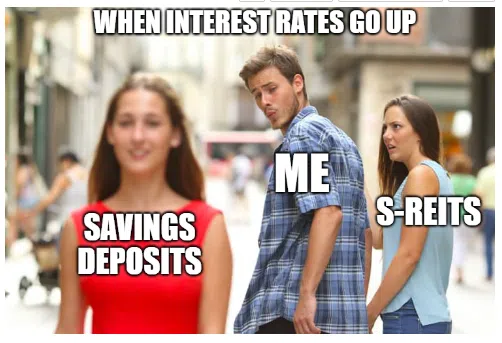
Reits typically take on debt to purchase properties for their portfolio. Higher interest rates don’t just eat into their profit margins, but also limit their ability to grow their portfolios. “If interest rates keep rising and there are no signs of stabilising, it will be challenging for Reits to make plans for new acquisitions (of properties) as the cost of debt they incur will continue to rise,” adds Chan.
Unit prices of S-Reits, in fact, seemed to be making a recovery early this year as there were talks that the Fed was nearing the end of its rate hike cycle. Alas, this was short-lived.
Most recently, S-Reits took a post-Budget hit following the announcement of higher Buyer’s Stamp Duty (BSD) on Feb 14. This comes as S-Reits with greater Singapore exposure would incur more costs when acquiring non-residential properties.
“However, some Reits are now trading at steep discounts to their net asset values (NAVs), and this could present a good buying opportunity for investors,” Chan says.
🔑 Diversification is key
Still, Reits continue to be a well-received choice in terms of investments due to one key reason: diversification.
“Incorporating S-Reits into their investment portfolios for those with a more conservative risk profile, for example, (can help investors), especially those seeking stable dividends,” says Chan.
“At the same time, for more aggressive investors, even a small holding of S-Reits can form the stable or less volatile base of the portfolio,” he adds.
We’re just at the tip of the iceberg when it comes to the world of Reits! If you’re curious for more about this investment, read on:
- Different categories of Reits to explore (such as retail, healthcare, and more!)
- Reits vs Reit ETFs (exchange traded funds)? Yup, they’re not the same…
- It’s normal for Reits to have exposure in another country! Take S-Reits and their stake in places such as China, India and Germany, for example.
The ball is in your court now – will you invest in Reits today? 🧐

TL;DR
- Reits offer a portfolio of income-earning real estate to invest in
- Higher dividends 💵 than the average stock…
- …although the outlook is murky due to the current interest rate environment 😞
- Nevertheless, can consider for diversification 🧬
Copyright SPH Media. All rights reserved.


