
Why are markets hitting record highs despite the Iran war?

Straight to your inbox. Money, career and life hacks to help young adults stay ahead.
[SINGAPORE] Is it just me, or has the stock market gone a little bonkers?
The Middle East conflict is still weighing on oil markets, the Strait of Hormuz remains far from fully open, and investors are stuck watching an endless carousel of ceasefire talks, blockades and geopolitical headlines.
Yet, stock markets have been breaking or hovering near record highs.
This sense of market absurdity again hit me when I read about American shoe brand Allbirds’ eye-catching, if slightly absurd, pivot to artificial intelligence (AI).
Last month, makers of the eco-friendly wool shoes agreed to sell its assets for US$39 million, less than 1 per cent of the US$4 billion it was once valued at.
Allbirds was once a Silicon Valley darling, worn by everyone from tech workers to former US president Barack Obama. But it never managed to sustain the hype or turn a profit.
Then last Wednesday, in what felt like a last-ditch move, the company announced plans to rebrand itself as NewBird AI and enter the AI infrastructure space, despite having no track record in the sector.

Its stock jumped by more than 580 per cent, before giving back some of those gains the next day.
Naturally, people started to draw comparisons to how adding “.com” to a company’s name used to send stock prices soaring during the dotcom bubble. Or when Long Island Iced Tea rebranded itself Long Blockchain during the early days of the crypto craze.



So what gives? As an investor, should I be worried? Or is this just how markets work?
Why is the market doing well in a war?
Unlike myself, Glenn Tan, a senior portfolio manager at Providend, isn’t as surprised.
He says April’s rebound makes sense when viewed in context. In March, rising oil prices and bond yields led investors to price in slower growth, weaker earnings and higher inflation.
Since then, oil prices have come off their highs. The geopolitical situation also briefly looked less severe, with US-Iran peace talks, a ceasefire and a reopening of the Strait of Hormuz which later turned out to be temporary. That helped markets recover.
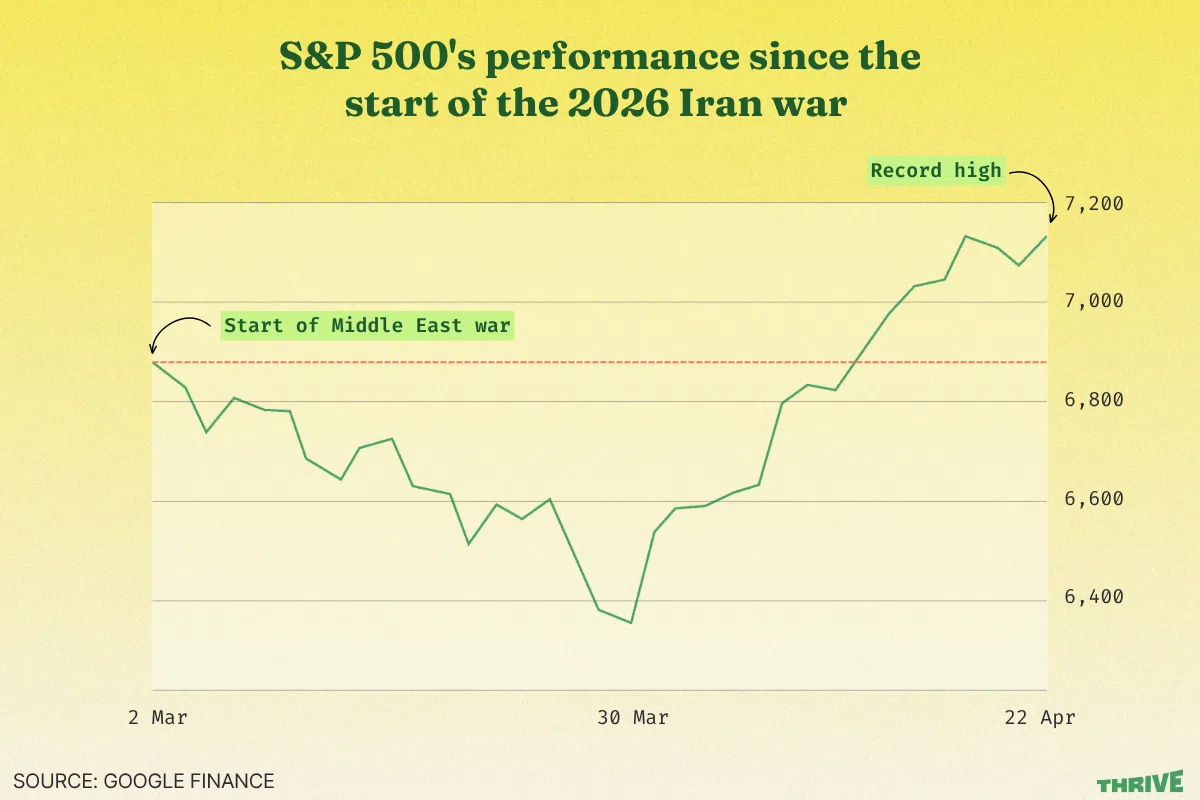
It’s valid to have concerns that investors are being too optimistic, says Tan. The speed of rebound has been swift and the Strait of Hormuz remains largely closed.
But markets often bounce back quickly after geopolitical shocks once there is some hope that things might not get worse.
“Markets are pricing the scenarios probabilistically, and right now the balance of probability seems to lean towards the resolution of the conflict,” says Tan.
The AI boost
Another factor in the market’s strong performance is the renewed interest in technology and AI stocks which have relatively stalled since late 2025.
Part of this had to do with Anthropic’s supposedly super powerful AI model Mythos. While Anthropic is a private company, it showed that AI models had room to improve significantly and that optimism has benefited other companies in the AI space.
And with a handful of AI-linked stocks making up a large proportion of the S&P 500 and other global indices, such shifts in expectation have a big impact on the broader market, says Hugh Chung, chief investment officer at Endowus. The S&P 500 index tracks the 500 largest publicly-traded companies in the US.
Asked about the Allbirds episode, Chung says that while parts of the market may get carried away, it would also be risky to avoid AI altogether, given the real impact it is already having on the economy.
Chung adds that unlike the dotcom bubble era, tech and AI companies today are generating actual earnings and cash flow. “Moreover, AI is already contributing to productivity growth of companies inside and beyond the tech industry.”
Likewise, Eddy Loh, chief investment officer of Maybank Group Wealth Management, sees the surge in Allbirds stock as the work of a speculative few rather than a sign of a broader market bubble. He remains positive on AI’s broader adoption and its potential to drive profits and returns.
Is it time to exit?
The rebound in the stock market throughout this war isn’t too different from past examples in history.
Previous market dips have consistently been followed by rebounds. Following a geopolitical shock, the S&P 500 on average falls around 6 per cent in the first three weeks, and bounces back in the next three, based on data from the Deutsche Bank Research Institute.
Chung adds that looking at around 40 major shocks over the past 85 years, the S&P 500 fell less than 1 per cent on average in the first month and was higher about 70 per cent of the time a year later.
“Markets often surprise people, and this is a good example of that,” he says. “Geopolitical events tend to cause short-term swings rather than long-term declines.”
Instead, corporate earnings and long-term expectations are more accurate indicators of market performance.
Nearly 80 per cent of the S&P 500 companies reporting first-quarter results so far have beaten analyst earnings estimates, according to data compiled by Bloomberg.
“When these fundamentals hold, markets tend to look past the distraction,” Chung says.
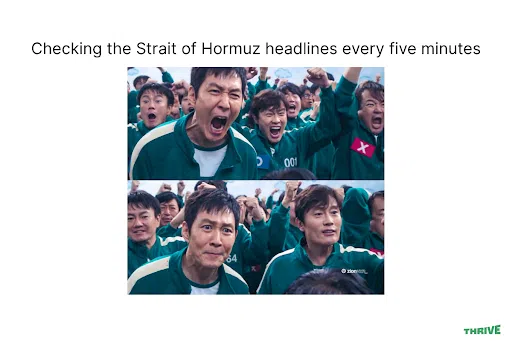
For investors, it’s important to remember that volatility in investments is the price of participation and returns, says Tan.
It can be tempting to sell your stocks or pause your investments whenever bad news hits the headlines. But that is essentially an attempt to time the market, which Tan calls a “very difficult and unrewarding affair”, even for experienced professionals.
A more useful approach, Chung says, is to check whether your portfolio still reflects long-term goals rather than being reactive to recent market performance.
For instance, if most of your exposure has become heavily concentrated in US equities or technology, it may be a good time to rebalance rather than add more in the same areas.
Loh, too, recommends investors keep their portfolios resilient through diversification and careful risk management.
With the benefit of hindsight, it’s easy to look back at previous market dips and be proud of sticking through them. However, it’s much harder to stay level-headed when the chaos is unfolding in real time.
While it’s tempting to pull out and look for another time to re-enter the market, the experts broadly agree on one point. Over the long run, consistency matters more than trying to guess the perfect moment to get in or out during a crisis.
Decoding Asia newsletter: your guide to navigating Asia in a new global order. Sign up here to get Decoding Asia newsletter. Delivered to your inbox. Free.
Copyright SPH Media. All rights reserved.
TRENDING NOW

LTA proposes combining car COE categories, adding rebate-surcharge system

StarHub to acquire MyRepublic’s mobile business amid ongoing telco consolidation

DBS, OCBC, UOB rout lops billions off STI as inflation, rate concerns spook investors

Grab CEO’s wife Chloe Tong on life with Anthony Tan and finding her purpose


