
The big questions for 2026

Straight to your inbox. Money, career and life hacks to help young adults stay ahead.
[SINGAPORE] Last year wasn’t the easiest for fresh graduates entering the workforce.
Economic uncertainties made companies cautious, hiring slowed and unemployment rates among younger workers ticked up in the second quarter of 2025.
Then, the government responded with new traineeships to quell unemployment concerns and boost the employability of fresh grads. How successful will this scheme prove to be?
In 2026, experts are already saying fresh grads will likely continue to face high competition as companies continue to use artificial intelligence (AI) to replace entry-level jobs.
Firms are expected to remain cautious and the latest ManpowerGroup Employment Outlook Survey shows that Singapore’s hiring outlook is set to worsen to its lowest level since 2022.
Companies are also hiring more selectively and leaning into skills-based hiring. So if degrees no longer guarantee jobs, will we see a growing backlog of unemployed graduates?
Will there be more support from policymakers to help a new cohort enter a job market that hasn’t fully absorbed the last?
🫂 And for the rest of us, will we continue to hug our jobs?
If fresh grads struggled to get in, those already employed were even less eager to leave – fuelling the “job hugging” trend that took off in 2025.
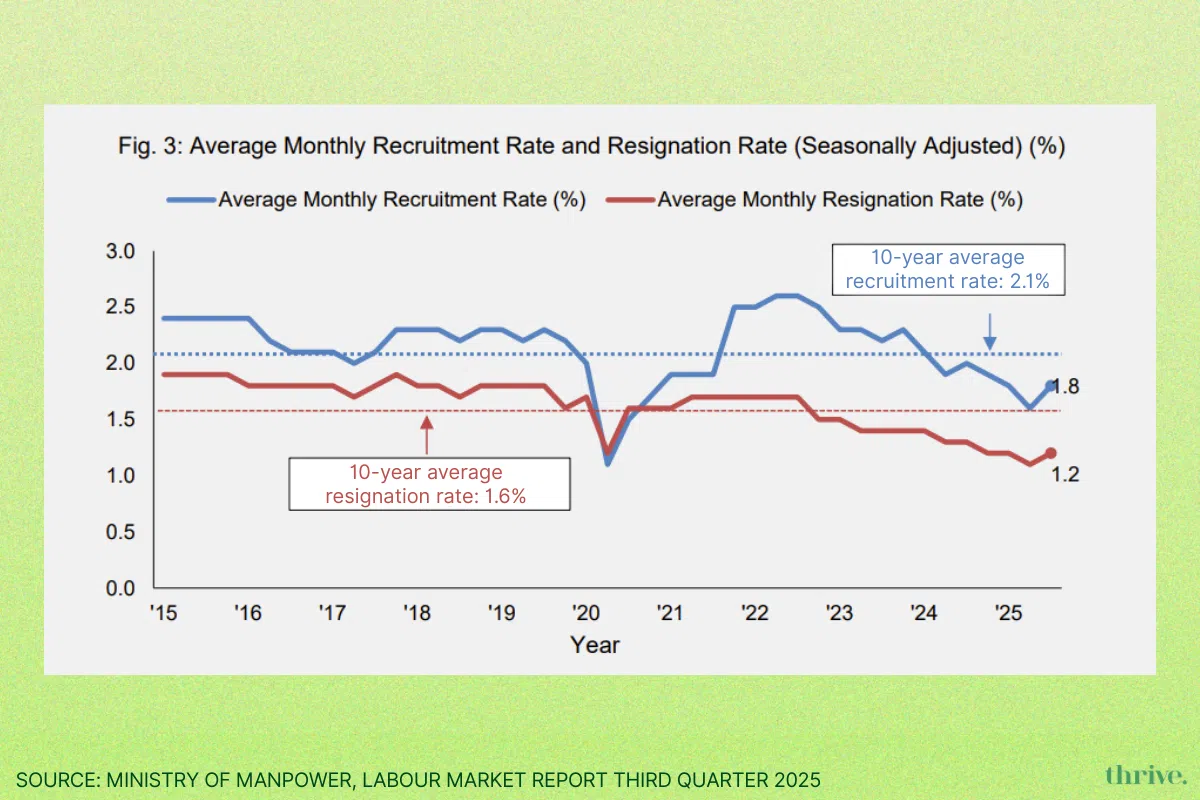
More workers are staying put and fewer are switching jobs.



Average monthly recruitment and resignation rates in Singapore continued to trend down since 2022, with both having now fallen below their 10-year averages, the Ministry of Manpower’s latest Labour Market Report notes.
In 2026, dissatisfaction with our pay cheques could finally push us to look elsewhere.
More than half of Singaporeans say they’d leave if salary increments or bonuses don’t meet their expectations.
But will employers actually hand out bigger pay cheques? Perhaps not.
Nearly half of employers are planning wage moderations or freezes and lower wage increments for the 2025/2026 financial year, a survey by the Singapore National Employers Federation (SNEF) found.
If bonus season disappoints, will workers actually act on their discontent or will fear continue to keep them in their current jobs?
📈 Will the Singapore stock market catch the eye of young investors?
The Singapore stock market had a strong run in 2025.
The Straits Times Index (STI) rose past 4,000 points for the first time in March 2025 and ended the year above 4,600, posting its strongest performance in at least four years with a total return of 22.7 per cent.
Last year, the Singapore Exchange (SGX) also launched the iEdge Singapore Next 50 Indices. Alongside this, a S$5 billion injection under the Equity Market Development Programme (EQDP) was rolled out to invest in listed firms and jolt the market out of a cycle of poor valuations and limited liquidity.
These coupled with a mix of monetary easing, strong performances from key index heavyweights and the local stock market’s reputation as a safe-haven amid geopolitical uncertainties lifted sentiments.
This momentum is expected to carry into 2026, with the STI continuing its run and analysts giving rosy predictions.
Come mid-2026, a “dual-listing bridge” is also set to launch, allowing companies to list on both the SGX and Nasdaq with just one set of listing documents.
Will these be enough to attract the likes of younger investors?
🤖 How will our relationship with AI develop?
Love it or hate it, most of us have had to embrace AI or risk getting left behind.
Companies were encouraged to integrate AI into workflows. Schools began to recognise the merits and importance of AI, but have also cracked down harder on students’ misuse of AI tools.
By now, many of us – especially younger workers – are expected to be able to use AI effectively, without becoming overly reliant or allowing it to replace us.
At the same time, generative AI chatbots have begun to sound increasingly human-like, apt at providing emotional support and advice that feels uncannily thoughtful – so much so, some of us have developed romantic relationships with these chatbots.
In 2026, OpenAI plans to release an “adult mode” within ChatGPT that would loosen certain safety restrictions around content such as erotic material. OpenAI is now working on its age-prediction model which it’ll use to gate users under 18. I can already hear the alarm bells ringing.
As GenAI continues to blur into our personal lives in 2026, where will we draw the line? Will more of us be willing to substitute human interaction for conversations with chatbots that are always eager to respond to us?
📱 Will we be weaned off social media?
In December last year, Australia became the first country to ban social media for children under 16. Now, many other countries are considering doing the same.
Singapore followed with tighter guidelines that limit smartphone and smartwatch use outside of lesson time for secondary school students starting this year.
Sceptics argue that teens will find workarounds (and they probably will). But ultimately, these regulations aim to promote healthier screen use among students.
Could this then set off a cultural shift that also trickles upwards?
Those who grew up with Myspace or saw the birth of Instagram may be long past their school years. Yet, many are just as tethered to their screens as today’s teens.
Plus, with all the hype around digital minimalism and dumb phones that are limited to calls and texts, will more of us begin to rethink our relationship with social media in 2026?

TL;DR
- Will young workers finally catch a break from a tough job market?
- Will we continue to hug our jobs?
- How will our relationship with AI develop?
- Will we be weaned off social media?
- Will the Singapore stock market catch the eye of young investors?
Decoding Asia newsletter: your guide to navigating Asia in a new global order. Sign up here to get Decoding Asia newsletter. Delivered to your inbox. Free.
Copyright SPH Media. All rights reserved.