
The government played Cupid. Did sparks fly?

Straight to your inbox. Money, career and life hacks to help young adults stay ahead.
[SINGAPORE] It’s a Wednesday night, and Carrie (not her real name) is having dinner with a guy she started texting a week ago. The conversation flows easily before the 24-year-old civil servant poses a question you don’t often hear on a date.
“Do you like the government date so far?” she jokes.
The pair met through FirstDate, the government’s pilot matchmaking service for public officers.
Carrie, like most of the other public officers interviewed, requested anonymity to avoid being identified by colleagues.
Singapore is no stranger to playing Cupid. The Social Development Unit was set up in 1984 to coax graduate singles to marry – and hopefully have children. In 2009, it merged with the Social Development Service, which catered to non-graduates, to form the Social Development Network (SDN).
That effort gradually wound down and in 2025, the government confirmed that the SDN had ceased operations.
Fast forward to 2026, the Government Technology Agency (GovTech) launched FirstDate, a Singpass-verified platform aimed at putting an end to swipe fatigue. Participants receive one match per cycle, with applications for the first cycle having closed on Oct 5.
How does FirstDate work?
FirstDate uses the Gale-Shapley Stable Marriage algorithm to match participants based on their values and preferences.
The pilot programme is restricted to public officers who are not married and aged 21 to 35. The eligibility age was later expanded to 45 for its second cycle.



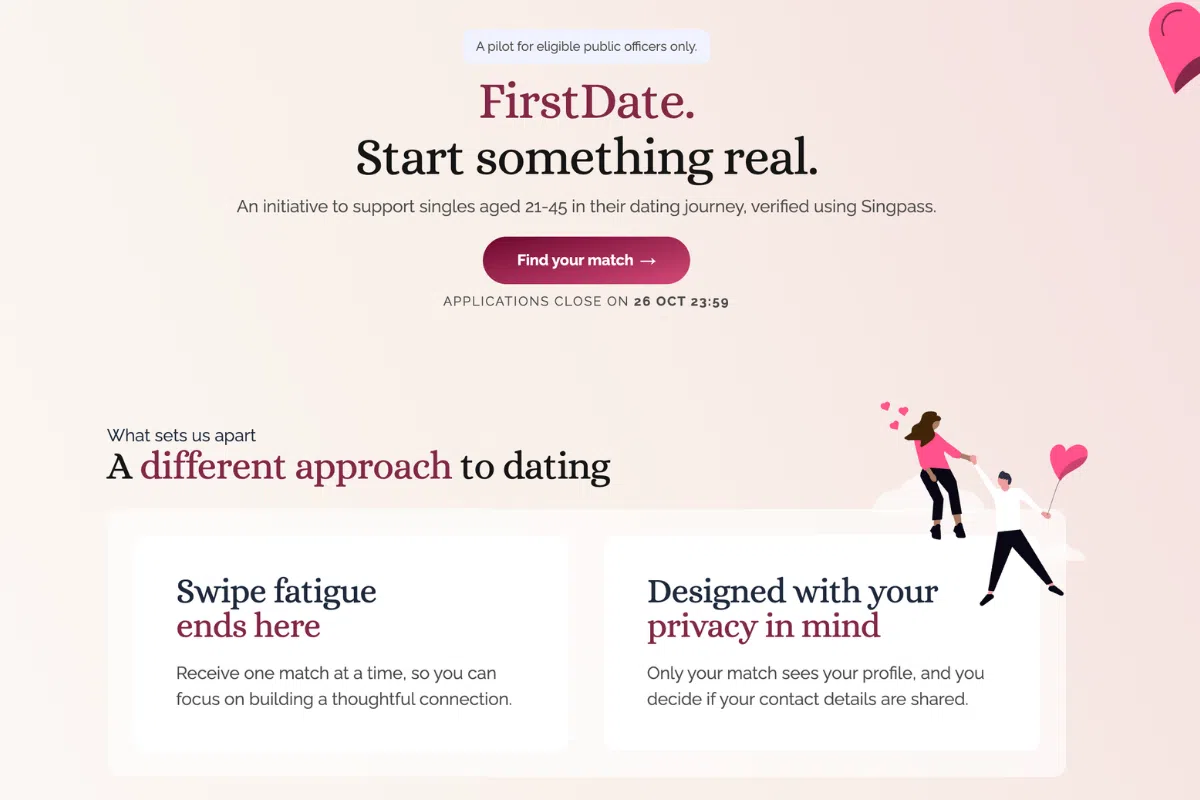
Participants complete a comprehensive questionnaire covering everything from relationship dealbreakers to travel styles and love languages.
Each participant then receives a match result which includes a compatibility score, their age and organisation, some fun facts, and a personalised note – but no photo.
They are notified by SMS and have three days to accept. Contact details are shared only if both agree.
While there’s no hard deadline to meet up, the programme offers S$30 in vouchers for each user by completing limited-time “date quests” – taking a walk in the park, doing something they haven’t done before, or trying new food together.
From curiosity to connection
Carrie had used dating apps before, but says matching with only one person was “a bit nerve-racking”.
“There’s still the second cycle, so you’re left wondering if the next match would be more compatible with you.”
Fortunately, she hit it off with her match over text, then in person, arranging a second date during dinner. The pair decided to forgo the vouchers.
“At first, I felt it was really dystopian… what do you mean the government is paying me S$30 to go out with a guy they pitched?” she says.
Vague responses
EQ Chen, 24, joined hoping to meet someone serious about a relationship. She liked FirstDate’s focus on values and preferences over appearances.
But her match’s vague answers to open-ended questions made it difficult to gauge how seriously he was looking for a connection.
“There wasn’t much to work with,” she says. She declined the match.
Doing it for the lore
Mark (not his real name), a 24-year-old teacher-in-training, signed up with a “why not” mentality. The vouchers, on top of meeting someone new, appealed to him.
Having used dating apps before, he appreciated how FirstDate’s detailed questionnaire gave him more room to express his preferences.
However, he missed the text message announcing his match – and the three-day deadline to accept.
Physical attraction still important
Like Mark, John (not his real name) signed up for fun, curious about the government’s take on a dating app.
“My match looked good on paper and appeared reasonably compatible with me,” the 30-year-old says.
After viewing her profile picture on Telegram, he realised that he wasn’t especially physically attracted to her. She was also upfront that she would not date someone shorter than her.
“While shared values and compatible life goals are important, physical attraction is the other side of the same coin.”
Their online conversation eventually fizzled out.
Vouchers as an incentive
Lucas (not his real name), a 26-year-old career adviser, would have preferred to know what his match looked like, given that users could easily look up their matches on LinkedIn.
“I can see it being a cool feature for those who like some mystery before a date,” he says. “But this felt a little unconventionally strange for a modern dating app.”
Still, the cash voucher gave him an extra nudge to meet.
“To me, I treated this as an opportunity to meet a potential life partner, maybe a new friend,” he says. “At worst, at least I get a voucher.”
The pair met for a meal at a hawker centre, played games at a board game cafe and completed the “walk in the park” date quest despite the haze.
By the end, both agreed to remain friends. Lucas says he is unlikely to use FirstDate again, preferring to meet people organically offline.
Even so, he would recommend it to those who value personality and connection over looks. He also appreciates the platform’s push to get people to meet in person.
“The ‘forced’ meetups also make sure users who participate are more authentic and willing to put in effort in dating,” he adds.
Decoding Asia newsletter: your guide to navigating Asia in a new global order. Sign up here to get Decoding Asia newsletter. Delivered to your inbox. Free.
Copyright SPH Media. All rights reserved.







