

Here’s a prudent retirement plan amid the latest CPF changes
Drawing up a spending strategy is a good first step, then match your assets accordingly

CHANGES to the Central Provident Fund (CPF), announced a month ago, have sparked discussions on retirement planning in various media and finance chat groups. So how should you regard CPF Life? What should a person age 55 and older do when the Special Account (SA) closes next year for them?
These decisions cannot be taken in isolation without considering retirement planning holistically. Start with crafting a good spending plan by first listing down all your assets which can give you an income. Based on the meaningful life that you want to live, carefully estimate your expenses at different stages in retirement.
For example, in the first five years of retirement, you may need S$10,000 a month, going down to S$8,000 a month in the next five years, before reducing it to S$6,000 a month for the rest of your life. From these estimated expenses, decide what amount is absolutely necessary (essential) with the remaining amount being good to have (discretionary).
The next step – also the most complex – is to match suitable assets/instruments in your list with the expenses needed at various stages in retirement. Generally speaking, to fund essential expenses throughout the lifetime of the retiree, assets that are safe and reliable regardless of financial market volatility, and which are able to mitigate longevity risk, should be used.
CPF Life, private annuities, retirement income insurance plans, investment-grade bonds, and sometimes even real estate are examples of such assets. For discretionary spending, you may use riskier asset classes such as equities and bonds. But at appropriate times, you need to gradually convert portions of these investments into cash or cash-like instruments for the discretionary expenses in the immediate five years.
Cash, fixed deposits (FDs), Treasury Bills (T-bills), Singapore Savings Bonds (SSBs), money in CPF Ordinary Account (OA) after age 55 and short-term single-premium endowments are some instruments to consider. A spending plan will help you to make better decisions with regard to the recent CPF changes.
What to do with the OA after SA closes in 2025
Next year, the SA closes for those aged 55 and older, and money will be transferred to the OA. How you should respond will depend on what the money was earmarked for in your spending plan. If it is meant to fund discretionary expenses in the immediate five years, you can consider placing portions of it in other cash/cash-like instruments if they are meaningfully higher than the 2.5 per cent a year offered by the OA.
Otherwise, you may just leave it in the OA, and it should not affect your retirement income too much. But if the money in the OA is not needed for discretionary expenses until much later, you can consider investing in riskier assets to potentially get higher returns.
How much to put into the Retirement Account (RA) for CPF Life
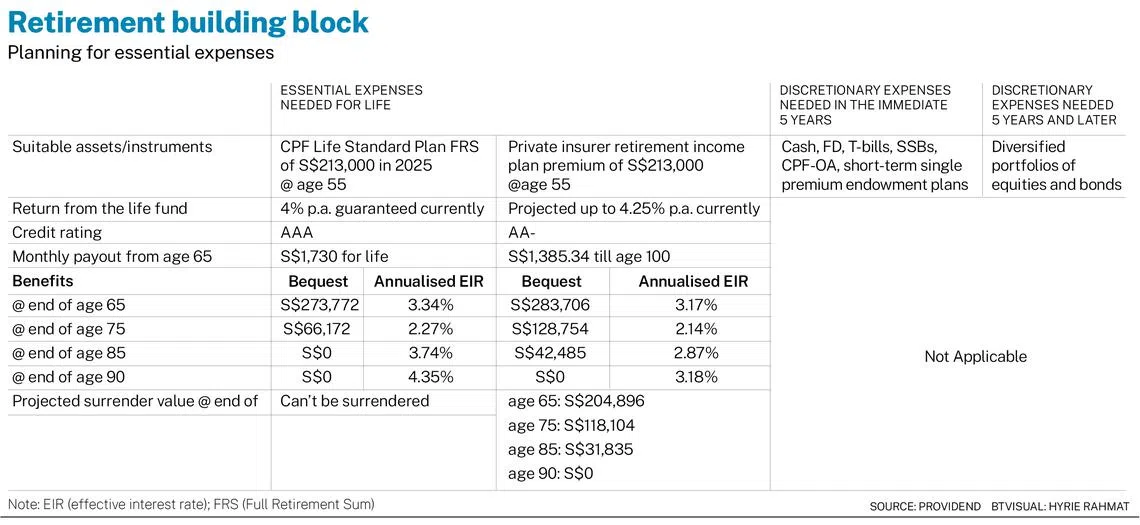
Because of space constraints, I compared CPF Life with only one of the popular retirement income insurance plans in the market. Given that all insurers have to use the same projection rates in their benefit illustrations, the results would not deviate too much except for the different frills offered by different product providers.
For comparison, I used the CPF Life Standard Plan and the Full Retirement Sum (FRS) for 2025. For the retirement income insurance plan, I used the higher end of the life fund projection of 4.25 per cent a year. Even at the higher end of the projection, you can see quite clearly that CPF Life is superior. The insurance plan’s bequest amount is higher, but it is because the monthly payout is lower.
But you should not be buying an annuity/retirement income plan for its higher bequest. That is also why CPF Life’s effective interest is still higher, all things considered. The one advantage of private insurance plans is that you can surrender the policy if you need to, and get some money back. You cannot do the same with CPF Life.
So, first top up your RA up to the amount (subject to the maximum of the new Enhanced Retirement Sum in 2025) that will give you the CPF Life monthly payout you need for the essential expenses in your spending plan. If the maximum monthly payout from CPF Life is still insufficient, you can use other suitable instruments to supplement it.
Alternatively, if you can find private annuity plans which can provide the same or higher monthly payouts for life, you may buy private annuities instead of using CPF Life, and apply to be exempted from setting aside the retirement sum and also withdraw all your CPF retirement savings.
Unfortunately, it is quite difficult to find such policies these days. If you want more liquidity, you can just buy CPF Life up to your cohort’s FRS and supplement the rest of your essential expenses with other instruments such as retirement income insurance plans. But you may have to accept a lower monthly payout or pay a higher premium to get the payout you need.
A wealth plan’s goals of saving towards and spending in retirement will span decades. Many things in the world will change, including government policies. It is essential to ensure that your plan is robust enough to mitigate life uncertainties.
The writer is chief executive officer, Providend, South-east Asia’s first fee-only comprehensive wealth advisory firm
TRENDING NOW

Looking beyond looming CEO succession, should UOB potentially pursue a transformative merger?

MAS holds monetary policy settings, pausing after two straight tightenings

Once staunchly pro-China, Malaysian Chinese businesses are now distancing themselves from Beijing

Stocks to watch: Kore US Reit, Parkway Life Reit, Raffles Education, Vin’s Holdings

