

Tempted by ‘safe’ assets in times of uncertainty? Think again
Downside protection using so-called safe-haven assets has been far from consistent, a study has found
GEOPOLITICAL events seem unprecedented because they are largely unpredictable, and the factors that trigger them rarely happen in the same way twice.
But this is consistent – tensions and uncertainties always prompt plentiful bets on which investments are “safe”, and which are not.
Traditionally, US 10-year Treasuries, the US dollar, and selective commodities such as gold and oil, are considered safe-haven assets. Gold, in particular, has a reputation as a store of value. In times of geopolitical instability, when the value of paper currency and other financial instruments can be volatile, gold is perceived to have a stable intrinsic value.
Safe-haven assets also include currencies such as the Japanese yen against the US dollar, and the Swiss franc against the Euro.
But an insightful study by Goldman Sachs, looking at 12 historical geopolitical events over the last half-century, finds that the ability of various safe-haven assets to offer downside protection has been far from consistent.
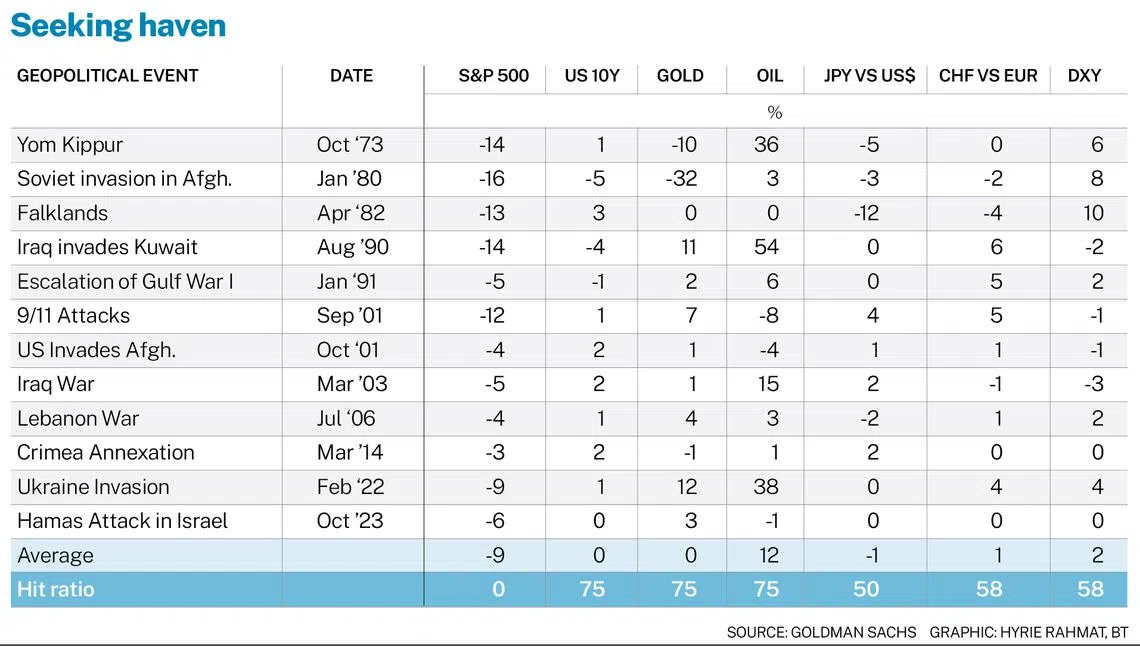
What investors ought to remember is this – despite being touted as “safe”, the returns (and losses) of such assets can vary, in some cases by a large margin. Depending on the time you purchased these assets, the results could turn out to be even more unfavourable.
Why safe-haven assets may not perform as we expect
Gold has a special place in the heart of investors, especially in emerging markets where currency has been volatile, and political risk has been high.
But because gold does not actually earn a yield, it is not easy to figure out what the “intrinsic value” of the asset should be. It also has long periods of muted performance. From gold’s peak in September 2011, it took almost nine years to return to the same levels in 2020. In that period, the S&P 500 went up nearly three times.
Comparatively, oil has performed worse than gold in the absence of geopolitical tensions and supply shocks. Over the last 20 years, Brent has annualised a return of 3.5 per cent, and if bought at the tail-end of geopolitical events (for instance, at the February 2022 peak after Russia’s invasion), investors could have lost more than 30 per cent of their principal.
What about US Treasury bonds? Although considered to have practically no credit risk, they do, however, have interest rate risk and, depending on the maturity of the bonds, duration risk.
The S&P US Treasury Bond Current 10-Year Total Return Index returned minus 25 per cent between July 2020 and October 2022. An investor who blindly thought US Treasury bonds were safe through any market cycle may have been surprised during this period. Conversely, during the Global Financial Crisis, the same index rose 21 per cent in 2008, proving to be a good diversifier to equities.
Cash is likely considered the most stable asset in times of crisis, but we have seen time and time again how cash can eat into real purchasing power as it fails to protect against inflation.
Taking the latest example of the JPY. Not only has the currency depreciated against the USD (and SGD) to the lowest level in recent history, it has also shown extreme volatility. The USD itself – expressed as a currency against a basket of all other currencies or DXY – has also historically been an unreliable safe haven for investors with assets and liabilities outside of the US.
To de-risk or not?
When geopolitics makes the front page, market commentators and participants claim they know how to navigate the markets. But the reality is that many people panic at the first sign of trouble, feeling compelled to take action even when their investment goals and appetite for risk have not really changed from the time they were first set.
In the past three years alone, we have traversed a chapter of many “unprecedented” events that have sent market sentiment from one extreme to another.
Witness the developments from the depths of despair during the Covid-19 pandemic and the subsequent flood of liquidity, to the expectation of transitory inflation and now a stubborn, higher-for-longer inflation narrative. We saw the quickest pace of interest rate hikes in history, igniting fears of recession, debates over the nature of the economic landing – hard, soft, or perhaps none at all – and now, a return to concerns over persistent inflation. This tumult unfolds against a backdrop of ongoing conflicts and escalating geopolitical tensions around the world.
When we juxtapose these tumultuous times with market performance, a different picture emerges. Over the last five years, despite the myriad changes and challenges, the global stock market, as represented by the MSCI USD Total Return Index, has achieved an annualised return of 9.7 per cent. Meanwhile, global bonds, tracked by the Bloomberg Global Aggregate USD Total Return Index, have posted a modest annualised return of 0.5 per cent.
To capture that 9.7 per cent annualised equity return over the past five years, one would have had to be “in the markets” through thick and thin for the entirety of that period. Attempting to time the market by frequently trading in and out during these volatile periods would have substantially diminished the chances of achieving such a return.
Learn from the legends
“Everyone has a plan ‘till they get punched in the mouth.’” This is one of my favourite quotes from the legendary boxer, Mike Tyson. Though not originally about financial markets, I think it is equally applicable to investors, novice and experienced alike.
This “punch” in our investing journeys can look different, but the quote vividly captures the essence of how unforeseen events can abruptly challenge our strategies and plans.
Our investment philosophy is about goal-based investing and, by extension, structuring investment portfolios such that they meet short-term and long-term goals on an inflation-adjusted (or real) basis.
In practical terms, short-term goals will be invested in asset classes which have little or low chances of drawdowns, while long-term investment goals can afford to take on more risk. This is usually achieved through diversification by region, sector, and various asset classes.
One should not try to predict when the market might throw us the “punch”. The possibility of large drawdowns in markets would have been considered and factored into asset allocations ahead of time, rather than being “reactive” to every market shift.
How do the best endowments invest in times of high volatility? The real answer is no secret and the truth is they usually invest no differently from times of low volatility. They adhere to the same disciplined, goal-based, long-term plan.
A prudent strategy in uncertain times
Ultimately, chasing safe-haven assets at the first hint of market volatility is closer to speculating than investing.
To mirror the approach of the best endowments and institutional investors, especially in periods of volatility and geopolitical uncertainty, it’s crucial to establish investment objectives, assess the risk tolerance, diversify your portfolio, maintain disciplined investing practices, and be vigilant about investing costs.
A prudent method is the discipline of the dollar cost-averaging – investing a fixed sum of money at regular intervals, regardless of the asset’s current price.
Today’s uncertainties may seem overwhelming, but this enduring principle holds true. There are potential rewards for those who remain dedicated to a risk-appropriate investment plan. Once you have done this, the best course of action amid uncertainty is to simply do nothing, and let the market do its work.
The writer is chief investment advisory officer, Endowus, an independent wealth platform with over S$7 billion in client assets across public and private markets
TRENDING NOW
8 public officers referred to police over property buys near unannounced MRT stations: Chan Chun Sing
Retrenched PMETs who return on lower pay see median 25% wage cut

Grab CEO’s wife Chloe Tong on life with Anthony Tan and finding her purpose

Vietnam’s northern provinces, not Hanoi or Ho Chi Minh City, are powering near 10% GDP growth

