Trump’s border wall spending creates a billionaire family
Fisher Sand & Gravel has won more than US$8 billion in government contracts since July
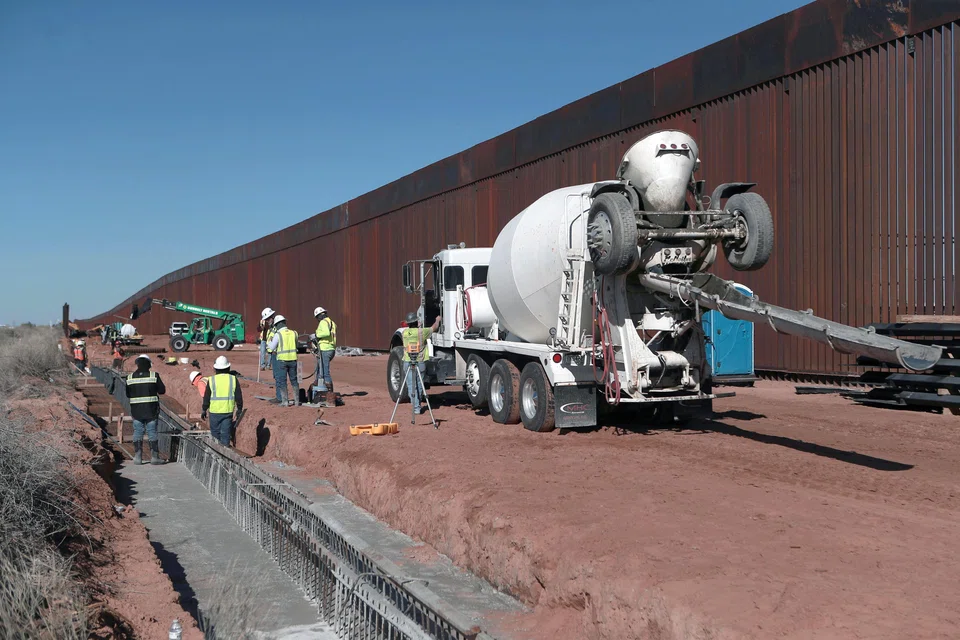
[NEW YORK] The biggest beneficiary so far of US President Donald Trump administration’s roughly US$171 billion immigration spending blitz is a third-generation family business that specialises in sand and gravel.
Since Trump signed the One Big Beautiful Bill into law on Jul 4, Fisher Sand & Gravel has won more than US$8 billion in contracts from the Department of Homeland Security (DHS) to design and construct segments of Trump’s long-touted wall on the southern border. The awards account for nearly one-fifth of the money DHS has agreed to spend over that timeframe, during which its three largest contracts – ranging from US$1.5 billion to US$1.7 billion each – all went to Fisher.
The surge in spending has made the Fishers the first known billionaire family born out of the Trump administration’s immigration policy.
It has been a long time coming for Tommy Fisher, the company’s president, who inherited the business from his father and has spent the better part of a decade evangelising his wall plan.
During Trump’s first term, Fisher became a regular pitch man on right-wing networks, insisting his wall would be built faster, sturdier and cheaper than the competition’s. He built a privately funded three-mile barrier in Texas. And later, he hired immigration bulldog-turned-border czar Tom Homan to help with lobbying.
Fisher Sand & Gravel, sometimes also called Fisher Industries, is now worth more than US$1 billion, according to the Bloomberg Billionaires Index, which is valuing the firm for the first time. Fisher, 56, owns the entire company along with trusts in the name of his two adult sons, Grant and Ryan, according to Arizona Corporation Commission records.
Amid the Trump administration’s sweeping push to arrest and deport hundreds of thousands of immigrants, less attention has been paid to the US$46.5 billion that’s been earmarked for a new border wall. It is the biggest chunk of money allocated in the Big Beautiful Bill for any one immigration programme and the spending is well underway, even as illegal border crossings are at a more than 50-year low, according to Pew Research Center.
The construction of the wall, a favourite talking point during Trump’s first campaign, has been the subject of criticism across the political spectrum over its cost, durability, purpose and impact on border communities and the environment.
While US Customs and Border Protection is adamant that “walls work” in conjunction with technology and its patrol agents, David Bier, director of immigration studies at libertarian think tank the Cato Institute, said there’s “zero evidence” they effectively prevent illegal immigration.
SEE ALSO


Fisher’s company has faced its own controversies. The three miles of wall it finished in Texas in 2020 did not meet basic building codes or industry standards, and the segment has an unusually shallow foundation – all putting it at risk of collapse during a flood, according to a federally commissioned inspection reported by ProPublica and the Texas Tribune in 2022. A lawyer for Fisher disputed the report’s findings at the time.
The Fishers have also faced other troubles, incurring monetary penalties for environmental, labour and safety violations, Bloomberg News previously reported. And the government once ordered the company to pay US$1.2 million in restitution, penalties and fines after it admitted responsibility for defrauding the US.
The Fishers did not respond to multiple requests for comment via text messages, phone calls and emails. A CBP spokesperson said the border wall is a “generational investment” in security and that it will “be integral in helping agents keep our border secure at the historic low levels we are seeing today.”
Three miles
Before Trump and his “Build the Wall” slogan became a US$47 billion political project, Fisher Sand & Gravel was a successful, if relatively niche, family business. Tommy’s father Gene founded it in 1952 and turned it into one of the largest sand and gravel companies in the country. It has built bridges, levees, dams and freeways across the West, and sold mining and other heavy equipment to the construction industry.
Tommy Fisher first became interested in barrier-building when Trump ran for office a decade ago, envisioning a completed wall along the nearly 2,000-mile-long southern border.
“We started working on it almost two years ago when he first made some of his campaign pledges,” Fisher told Fox News in 2018 shortly after the company was selected along with three others to build concrete prototypes of the wall. “All the employees of Fisher Industries were very, very excited.”
That work was held up after DHS and the US Army Corps of Engineers initially rejected Fisher’s prototypes because they did not meet the government’s requirements.
That’s when Fisher turned to private money to build segments of wall as a proof of concept, hoping he would one day be able to sell it to the government. Starting in the spring of 2019, a nonprofit co-run by Steve Bannon called We Build the Wall started sending the company what would end up being more than US$8 million to build its first barriers.
Concerns were soon raised about the structural integrity of the three-mile, privately funded wall it built close to the Rio Grande river in South Texas, but Fisher still went on to win US$2.5 billion to construct 135 miles worth of barriers in Arizona and Texas during the final year of Trump’s first term in office. The CBP spokesperson said the agency was “not involved in any private projects” and that all CBP projects are done in accordance with its established design standards.
When Joe Biden became president in 2021, his administration halted all Trump-era border wall work, including Fisher’s.
‘Smart wall’
With Trump back in the White House, the work has started up again in a big way. DHS has so far awarded nearly US$20 billion in contracts to various companies for “vertical barrier,” “vertical border,” “border wall” and “border barrier” since Trump re-entered office, according to government contracting records. That’s billions of US dollars more than the amount all agencies spent on border wall building during his entire first term.
Other companies that have won bids for work related to the border include AMI Metals, which was awarded a US$1.5 billion contract in February for a bulk steel order, as well as another family business in Galveston, Texas, called SLS Federal Services and BCCG, a joint venture based in Montgomery, Alabama. A CBP spokesperson said “contracts are awarded in compliance with the Federal Acquisition Regulation.”
Those contracts are the beginning of a plan to build more than 1,300 miles of what the Trump administration is calling a “smart wall,” which includes steel bollard walls, waterborne barriers, detection technology, cameras and lighting. They also sometimes involve a secondary wall to create “an enforcement zone,” according to CBP.
The segment Fisher Sand & Gravel is currently building in the San Rafael Valley of Arizona is a roughly 27-mile, US$300 million-plus project that started late last year. Photos of the construction in progress show heavy-duty machinery slotting the fences into ditches. Around six miles have been completed, according to Myles Traphagen, borderlands programme coordinator for Wildlands Network, who visits the site every couple of weeks.
It’s unclear how long the project will take, especially as the construction industry faces constraints from Trump’s immigration crackdown. In the states where these projects are concentrated – California, Arizona, New Mexico and Texas – approximately 25 per cent to 40 per cent of the construction workforce is made up of immigrants, according to the National Association of Home Builders. BLOOMBERG
Decoding Asia newsletter: your guide to navigating Asia in a new global order. Sign up here to get Decoding Asia newsletter. Delivered to your inbox. Free.
Share with us your feedback on BT's products and services