

A future-ready tool kit for tomorrow’s financial complexity
AI and tokenised money are key, but even the best tech needs security, common standards and partners to scale

IN THE past three decades, money moved across borders through established networks, though it was constrained by banking hours, limitations of credit availability and the lack of certainty over settlement dates.
As cross-border payment volumes grew, these networks became more concentrated. Yet, the standardisation of delivery to users of payment and trade settlement services remained elusive.
These current frameworks no longer meet the expectations of institutions, especially in a fast-changing economic and commercial environment.
In a recent survey of more than 400 large corporations in 11 markets, we found that some three-quarters of them faced challenges on multiple fronts over the past year. These obstacles ranged from heightened foreign exchange and energy price volatility to complications in cash forecasting and liquidity planning.
A similar proportion felt pressure to expand into new markets, further complicating supply chains.
Businesses are navigating an increasingly fragmented operating environment, with more markets, currencies and banking relationships to manage than before.

Meanwhile, digital commerce never sleeps, requiring cash management, liquidity and treasury operations to keep pace with an always-on, borderless economy.
The question is not whether businesses can predict the next shock. It is whether they have the resilience to absorb it and thrive.
This calls for a future-ready tool kit built around technologies – such as tokenised money and artificial intelligence – that turn complexity into opportunity, providing businesses the ability to expand with greater confidence.



But adopting tools is only half the equation. To scale, tools need common standards, interoperable infrastructure and robust guardrails. Businesses also need trusted innovation partners that can help redesign operating models as money and decisions move at unprecedented speed.
Unlocking the potential of tokenised money
Traditional payment systems remain the backbone of global commerce, yet their reliance on legacy operating hours and sequential processing are increasingly misaligned with a 24/7 economy.
Tokenised money bridges this gap by enabling atomic, round-the-clock value transfers that transform treasury operations, enhancing cash visibility, accelerating liquidity velocity and providing payment certainty.
This shift is rapidly moving from theory to active adoption. Based on our survey, 88 per cent of businesses are already piloting or deploying tokenised money use cases.
Yet even the most advanced payment innovations will stall without network density. In an increasingly digital infrastructure, isolated ledgers risk creating fragmented silos that exacerbate – rather than resolve – friction.
Tokenised money can unlock exponential value at scale only if it achieves interoperability across sovereign borders, currencies and disparate ledgers.
Achieving this requires regulators, industry practitioners and market infrastructure providers to harmonise standards and regulatory frameworks. This ensures tokenised money and assets move seamlessly without compromising systemic security or legal finality.
We are already witnessing the blueprint for this interconnected future. Swift’s initiative to develop a blockchain-based digital ledger – with DBS participating in its core design group – aims to connect global banking rails for instant, always-on cross-border transactions, while maintaining interoperability with traditional correspondent banking infrastructure.
Demonstrating this practical utility, the ledger enabled DBS and Citi to execute a weekend US dollar tokenised deposit-based payment between Singapore and New York in minutes, compared with the industry norm of up to two business days.
Similarly, Project Bloom, spearheaded by the Monetary Authority of Singapore, is pioneering interoperability frameworks and live use cases for different forms of tokenised money to move across networks.
As these collaborative initiatives mature, DBS and industry peers are actively laying the foundations for a safer, more connected and scalable tokenised financial ecosystem.
Operationalising AI in treasury management
While tokenised money redefines the speed and velocity of value transfers, its convergence with AI introduces even more transformations to treasury management.
AI adoption continues to accelerate, evolving rapidly from a tool for data synthesis and content generation into systems capable of coordinating complex, multi-step processes. This progression is bringing AI deeper into the everyday machinery of business.
In our survey, roughly three-quarters of businesses are already experiencing, or expect to experience within two years, tangible operational enhancements from AI in their treasury operations.
When paired with tokenised money, AI-driven workflows and smart contracts unlock financial agility, enabling treasurers to model cash flows, simulate liquidity scenarios and initiate payments with precision.
However, always-on capabilities demand rigorous controls. Unlike conventional payment rails featuring built-in reconciliation windows and extended manual-review cycles, a tokenised environment operates at a speed that leaves little margin for error, making accountability, recovery and recourse critical considerations.
Consequently, AI usage must be anchored in robust controls and frameworks. This starts with the data on which AI depends. Institutions that have built deep, well-governed pools of proprietary data have a powerful moat, enabling agents to generate insights and take action grounded in the organisation’s knowledge of its customers and industry best practices.
Yet that advantage holds only if agents can be deployed responsibly. Institutions should establish clear identities, permissions and guardrails for every agent, with higher-risk actions requiring human approval.
Agent activities should be traceable and continuously monitored, supported by adversarial testing to identify vulnerabilities early. The goal should not be automation at all costs, but AI that is safe, explainable and operationally useful.
Banks as trusted innovation partners
Together, AI and tokenised money form a powerful toolkit for navigating a fragmented world. However, operationalising them is not straightforward.
Survey respondents cited regulatory uncertainty, data security concerns and gaps in internal resources as challenges holding back implementation.
Businesses do not need to navigate this transition in isolation. Our survey points to an evolution in the role of banks beyond financing and transaction execution. Banks are increasingly viewed as trusted innovation partners that help clients with their technology-enabled transformations.
Around two-thirds of businesses expect banks to provide a single point of integration into tokenised money ecosystems and support for tokenisation pilots.
On AI, nearly two-thirds want access to bank-enabled infrastructure and platforms, and more than half expect support for pilots and transaction data in AI-ready formats.
The bank of the future will therefore be assessed not only by its balance sheet and credit standing, but also by its expertise and capability to help clients innovate safely and seamlessly.
In a world of constant rewiring, the institutions that thrive are those able to coordinate amid complexity without losing visibility or control over their operations.
This requires investment not just in technology, but also in new operating models, strong governance and trusted partnerships.
Ultimately, success will belong to organisations that can turn complexity into optionality, adapt with agility and capture opportunities in a rapidly changing world.
The writer is group head of global transaction services, DBS Bank
Decoding Asia newsletter: your guide to navigating Asia in a new global order. Sign up here to get Decoding Asia newsletter. Delivered to your inbox. Free.
Share with us your feedback on BT's products and services
TRENDING NOW

South-east Asia has lost Nvidia’s best salesman

‘If there’s a price to be paid, so be it’: George Yeo says Singapore must safeguard its reputation

Demand, tech capabilities position Apac and AI as Skyscanner’s next growth frontiers: CEO Bryan Batista
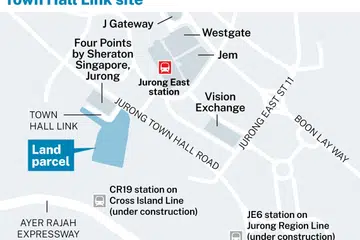
CapitaLand, Far East, Sing Holdings team up for S$1.8 billion bid at S$910 psf ppr for Jurong Lake District site

