

The next phase of innovation in banking
Roundtable panellists discuss the challenges and opportunities arising from the adoption of agentic AI


ROUNDTABLE PANELLISTS:
- Nimish Panchmatia, chief data and transformation officer, DBS
- Shayan Hazir, chief digital officer, Asia (ex-HK) & MENAT, HSBC
- Praveen Raina, head of group operations and technology, OCBC
- Moderated by Genevieve Cua
WITH more than a decade of digitalisation and transformation under their belts, Singapore banks are entering a new phase in their use and deployment of artificial intelligence. At stake is not just higher levels of operational efficiency and also the prize of greater customer satisfaction and loyalty.
Our roundtable discusses the challenges and opportunities arising from the adoption of agentic AI and the guardrails needed to ensure success is sustainable.



Cua: Looking ahead, what are the bank’s priorities in terms of innovation?
Panchmatia: Our focus is on applying digital innovation with purpose, to become the best AI-enabled bank with a heart, driving tangible value for our customers, our people and the bank.
We have been on our AI journey since 2014, progressively building the data, technology, and governance foundations to move from experimentation to industrialisation. We have deployed more than 430 AI use cases and 2,000 models across the bank.
The next phase is fundamentally different. We are moving beyond deterministic automation, where rules execute known steps, into probabilistic reasoning and agentic execution, where AI can reason, plan, use tools and act across multi-step workflows. This changes not only the technology, but the nature, speed and accountability of work.

Our priority is therefore not simply to deploy more AI, but to redesign how work gets done around human-AI collaboration. Through operating model transformations, we are re-engineering processes end-to-end, augmenting human judgment and creating capacity for our people to focus on higher-value work.
This is scaled through two complementary pathways: horizontal capabilities that democratise AI across the workforce, and vertical capabilities embedded into specialised roles and workflows.
DBS-GPT, for example, gives employees access to enterprise knowledge and agent-building capabilities, generating more than one million prompts each month.



Our vertical capabilities bring AI directly into areas such as relationship management, customer service and operations.
Ultimately, the AI advantage will not come from having the best model, but from redesigning enterprises around intelligence, combining trusted data, scalable technology, embedded governance and human judgment.
Hazir: For us, innovation starts with a problem that matters to customers, not with the technology itself. Across the markets we serve, customers increasingly expect banking to work across borders, channels and systems without having to navigate a bank’s internal complexity.
One priority is aligning our services more closely with the way clients operate. HSBCnio, introduced this year, gives corporate and institutional clients different ways to access transaction banking, including through their existing systems and workflows.
In parallel, our Tokenised Deposit Service enables round-the-clock access to liquidity across participating markets, in supported currencies and payment arrangements. These are different technologies, but they address the same practical need: making it easier for clients to manage money.
Another priority is applying AI responsibly at scale. Our Global AI Centre of Excellence in Singapore will be part of a wider network of technology and AI specialists across our home markets and other key locations, developing capabilities to address opportunities across the bank globally.
Singapore’s talent and its strengths as a wealth, trade and innovation hub make it a valuable part of that network. Initial areas of focus include more personalised conversations with wealth customers, agentic treasury solutions and AI-initiated safe digital payments.
We also need to invest in the foundations that make innovation useful and reliable: modern infrastructure, interoperability, skilled people and robust controls.
The test of a new capability is not whether it is technically impressive. It is whether clients can do something more easily, securely or effectively than before.
Raina: The next phase of banking innovation will not be defined by how much technology we add, but by how much complexity we take out.
Banking innovation has largely focused on giving customers new ways to bank, from Internet banking to mobile apps and expanding the range of digital services. These brought convenience but also layers of complexity. The opportunity now is to connect intelligence, experience and execution, so the bank operates as one intelligent, integrated system.
Under our corporate strategy, the Next Frontier, AI, digital and data sit at the core. Our priority is to embed these capabilities into our platforms, data foundations and the way our teams build and run technology.
With that, we can better understand what matters to customers, anticipate needs earlier and shorten the path from insight to action. The technology underneath becomes more sophisticated, but banking itself becomes simpler.
That requires transforming the bank from within too. We are modernising our core platforms for an AI-driven future: more modular, more connected through APIs and built on trusted data, while developing engineering talent that can build, operate, and secure intelligent systems. Technology should take out repetitive work and complexity, giving our people more time for judgment, problem-solving and building relationships.
My litmus test: Does it make banking easier for our customers and our people more effective? If it does both, we are creating real value. If it simply gives us another system to run, it is not innovation; it is overhead.
Cua: How will generative and agentic AI improve engagement and customisation for clients?
Panchmatia: I think we’re moving from an era where customers use AI to find information, to one where AI helps them get things done.
We’ve already seen this shift through DBS Joy and digibot, our AI-powered virtual assistants, which today serve more than 10 million corporate and retail customers across Singapore, Hong Kong and Taiwan.
DBS has evolved these from chatbots that simply answered questions into intelligent assistants that can understand intent, provide contextual responses and increasingly help customers complete tasks through a single interaction.
DBS Joy, upgraded with agentic AI capabilities, can now retrieve, analyse and fulfil everyday banking requests – such as checking payment statuses, transactions and fees – directly within a single conversation, eliminating the need to navigate multiple screens for our corporate customers.
What excites me most is the potential for personalisation at scale. AI allows us to understand context, preferences and needs in a much richer way, enabling more relevant and timely interactions for every customer. But banking remains a trust business.
AI cannot replace human relationships, but it can help us deliver more intuitive, personalised and seamless banking experiences. However, humans must remain in the lead, to ensure that AI is used responsibly in order to preserve the trust that customers place in us.
Hazir: Customers do not experience banking as a collection of technologies. They want relevant information, timely service and access to the right expertise when a decision matters. AI can help us improve all three, although the application differs across our businesses.
In wealth management, generative AI can help relationship managers make sense of large volumes of information and prepare for more informed conversations. HSBC’s Wealth Intelligence draws on research and external information from more than 10,000 sources, while AI Prepare helps colleagues assemble a client’s financial picture before a meeting.
The value is not simply faster preparation. It gives our people more time to understand a client’s circumstances and apply their judgment.
Customers themselves are becoming more sophisticated users of AI. HSBC research found that 76 per cent of Singapore investors surveyed use AI for financial or investment tasks, but only 8 per cent said it was the single most influential source in their last major investment decision. They value the technology, but still look for professional judgment and accountability.
Agentic AI could take this further, especially in corporate banking. Within clearly defined permissions, AI agents could help monitor cash positions, flag unusual transactions or coordinate steps in treasury workflows. These are emerging possibilities, but not a case for handing consequential financial decisions to an unsupervised system.
For us, personalisation is not about increasing the number of digital interactions. It is about making each one more relevant and giving colleagues better tools to serve customers.
Raina: The Internet gave customers access to banking. Mobile put banking in their hands. AI will increasingly bring banking to the customer.
Most banking apps today still expect customers to know what they need, find the right feature and interpret what they see. AI changes that. It can anticipate what may be relevant and bring the right insight or action to the customer at the right time.
We are beginning to see this through OCBC WoW, our AI-enabled wealth platform. It is evolving from personalised wealth insights into a more holistic experience that brings together proactive signals, servicing and product activation, making it easier for customers to move from understanding what is happening to taking action.
AI can help customers understand choices, anticipate needs and navigate complexity, but customers must remain in control of consequential financial decisions. Ultimately, the shift is from customers having to navigate banking to the bank adapting around them.
Cua: What governance and guardrails are most important as banks adopt more technology?
Panchmatia: As we move into an era of agentic AI, the blast radius increases. Agents are no longer simply generating an answer. They can reason, plan, take actions and increasingly interact with other agents and systems. That creates tremendous opportunity, but it also introduces incremental risks around autonomy, scale and cascading errors.
That is why we embed guardrails into the technology itself, rather than treating governance as something that happens after deployment. We have addressed this by developing a control plane that turns autonomy into governed behaviour, providing the identity and access controls, observability, traceability and runtime guardrails across our agentic architecture.
It’s also critical to note that technology guardrails are only as strong as the foundations underneath them. Trusted data becomes even more important as AI becomes more autonomous. Without clear ownership, strong governance and high-quality data, even the most sophisticated models become fragile.
Finally, human accountability remains fundamental. AI can synthesise information, reason and provide recommendations, but for consequential decisions, people remain accountable for the outcome. The opportunity is therefore not autonomy at all costs, but finding the right balance between what we allow AI to do independently and where human judgment and oversight remain essential.
Ultimately, it is about creating the conditions to innovate safely at scale: trusted data at the foundation, guardrails embedded into the technology, and meaningful human accountability around the outcomes.
Hazir: The risks change when AI moves from generating information to taking action. A tool that drafts a summary is different from an agent that can initiate a payment or change a financial instruction. The safeguards should reflect that difference.
The starting point is clarity about what each system is permitted to do: which information it can access, which actions it can take, what requires human approval, and when it must stop or escalate. For higher-risk applications, oversight cannot end at initial testing or deployment. We need controls that operate while a system is running, together with ongoing monitoring and records that allow actions to be traced and reviewed.
Data privacy, cybersecurity and operational resilience are equally important. Even an accurate model cannot be relied upon if customer information is not adequately protected or its outputs cannot be challenged. We also need colleagues who understand the limitations of these tools and know when to intervene.
At HSBC, we have principles for ethical use of data and AI to help guide these decisions.
HSBC and Mastercard are co-leading the BuildFin.ai Payments Working Group to develop common approaches for trusted AI-agent payments across financial institutions and payment ecosystems.
Building on the Safeguards for Agentic Finance at Runtime framework, the group will address agent identity, authority controls, transaction approvals and immutable audit trails.
Convened by the Monetary Authority of Singapore, BuildFin.ai brings together industry, technology and research partners to advance responsible AI in financial services.
Responsible adoption does not mean slowing every innovation to the same pace.
It means applying controls proportionate to the risks and designing them into services from the start, so customers can rely on the outcomes.
Raina: As AI becomes more capable and more autonomous, cybersecurity, resilience and governance must become properties of the technology itself, not controls added afterwards.
Agentic AI changes the risk equation. We are moving from systems that generate information to systems that can reason, use tools and initiate actions. That means securing the entire chain, across identity, data, models, agents, APIs and transactions.
Governance therefore cannot be an approval gate at the end of development. It must be engineered in from day one, with clear accountability, continuous monitoring and testing, full traceability, and the ability to contain or reverse an action outside intended boundaries.
Resilience matters just as much. Intelligent systems need to meet the same standards of reliability and recoverability we expect of the core banking platforms.
We must also prepare for emerging risks, from AI-enabled cyberthreats today to preparing for our cryptographic foundations for a post-quantum world.
The aim is not to put more gates around innovation.
Strong governance gives us the confidence to operate AI at scale while preserving the trust our customers place in us.
Decoding Asia newsletter: your guide to navigating Asia in a new global order. Sign up here to get Decoding Asia newsletter. Delivered to your inbox. Free.
Copyright SPH Media. All rights reserved.
TRENDING NOW

South-east Asia has lost Nvidia’s best salesman

‘If there’s a price to be paid, so be it’: George Yeo says Singapore must safeguard its reputation

Demand, tech capabilities position Apac and AI as Skyscanner’s next growth frontiers: CEO Bryan Batista
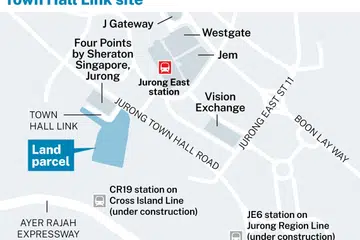
CapitaLand, Far East, Sing Holdings team up for S$1.8 billion bid at S$910 psf ppr for Jurong Lake District site

