

Why connectivity is Asia’s next financial advantage
Clients want solutions that allow capital and liquidity to move with greater flexibility across markets

FOR much of modern financial history, global capital flowed through just a handful of Western financial centres, with Wall Street and London sitting at the heart of the system.
Today, however, the centre of economic gravity has shifted. Trade corridors increasingly run through Asia, linking Shenzhen and Singapore, Jakarta and Hong Kong, Asean, and mainland China, Hong Kong and Taiwan.
Capital, investment and wealth are beginning to follow the same path.
The next chapter of finance may therefore be shaped less by a single financial centre and more by a network of connected markets. And in my view, digital finance will be the rails that make these networks possible.
The industry’s initial focus on building digital-asset hubs was a necessary first step: Hong Kong and Singapore established regulatory frameworks, encouraged innovation and explored initiatives ranging from tokenisation and digital currencies to blockchain-based market infrastructure.
These efforts are helping to build the trust required for institutional participation and cross-border adoption.

As the industry matures, success will not be determined by hubs in isolation, but by the strength of the corridors connecting them. Shipping ports provide a useful analogy. A port creates economic value not simply because it is large, but because of the trade routes connecting it to the rest of the world.
Digital finance could work in much the same way. A tokenised asset sitting within a single market has limited value. Its usefulness increases significantly when investors, issuers and liquidity can connect across markets through trusted and interoperable networks.
As commercial activity becomes more interconnected, clients are looking for financial solutions that allow capital, liquidity and investment opportunities to move with greater flexibility across markets.



Immediacy is also becoming key. In answer, financial solutions are becoming more regional, and increasingly digital, in nature.
Stablecoins are not banks’ enemy
If connectivity is the goal, the question becomes what infrastructure can support it. This is where stablecoins and tokenised deposits and assets may play an increasingly important role.
Stablecoins are often portrayed as a threat to the traditional banking system. Concerns are that digital money could disintermediate banks, move deposits outside established institutions and ultimately challenge the role banks play in payments.
I see them differently. Properly regulated and integrated, they can be complementary to banks and even be a catalyst for the development of a modernised financial system. Stablecoins, tokenised deposits and traditional banking rails can coexist in the same ecosystem.
If these technologies could answer how customers want money to move, banks remain best placed to provide the trust, governance and safeguards needed for money to move safely. The winners are therefore unlikely to be those who seek to replace the existing financial system. They will be those who modernise it.
This is also why tokenisation should not be viewed simply as another chapter of cryptocurrency. Its more profound potential is as an upgrade to financial infrastructure.
In a world of connected financial corridors, tokenisation allows assets to move more efficiently across institutions and jurisdictions, reducing friction between markets that have traditionally operated in silos.
It creates an opportunity to rethink how assets are issued, distributed, settled, held and transferred, and how cash and assets interact throughout their life cycle.
The real opportunity is not measured by how many assets become tokenised. It lies in enabling capital to move more efficiently, improving market connectivity and making financial products more accessible, responsive and scaleable across borders.
The GoldX token, launched by OCBC with Lion Global Investors and DigiFT, provides a practical example of this potential.
By representing a physical gold fund on blockchain infrastructure, it opens access to a broader pool of digital-native investors and liquidity sources beyond traditional distribution channels.
In doing so, it shows how tokenisation can expand market reach and create new pathways between investors and investment opportunities, rather than simply digitising existing assets.
Regulation as the real enabler
Technology alone, however, will not create successful digital-asset corridors. Just as trade corridors depend on common standards and trusted rules, digital-asset corridors will ultimately rely on regulatory interoperability.
Regulatory clarity is increasingly becoming a competitive advantage for Asia. Singapore and Hong Kong are moving the industry beyond experimentation and creating conditions for institutional adoption. This allows capital, customers and infrastructure providers to participate with greater confidence.
The next challenge, however, is not simply regulatory clarity within individual markets, but greater convergence across jurisdictions.
Encouraging progress is emerging globally, with policymakers in the US, Europe, Hong Kong and Singapore advancing frameworks for stablecoins and digital assets.
Singapore’s stablecoin framework, Hong Kong’s Stablecoins Ordinance and developments in other major financial centres reflect a growing recognition that digital finance requires trusted rules and standards.
As these frameworks mature, greater consistency will be important in supporting cross-border use cases. Businesses operating across multiple markets need confidence that digital money, tokenised assets and related infrastructure can move seamlessly across jurisdictions.
Banks, corporates and investors alike will benefit from clear and interoperable standards that enable liquidity, payments and investment opportunities to flow more efficiently across borders.
Imagine a regional financial ecosystem in which businesses operating across mainland China, Hong Kong and Taiwan, and Asean can access liquidity, investment products and financing more seamlessly, and where regulated digital money and tokenised assets can connect pools of capital that remain fragmented today across markets. That is the real promise I see in the digital-asset corridors that are emerging across an economic map that is being redrawn.
While there is still work to be done, the direction of travel is increasingly clear. Successful digital-asset ecosystems will be built not only on technological innovation, but also on regulatory frameworks that are trusted, interoperable and increasingly aligned across markets. In that world, connectivity between Asia’s markets may matter more than the size of the markets themselves.
The connections between Singapore’s Chulia Street, Hong Kong’s Central district and Shanghai’s Lujiazui financial zone may matter just as much as their connections to Wall Street. That could prove to be the region’s next great financial advantage.
The writer is head of digital assets, OCBC
Decoding Asia newsletter: your guide to navigating Asia in a new global order. Sign up here to get Decoding Asia newsletter. Delivered to your inbox. Free.
Share with us your feedback on BT's products and services
TRENDING NOW

South-east Asia has lost Nvidia’s best salesman

‘If there’s a price to be paid, so be it’: George Yeo says Singapore must safeguard its reputation

Demand, tech capabilities position Apac and AI as Skyscanner’s next growth frontiers: CEO Bryan Batista
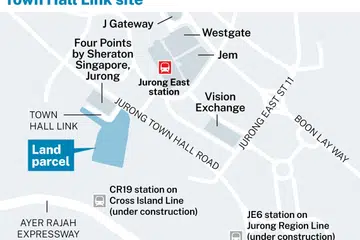
CapitaLand, Far East, Sing Holdings team up for S$1.8 billion bid at S$910 psf ppr for Jurong Lake District site

