

Good yield hunting: Building resilient portfolios
A diversified approach is all about balancing yield, capital preservation and long-term growth objectives

[SINGAPORE] As bond markets were buffeted by cross currents of rising energy prices, inflationary pressures and monetary tightening last month, the hunt for yield has become front and centre for investors.
Higher energy prices prolonged by the Middle East impasse has pushed Brent crude above US$100 a barrel, adding upside risks to the global inflation outlook.
Last month, the US Federal Reserve raised rates for the first time in three years to bring inflation back to its 2 per cent target, starting a monetary tightening path along with European Central Bank that hiked deposit rates by 25 basis points (bps) to 2.5 per cent and Bank of Japan, which raised overnight call rates by 25 bps to 1.25 per cent. Both raised rates for the second time this year.
This sparked sharp repricing in long-term government bond yields to multi-decade highs. The 10-year US Treasury (UST) rose above 5 per cent for the first time since 2007; UK gilts reached 20-year highs at 5.4 per cent and 10-year Japanese government bonds at 30-year highs above 3 per cent.
Higher rates cut both ways for fixed income investors. On the one hand, they increase income opportunities through higher yields. On the other hand, rate-driven sell-offs in USTs and bonds can weigh on prices, potentially pushing total returns across fixed income markets into negative territory.
Bond returns are derived from both coupon income and price performance, with the latter influenced by changes in credit spreads and duration, the measure of a bond price’s sensitivity to interest rate movements.
While equity markets have remained remarkably resilient against the backdrop of earnings revisions on strong corporate fundamentals, rising rates could pose inherent risks for global financial conditions and affect companies that are vulnerable to higher costs of capital and rate volatility.
Hunt for yield
Against an inflationary backdrop, investor focus has turned to “real yield” which is nominal yield adjusted for inflation. The need to seek sources of real yield has re-emerged as a critical feature of portfolio construction to generate overall long-term risk-adjusted portfolio returns.
This marks an important shift in market dynamics. Portfolio income has once again become a key contributor to total returns.
Elevated government bond yields, attractive credit carry and expanding opportunities in private markets allow investors to seek yield across a range of risk profiles. This allows greater flexibility in portfolio construction, reducing the need to extend towards excessive duration or the lower-quality part of credit spectrum.
Beyond bond yields, sources of income can come from equities, private markets, infrastructure, real assets, structured products and even higher-yielding currencies.
As part of a “whole portfolio approach”, we believe a diversified approach to income generation is all about balancing yield expectations, capital preservation and long-term growth objectives, while considering interest rate volatility, credit quality, illiquidity, sustainability of income and other risk considerations.
Fixed income: Keep calm and carry on
At Bank of Singapore, we are currently underweight fixed income within our tactical asset allocation for a balanced portfolio profile. This modest overall underweight position and neutral portfolio duration preference in fixed income strategy reflect the ongoing market volatility.
In developed markets, we prefer investment grade (IG) over high yield (HY) while in emerging markets (EM), we remain neutral on corporates and underweight on sovereigns.
Carry opportunities have emerged and materially expanded the opportunity set in fixed income. But we believe disciplined credit selection and active duration management remain critical for bond investors amid risks of elevated rate volatility, rising bond supply and limited spread buffers.
Recent spikes in UST yields reinforce the case for a disciplined approach to managing duration risk. In this environment, extending duration aggressively may expose portfolios to further mark-to-market volatility without adequate compensation.
Current positioning within the “efficient carry” quadrant of our Credit Quadrant Framework focuses on short-dated and high-quality income opportunities, reflecting our overall neutral duration profile closer to three to five years within our three to seven-year preferred range.
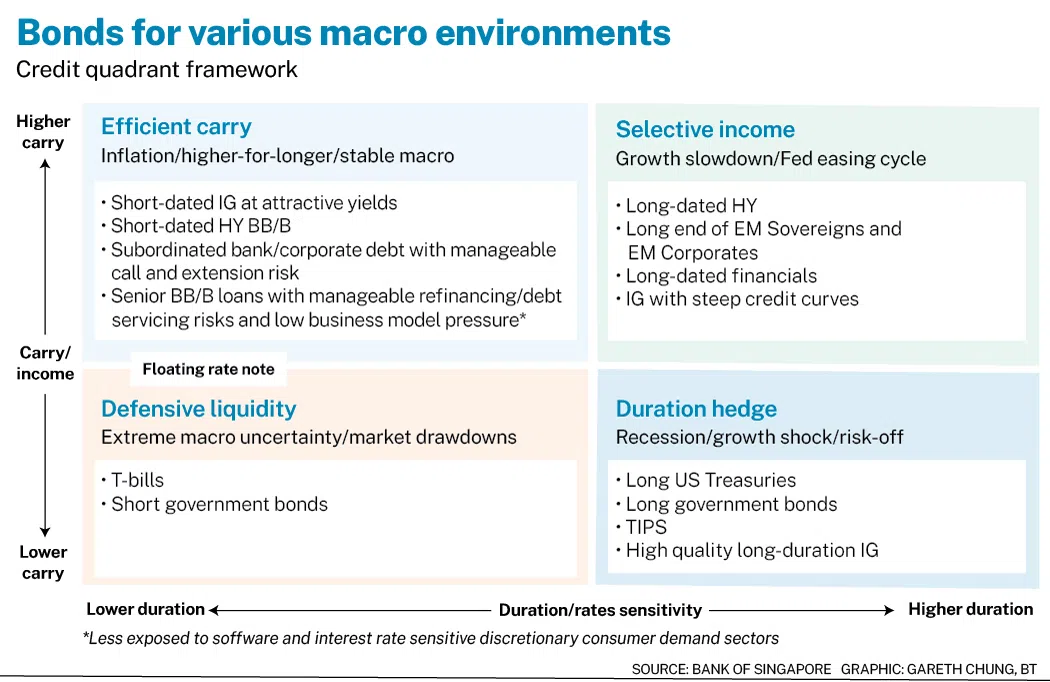
This allows portfolios to remain invested, earn income and preserve flexibility while waiting for greater clarity on the path of policy rates and inflation.
While longer-dated government bonds can serve as a hedge against growth slowdown or a decline in yields, duration exposure should be added selectively and opportunistically, rather than aggressively at current levels.
Equity yield: Quality dividends and total shareholder yield
Equity yield is not solely based on prevailing recurring dividend payments alone, especially in a higher interest rate environment. The focus is on quality companies with durable business models, pricing power and disciplined capital allocation.
Firms that can consistently grow earnings and cash flows often possess greater flexibility to raise dividend payouts, undertake share buybacks or reinvest for future growth, and sustain total shareholder yield over the long run.
Hence, yield seeking in equities should not be simply chasing the highest dividend-paying stocks or headline dividend yields.
Be watchful of exceptionally high dividend yields that may signal underlying weakening fundamentals reflected in a weak share price, or boosted by one-off dividends.
Investors may wish to focus more on a company’s ability to compound shareholder returns through a combination of income generation through earnings growth, dividend policy and prudent capital management.
Diversified yield sources
Alternatives including private markets and hedge funds can expand the income opportunities beyond traditional bonds and dividend equities. Private credit, through direct lending and asset-backed finance opportunities, private real assets, real estate and critical infrastructure offer investors exposure to durable income streams.
The case for alternatives involves assessing the sensitivity of each sub-asset class to macroeconomic conditions, industry dynamics, predictability of income sources, inflation protection, duration, credit fundamentals, underwriting terms, contractual agreements and investor base.
Hence, selection of active managers with a disciplined investment process, risk management and proven track record is critical when structuring access to private markets via managed solutions.
Within well-diversified portfolios, private markets exposure can complement public markets by offering investors access to stable, predictable cash flows that can enhance overall portfolio resilience and income durability.
Mutual fund and hedge fund managers specialised in managing fixed income, credit and macro-driven portfolios may also deploy investment strategies that complement duration exposure or credit risks of portfolios.
With the recent rate hikes by the Fed and other central banks, carry opportunities have also emerged in foreign exchange markets.
For investors seeking exposure away from the US dollar, the Australian dollar offers a higher yield while the pound offers a similar yield to the US dollar among the major currencies.
For appropriate risk profiles, structured products offering yield enhancement payoffs linked to single or multiple assets including equities, bonds, interest rates and currencies can enhance portfolio yield. Interest rate hedging solutions can also mitigate concentrated bond portfolios.
Against the evolving macroeconomic landscape, a diversified whole portfolio approach to income generation can help investors balance yield, capital preservation and long-term growth objectives.
The writer is global chief investment officer, Bank of Singapore
TRENDING NOW

Companies still in search of AI use cases with worthwhile ROI, says Broadcom’s CEO

Malaysian king buys stake in Singapore-listed mining firm expanding into rare earths

Once staunchly pro-China, Malaysian Chinese businesses are now distancing themselves from Beijing

Singapore’s wealth management success should extend to everyday families

