

Perspectives on the Fed rate cut, gold and the US dollar
Instead of chasing the latest investment trend, focus on generating stable and less-volatile returns with a diversified portfolio that is appropriate for your risk appetite
THE US Federal Reserve cut rates as expected, but all the action happened prior to the reduction itself. The latest cut was no surprise, as Treasury yields both on the short and long end continued to decline from July.
Despite the fact that interest rates fell, the US dollar has strengthened. The currency has gained for several months now. Despite that, prices of gold and other traditional risk-off assets, as well as of all major risk assets, have continued to climb. It is almost too good to be true.
The Fed has a dual mandate to keep inflation at bay and aim for full employment.
Inflation has abated, but whether this remains so is uncertain due to policy and geopolitical risk. Employment is seeing a strange phenomenon where both supply and demand are declining at the same time. This is why the range of possible outcomes has increased, as well as the uncertainty in predicting Fed rate policy.
It may be the right time for us to ask whether we can continue to extrapolate the current trajectory of the economy, markets, asset prices and interest rates from here.
The market moves ahead of the action
The market had already assumed the October cut and even a third cut in December. The comments by Fed chair Jerome Powell last Wednesday (Oct 29) were aimed at tempering expectations and preventing complacency. As a result, the market probability of a rate cut in December dropped suddenly from above 90 per cent to below 70 per cent.
Still, the data is suggesting a slowing economy, a looser employment market and a stable inflationary environment, which may allow the Fed to deliver a third and final rate cut for 2025 in December.
Also, the Fed will end quantitative tightening then, and will stop reducing the size of its securities portfolio and banking system reserves.
A third cut would put the Fed rate at 3.5 to 3.75 per cent heading into 2026. But the central bank is likely to remain data dependent and may maintain a more neutral stance for as long as possible.
Recession or more cuts in 2026?
The Fed could once again remain on hold to see how the labour market and inflation trend. However, two potential triggers could change this.
The first is Powell’s term ending in May 2026. The Trump administration is likely to push the Federal Open Market Committee towards a more dovish tilt. This could lead to renewed market optimism that a more aggressive rate cut and risk-on scenario will ensue in 2026.
The second is less positive. A US recession and/or deterioration of labour markets – both of which are inherently disinflationary in nature – could allow the Fed to cut rates more proactively.
In the first scenario, all risk assets may continue to do well in 2026. However, in a recessionary scenario, equities tend to lag and Treasuries and gold could do well.
Gold acts as a natural hedge in a risk-off scenario, and it also benefits from the lower opportunity cost of holding the non-yielding asset as interest rates decrease.
But gold has already done so well. It’s interesting that people talk about high valuations for equities and tech stocks, and yet no one talks about the valuations of gold or Bitcoin. This shows that valuations are an output, not an input, of investment decision-making.
What is driving gold
Price is a function of demand and supply; gold is no different. There is a demand-driven story for gold as central banks and individual buyers have stepped up on the gold trade with Chinese buying as a key factor. Gold has been the best-performing asset – up 50 per cent for the year. The next best-performing assets are China equities, Japan equities and the Nasdaq, with Bitcoin and other assets trailing far behind.
However, gold’s sudden downdraft of 10 per cent in the past two weeks has certainly been a rude awakening. If you are a Singapore-dollar or non-US investor, then the returns are tempered even more as the weaker US dollar dampens returns in local currencies.
Many cite various theories on why gold has done so well. Some say it’s because the US Fed has debased the currency by printing too many dollars. Others believe the US’ fiscal situation is to blame. It has too much debt and the cost of servicing that debt is unsustainable.
However, if gold was truly a proxy for the anti-dollar debasement trade, it would have an inverse relationship with the greenback.
Instead, gold rose when the US dollar was weak and also recently when the greenback was stronger. In fact, the US dollar has stopped depreciating against a basket of global currencies since the summer; yet gold has continued to rise due to the demand-supply mismatch.
One argument suggests that the Chinese central bank has been buying the precious metal, not necessarily because of a negative view on the dollar or to sell US assets, but rather to shore up its reserves as a defensive move against a future depreciation of the renminbi.
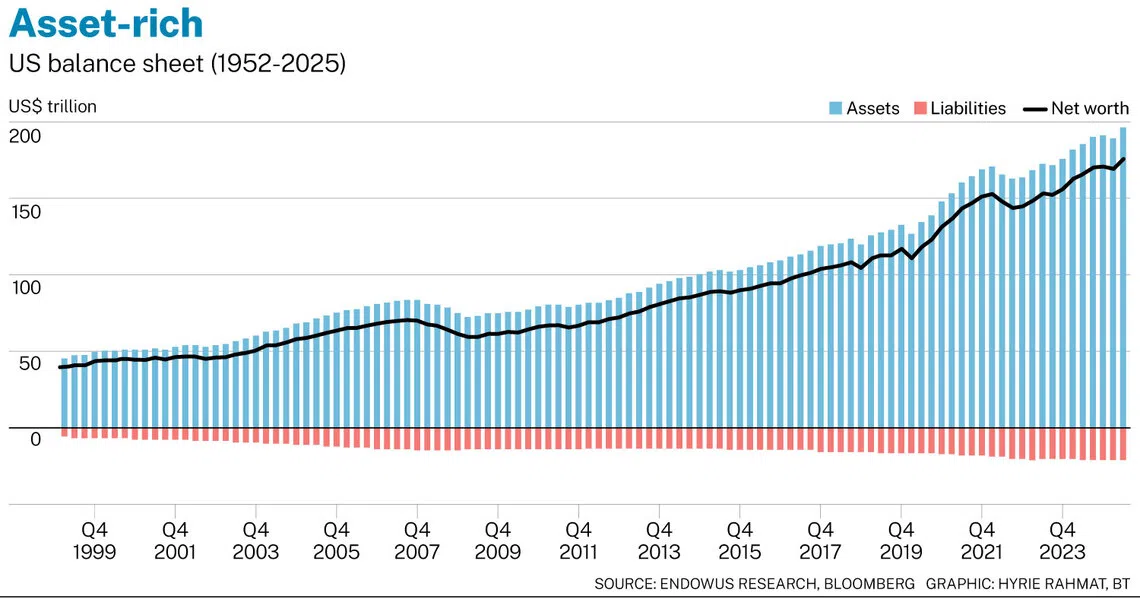
We also feel that the continued noise about the US dollar-debasement theory and concerns about US’ debt are misplaced.
While most people focus on the absolute size of the debt, one should also look at the cost of borrowing and the ability to service and eventually repay the debt.
In this regard, the US is and remains a very reliable and trustworthy borrower. It has never defaulted on payments and its ability to service its debt is high. The total assets of the nation or the collateral to back up that borrowing is still absolutely high, and is 10 times as large as its borrowing.
Where do we go from here?
We are often asked about the weakness of the US dollar versus the Singapore dollar, and many investors are rushing to exit their US-dollar exposure.
However, we all have a recency bias, where we anchor our expectations against what has happened most recently.
Since the middle of the year, in fact, the US dollar has strengthened and the Singapore dollar has weakened. For currencies, while short-term price movements are driven by demand-and-supply mismatches, the interest-rate differential is a critically important factor. Even with the rate cuts, the rate differential remains high at 3.75 to 4 per cent compared with the Singapore Overnight Rate Average, which stands at 1 to 1.45 per cent.
The most dangerous four words in investing is “this time is different”. The longer you invest, you realise that history often rhymes, but doesn’t repeat itself. We need to overcome our recency bias, and instead anchor our expectations on the longer-term historical evidence.
Gold’s recent outperformance has been the exception; over the long run, its average return falls behind the returns of equities. We know that gold can be a good store of value; but it has no yield, and thus there is no compounding nature in gold across economic cycles.
It is perfectly fine to have an allocation to gold as a defensive store of value. But we need to understand that it is a diversification tool and can also have extended periods of underperformance, especially when your starting point is high.
Most importantly, it is important to refrain from chasing the latest hot asset class or country. Keeping a core allocation to equities and fixed income in a diversified portfolio that is appropriate for your risk appetite can generate stable and less-volatile returns through the cycle.
Samuel Rhee is group chief investment officer, and Hugh Chung is chief investment officer at Endowus, a digital wealth platform with more than S$12 billion in client assets across public, private markets and pension (CPF and SRS)
TRENDING NOW

Britain’s mansion tax shows the difficulty of targeting wealth

Once staunchly pro-China, Malaysian Chinese businesses are now distancing themselves from Beijing

The only common thing in S-E Asia is that we all eat rice: Cisco’s Asean president

Singapore data centre operator DayOne opts for US IPO at likely US$20 billion valuation

