

Pimco investment chief sees silver lining in higher bond yields
However, ‘materially higher’ yields from current levels can lead to weakness in credit spreads and equities

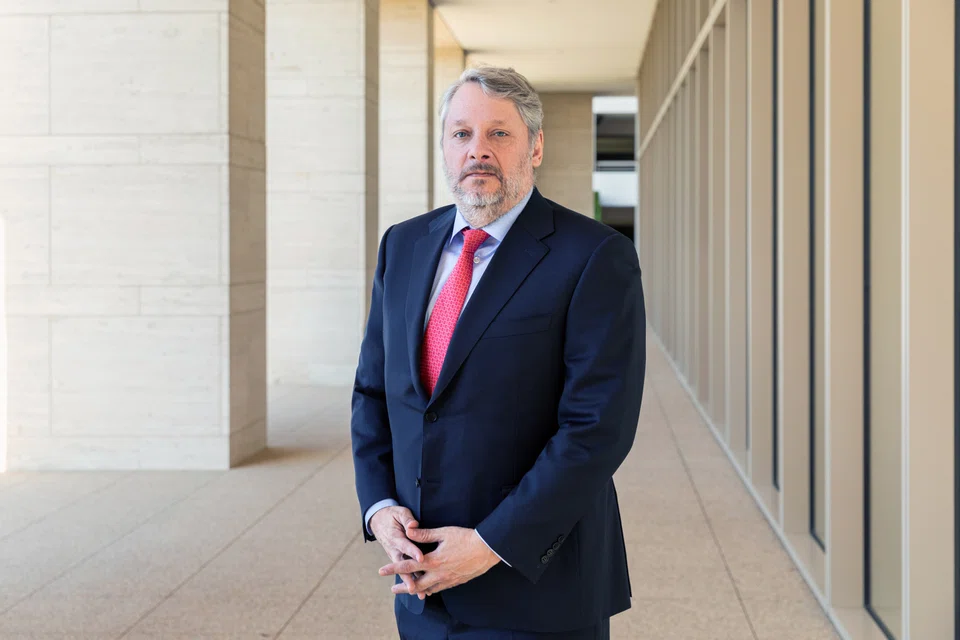
[SINGAPORE] Equity investors may fret over the spike in bond yields, but fixed-income investors – at least those looking to lock in higher bond returns – have reason to celebrate.
Daniel Ivascyn, Pimco group chief investment officer, said that for bond investors, higher real yields “should be something exciting”.
“For those who have been investing in fixed-income markets since the global financial crisis, these (current) yields feel very high.”
Last week, the 10-year US Treasury yield hit 5.34 per cent – a 24-year high – before dropping back to around 5.24 per cent.
Ten-year Treasuries yielded 5.25 per cent in 2006 and 2007, he said.
Ivascyn added: “Real yields 20 years ago on a Treasury inflation-protected security were somewhere around 2.5 per cent. Today we’re closer to 3 per cent. These are the most attractive real and nominal yields in (more than) 20 years.”
The bottom line, he said, is the high correlation between the starting yield of fixed-income assets, and the return that accrues to investors over a three to five-year period.
Currently, the Bloomberg US Aggregate Bond index has a nominal yield of around 5.6 per cent, and he added that investors will probably “earn that over the next five years”.
The index itself “isn’t very exciting”, as it does not hold non-US bonds or asset-backed securities, among others. “With a portfolio investing in more areas of the market, you’d have a higher starting yield of 7.5 to 8 per cent... the highest in 30 years.”
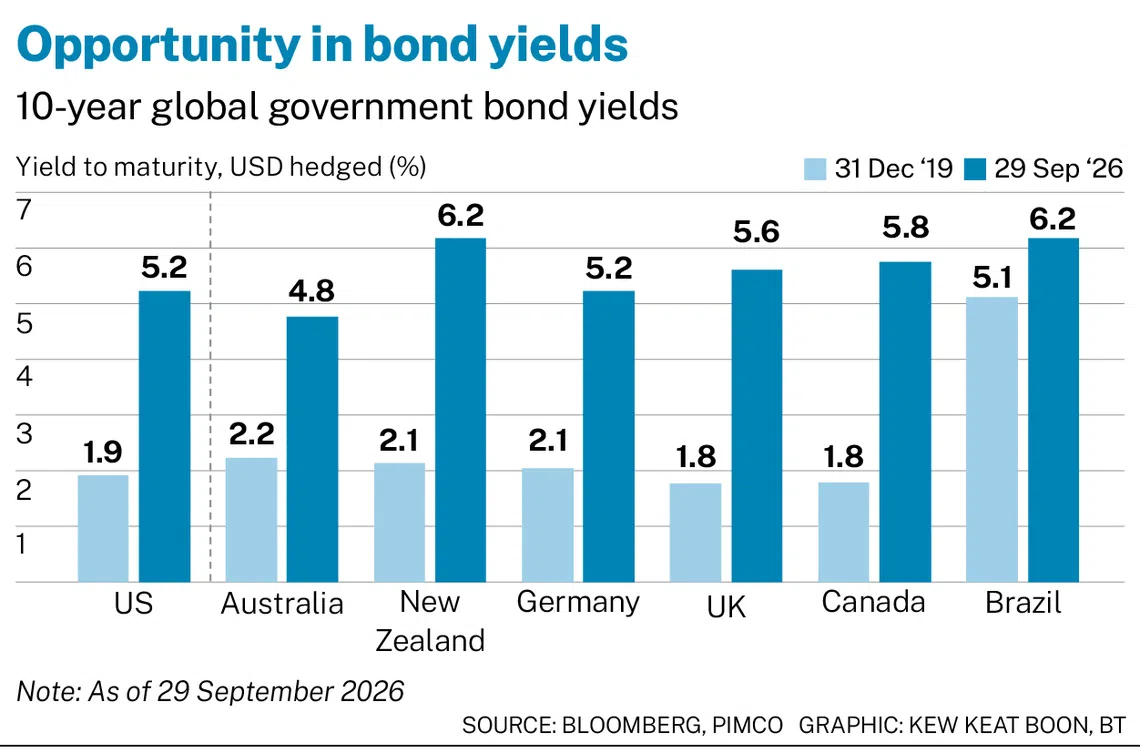
Higher sovereign bond yields are a global phenomenon, driven by high and rising public debt, stiff competition for capital, geopolitical shocks and higher inflation.
Ivascyn recently told the Financial Times that 10-year Treasury yields could hit 6 per cent due to worries over inflation and US government debt.
Pimco’s income strategy had a portfolio yield to maturity of 7.36 per cent as at August 2023. In the subsequent three years to August 2026, it generated an annualised total return net of fees of 6.94 per cent.
Today, the fund’s yield to maturity is around 7.42 per cent. Ivascyn was in Singapore last week to mark the 30th year of its office in the Republic, where it has more than 120 employees in Pimco and Pimco Prime Real Estate.
Pimco manages around US$2.33 trillion in assets as at end-June.
Impact on equities and credit
Ivascyn said that “materially higher” yields from current levels could lead to weakness in credit spreads and equities.
Current corporate spreads are tight at around 84 basis points for investment-grade debt, and about 308 basis points for high yield. Most Pimco portfolios, he noted, have a relatively low exposure to corporate bonds because of the tight spreads.
Private assets are also likely to feel the bite of higher rates. “There is already increasing concern about losses in private credit and direct lending, and real estate markets haven’t fully stabilised yet.
“The forecasts for higher policy rates from the US Federal Reserve and other central banks will make it more challenging for companies in the riskier areas of private markets to roll over their debt.”
He noted that high debt issuance to fund artificial intelligence infrastructure investments has already led to wider spreads for technology companies and hyperscalers, although spreads on non-tech issuance have remained stable.
“We think over time, you’ll probably see wider corporate credit spreads across the board. What we and the market will be looking for is the degree to which the capital investments begin to turn into sustainable sources of positive cash flow or earnings. That’s where uncertainty continues to exist.”
He added that there is no rush to own hyperscaler debt.
“The financing needs in the tech sector, hyperscalers and other high-quality, even investment-grade firms are quite large. We’ve been patient and are becoming even more patient, because we don’t think there is any rush to own this risk today.
“There is so much supply coming to market that it will be difficult to absorb without investors receiving even more favourable terms... We will continue to partner companies where we can get sufficient spread compensation for our investors, along with structural protections and the ability to control outcomes that we think is necessary.”
Global AI-related debt is expected to reach US$570 billion in 2026, more than double the issuance last year.
For now, he said investors rightly focus on the inflation risks and the ability of markets to absorb the debt.
“But right around the corner, we could see increasing signs of disinflation, and this would be a very bullish scenario for bonds. Pimco isn’t quite there in terms of our base-case view, but we’re sympathetic to that line of thinking.”
More widespread AI adoption could lead to job displacements and “significant cost efficiencies” in the service economy.
Ivascyn also warned against the tendency to rely on investment-grade credit ratings to justify an investment. “We found out the hard way during the global financial crisis that it isn’t always true. But it’s great for active managers because we do our credit work.”
TRENDING NOW

Once staunchly pro-China, Malaysian Chinese businesses are now distancing themselves from Beijing

Inside Singapore’s government team that kills its own products

Johor’s investment boom is real, but actual contribution from JS-SEZ unclear

Inside F1: How ‘reactive’ DHL acted quickly to fit Malaysia race just before Singapore’s

